

116,000 Texas Kids Just Got School Choice. Democrats Filed Nine Bills to Take It Away.
Most of the students using Texas’s new education accounts come from low-income families, and 95,000 more are waiting. Nine bills filed last week would end the program. A Republican state Senate stands in the way.

Kelci Jagge tried public school for her son Ruslan for about two months. He has cerebral palsy and a seizure disorder, he can’t speak or walk, and he’s fed through a tube. The San Antonio-area school called her to pick him up nearly every day. So she went back to teaching him at home, and this fall Texas finally sent her family help: up to $2,000 a year for his learning tools. She calls it a “huge blessing.”
Last week, Democrats in Austin filed nine bills to end the program that pays for it.
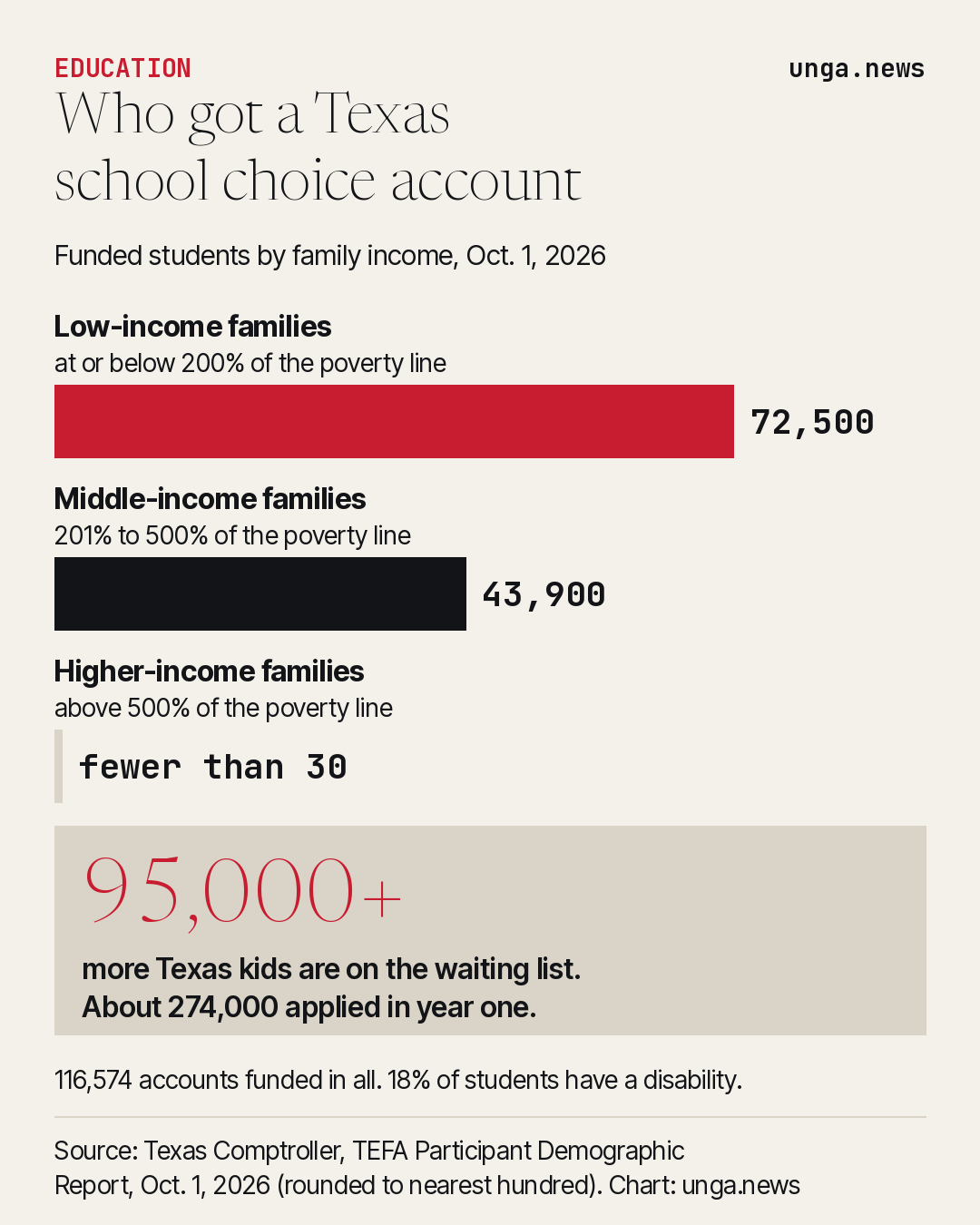
Texas Education Freedom Accounts opened this school year after Gov. Greg Abbott spent years fighting for them. By Oct. 1, the state had funded 116,574 accounts, according to the comptroller’s office, which runs the program. About 274,000 students applied in the first year. More than 248,000 qualified. More than 95,000 are still on the waiting list, which the comptroller calls “the largest school choice waiting list in the country.”
Built for the families who could least afford a choice
The loudest line against school choice has always been that it’s a giveaway to rich families who already pay for private school. Texas wrote its law to make that impossible, and the state’s own numbers show it worked.
Students were funded in priority order. Kids with disabilities from households at or below 500% of the poverty line came first. Low-income families came next, then middle-income families. Out of everyone funded, 62% come from homes at or below 200% of the poverty line, about 72,500 students. Another 43,900 come from middle-income homes. Fewer than 30 students from families above 500% of the poverty line got an account, and the comptroller says those only came in because state law requires siblings to be funded together.
More than 18% of participants have a qualifying disability. The Texas Tribune counted over 18,800 of them.
A family with a child in private school gets $10,474 for the 2026-27 year. Homeschool families get up to $2,000. Students with disabilities can get up to $30,000, though the Tribune reports very few received the maximum.
State data cited by The Dallas Morning News shows about 70% of recipients were already in private school or homeschooling before the accounts existed. Opponents lean on that number. Read it another way: these are mostly working families who were already paying twice, once in school taxes and again in tuition or curriculum, and the state finally let some of their own money follow their kids.
Nine bills, one goal
The repeal bills landed between Nov. 9 and Nov. 12, before anyone has been sworn in. The Texas Dispatch lists them from Texas Legislature Online: Senate Bill 106 by Sen. José Menéndez of San Antonio, Senate Bill 294 by Sen. Royce West of Dallas, and seven House bills from Reps. John Bucy, Mary González, Herbert, Jimenez, O’Brien Duzan, Lalani and Turner.
The text of SB 106 shows the plan. It strikes the part of the Education Code that creates the accounts. Families keep this year’s money under current rules, and the repeal takes effect Sept. 1, 2027. With a two-thirds vote in both chambers, it would take effect right away. Either way, a family whose child just switched schools in August would lose the help after one year.
Gov.-elect Gina Hinojosa has made her goal plain. “We will work tirelessly to repair the damage of the Texas voucher scam,” she said in her victory speech. Asked by the Houston Chronicle whether she would veto the program’s money in the next budget, she wouldn’t rule it out. “We’ll just have to see,” she said. “The next six months is going to be one big negotiation, right? I’ll have leverage in a way that we have not had before, and that’s exciting.”
Rep. Diego Bernal of San Antonio, the Democratic vice chair of the House education committee, went further in an interview with the Tribune and ProPublica. “I guarantee that program is not going to be untouched, and it will be probably unrecognizable, if not extinct, by the time we’re done with it,” he said.
The parents on the other end of the word “scam”
Joy Smith of Roanoke homeschools her 7-year-old son, who has autism. “Every therapy known to man my child has been through, and it was life-changing to not have to worry about where (the funding) was going to come from,” she told the Tribune.
Elizamae Dowd’s 11-year-old daughter used to come home from her public elementary school in tears from bullying. Now she attends a Killeen private school built for neurodivergent kids, paid for with an account. Dowd broke down describing the night Hinojosa won. “She won on the premise of taking this away from these children, and it’s devastating,” she said.
Jagge, a mother of six with three kids in the program, said losing it would leave little room to try new things for Ruslan. “I would not try public school again. It does not work for him,” she said.
The Tribune asked Hinojosa and Lt. Gov.-elect Vikki Goodwin how they would help low-income families and families of children with disabilities if the program ends. Neither answered.
The Senate stands in the way
Democrats won a majority in the Texas House for the first time in more than two decades, but Republicans kept their majority in the state Senate. A repeal needs both chambers and the governor’s signature. That makes the Senate the firewall for these 116,574 kids and the 95,000 behind them, and the Republicans there know it.
Conservatives are also playing offense. Rep. Vasut filed House Joint Resolution 47, a constitutional amendment saying the state and local governments “may not regulate the educational program of a private school, including a home school.” If two-thirds of both chambers agree, Texans would vote on it Nov. 2, 2027.
The bigger danger is quieter. A governor who can’t win a repeal vote can still line-item veto the program’s money, and Hinojosa has pointedly left that door open.
Arizona shows how hard this gets once families have the money in hand. Republicans opened that state’s accounts to every student in 2022, and enrollment jumped from about 12,000 to more than 110,000, according to KJZZ. Gov. Katie Hobbs promised to “crack down on the waste, fraud, and abuse in the out-of-control ESA entitlement program,” but her own spokesman says a full repeal isn’t necessarily the plan. Once 110,000 families depend on something, even its fiercest critics start talking about guardrails.
Texas Democrats are betting they can do what Arizona’s won’t. The families on that waiting list are betting the Senate holds.
Sources
- Texas Comptroller of Public Accounts — Texas Education Freedom Accounts Participant Demographic Report 2026-27 (Oct. 1, 2026)
- The Texas Dispatch — Thirteen Filed Bills Would Repeal, Add Conditions to or Shield Texas Education Savings Accounts (Nov. 16, 2026)
- The Texas Tribune — Parents of students with disabilities fear losing Texas’ “life-changing” school vouchers (Nov. 13, 2026)
- The Texas Tribune and ProPublica — Texas’ school voucher program could be “unrecognizable, if not extinct,” says Democratic lawmaker (Nov. 7, 2026)
- The Dallas Morning News — Texas school voucher program faces repeal, reform efforts
- KJZZ — How Democrats plan to reform Arizona’s school voucher program (Nov. 12, 2026)