

A 5-Month-Old Startup Says Its SI Beats Google at Predicting How Drugs Grab Their Targets
Geodesic Intelligence’s NovaAtom-Lite tops AlphaFold 3 on antibody and drug-binding tests, by the company’s own count. Outside checks haven’t happened yet.
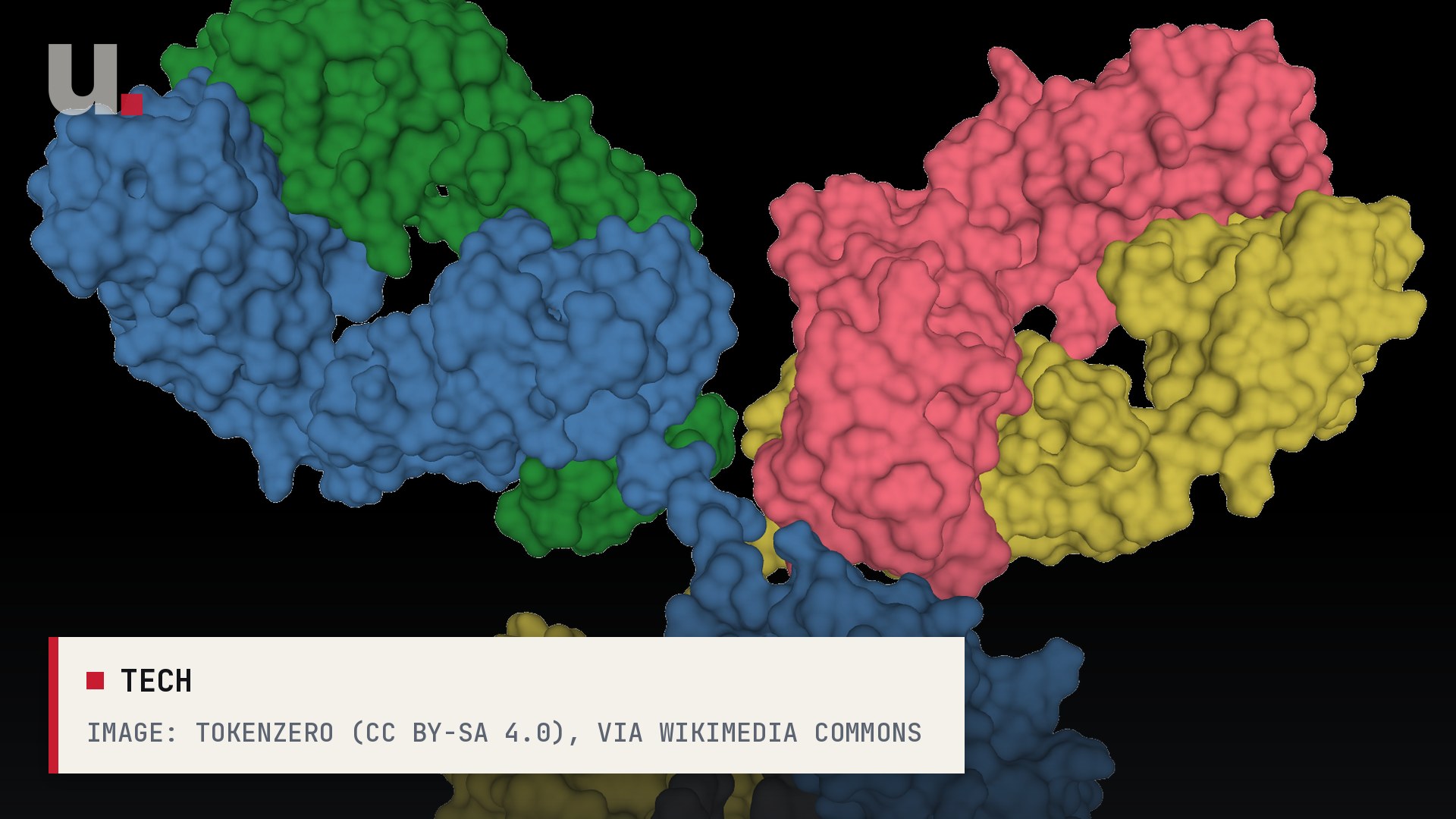
For the last two years, if you wanted a computer to tell you how a drug or an antibody would latch onto its target, the answer usually started with Google. Its AlphaFold models won a Nobel Prize and became the yardstick every lab measured itself against.
On Tuesday, a startup that did not exist last spring said it had beaten that yardstick on the job drug hunters care about most.
Geodesic Intelligence, founded in June by UCLA professor Quanquan Gu, released NovaAtom-Lite, an SI model that predicts the 3D shape of proteins, DNA, RNA and the small molecules that stick to them, all in one pass. The company says it is now the best public tool for guessing exactly how an antibody grabs the thing it is meant to fight.
Geodesic Intelligence on 𝕏, Nov. 10, 2026: NovaAtom-Lite scores 79.07% on FoldBench antibody–antigen predictions, against 75.58% for Isomorphic’s IsoDDE and 47.90% for AlphaFold 3.
— @Geodesiclab View on 𝕏
Why the shape is the whole game
Most medicines work by fitting into something. A drug molecule slides into a pocket on a protein and jams it. An antibody, the Y-shaped protein your immune system makes, clamps onto one specific spot on a virus or a cancer cell. If you know the exact shape of that handshake, you can design something that fits better, or rule out a candidate before spending months in a lab on it.
Getting that shape the old way means growing crystals or freezing samples and firing beams at them. It can take months, and sometimes it never works. SI models like AlphaFold changed that by predicting structures from the sequence alone. But they have always been weakest right at the joints, where one molecule meets another, and antibodies have been one of the hardest cases.
That is exactly where Geodesic aimed.
The numbers, and who measured them
Geodesic tested its model on FoldBench, a public benchmark of 1,522 molecular structures that scientists deposited between January 2023 and November 2024. To keep the contest fair, NovaAtom-Lite was trained only on structures released before October 2021, the same cutoff AlphaFold 3 used, so the test cases are ones neither model could have memorized.
On antibody–antigen pairs, the model got 79.07% of 172 cases right by the benchmark’s standard. Isomorphic Labs’ IsoDDE, the drug-design system from Google DeepMind’s sister company, reports 75.58%. AlphaFold 3 scored 47.90% on the 167 cases it could handle, according to FoldBench’s own evaluation.
On protein–ligand pairs, which is how most pill-type drugs work, NovaAtom-Lite scored 77.06%, against 75.99% for IsoDDE and 64.90% for AlphaFold 3.
The gap gets bigger when the bar goes up. At the strictest quality level, Geodesic says its model got 41.28% of antibody cases essentially perfect, more than double AlphaFold 3’s 19.2%.
Here is the part a fair reader needs. Every one of those NovaAtom-Lite numbers comes from Geodesic’s own run, scored with FoldBench’s official tool. The IsoDDE figures are what Isomorphic reported, not a head-to-head test. As Snape Report noted, nobody outside the company has checked the results yet. Geodesic’s own write-up admits the case counts differ between reports and says a gap of “a point or two” should be read as a tie.
And the model does not win everywhere. On ordinary protein–protein pairs, it scored 75.63%, a hair behind OpenDDE at 76.9%. On protein–DNA pairs, AlphaFold 3 still came out ahead, 79.18% to 74.24%. For plain single proteins, every model on the chart landed within a couple hundredths of a point of each other, which tells you folding a lone protein is close to a solved problem.
A tiny team with a big claim
What makes this stand out is who built it. Gu told followers the model came from “a small, exceptional team in just a few months with only a few hundred GPUs.” Fans online have put the team at about 15 people. Isomorphic, by comparison, has the backing of Alphabet.
Gu is not a newcomer. He is a computer science professor at UCLA who previously worked at ByteDance’s Seed research group, where reports say he led work on its own protein-folding model before leaving to start Geodesic. A preview of NovaAtom came out in September.
The model is live now through Geodesic’s paid API and its NovaDDE drug-design platform. That means a biotech startup or university lab can try NovaAtom-Lite today rather than just read about it.
Gu says a bigger model, NovaAtom-Pro, is coming “in the next few months,” and that the company’s early wet-lab results are “looking very promising.” Those lab results have not been published.
Ten years is too long
Gu has been blunt about why he thinks speed matters. A new drug commonly takes a decade or more to go from idea to pharmacy shelf, and much of that time is spent on guesses that do not pan out.
Quanquan Gu on 𝕏, Nov. 11, 2026: “Some patients don’t have 10 years. Some don’t even have 4.”
— @QuanquanGu View on 𝕏
A better structure prediction does not cure anyone by itself. It is the first step in a long chain, and a model that shines on a benchmark still has to prove itself on real targets in real labs. Plenty of SI tools have posted great scores and then stumbled on messier, real-world problems.
But for drug designers, getting the antibody handshake right more often means fewer dead-end experiments and cheaper tries. If independent labs confirm Geodesic’s numbers, a five-month-old startup will have topped the best that Google’s drug-discovery arm has published on the task that matters most to antibody makers. That would be a sign that in this field, the best tools are no longer reserved for the biggest companies.
Sources
- Geodesic Intelligence on 𝕏 — Introducing NovaAtom-Lite
- Geodesic Intelligence — Introducing NovaAtom-Lite
- Quanquan Gu on 𝕏 — 10 years is too long
- Snape Report — Geodesic Intelligence's NovaAtom-Lite predicts 79.07% of FoldBench antibody–antigen interfaces, ahead of AlphaFold 3