

A Bankrupt Chatbot App Wants to Sell Millions of Kids’ Private Chats to a Mystery Buyer
Character.AI is auctioning chat logs from 21 million U.S. accounts, including 2.1 million registered to minors, to a company formed the day before it was picked. Attorneys general from Utah, Florida, Tennessee, 38 other states and D.C. say no.
Picture a 13-year-old typing out her worst night into an app at 2 a.m. She thinks she’s confiding in a kind “therapist.” It’s a chatbot. That conversation, tied to her account and the internet address she typed it from, is now one of millions headed for an auction on Dec. 1.
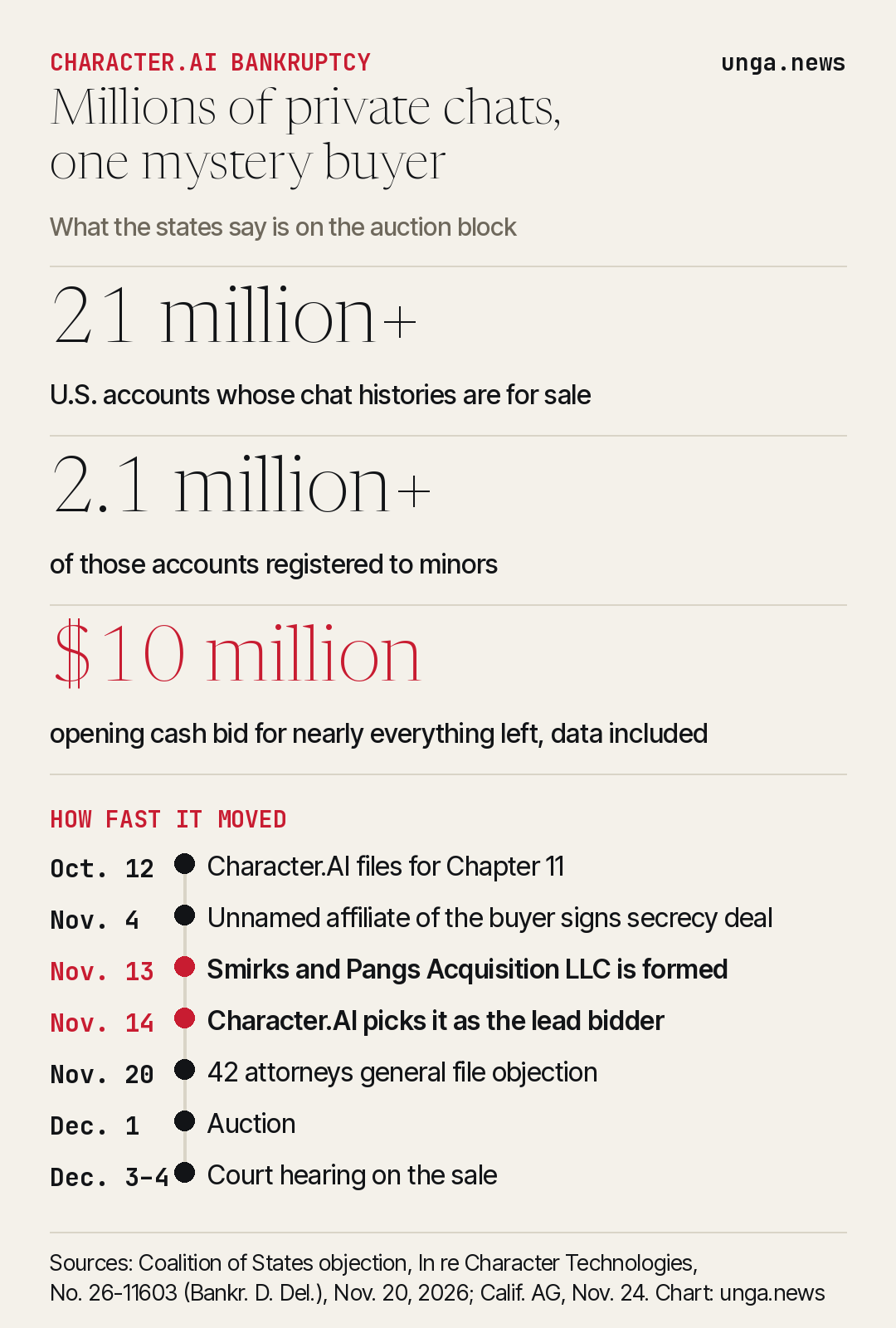
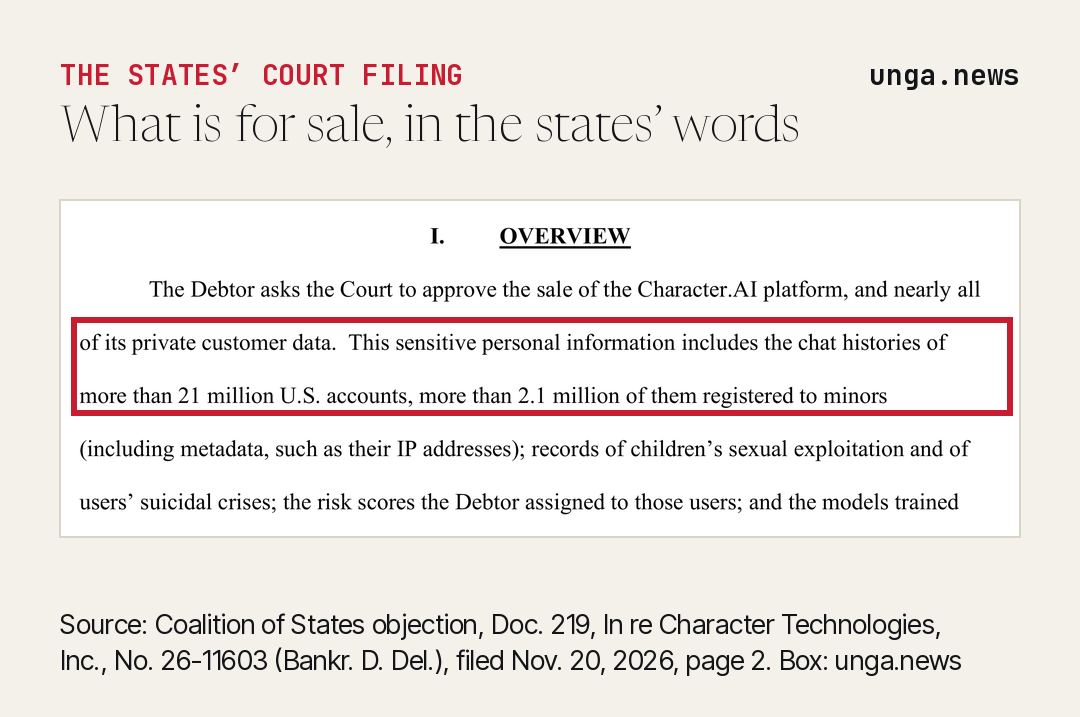
That’s what attorneys general from 41 states and Washington, D.C., are telling a federal bankruptcy judge in Delaware. Character.AI, the app where people chat with made-up characters, celebrity personas and bots that play doctor or counselor, filed for Chapter 11 on Oct. 12. Now it wants to sell nearly everything it has left, including the chat histories of more than 21 million U.S. accounts. More than 2.1 million of those accounts were registered to minors.
The states filed their objection on Nov. 20, and California’s attorney general put out word of it on Nov. 24. The coalition crosses party lines, but a long list of the names on it belong to conservatives who have made protecting kids online a calling card: Utah’s Derek Brown, Florida’s James Uthmeier, Tennessee’s Jonathan Skrmetti, Kansas’ Kris Kobach, Kentucky’s Russell Coleman, Arkansas’ Tim Griffin, Mississippi’s Lynn Fitch, South Carolina’s Alan Wilson and North Dakota’s Drew Wrigley.
A buyer born the day before the deal
The bidder is a company called Smirks and Pangs Acquisition LLC. According to the states, it was set up in Delaware on Nov. 13. Character.AI picked it as its lead bidder the very next day. It offered $10 million in cash for every asset not already promised to Disney, which has offered $20 million to license some of the company’s technology and says its deal leaves users’ personal information out.
So who owns Smirks? Nobody outside the deal seems to know. The states say the purchase agreement names no parent company, no sponsor and no officer, and was signed by an “Authorized Signatory.” It allows foreign investors in the buyer whose identities, the states wrote, “are to be disclosed in writing to the Debtor and to no one else.” And an unnamed “affiliate of Purchaser” signed a confidentiality agreement with Character.AI on Nov. 4, nine days before the buyer legally existed.
The money behind it is thin, too: a $1 million deposit and no parent guarantee. Nothing stops the buyer from reselling the data. In the states’ words, users’ data “could thus pass to yet another undisclosed owner the day after closing, with no notice to users, the States, or this Court.”
Then there’s the one hire. The agreement requires the buyer to offer a job to exactly one person, John Chatowski, whom the filing identifies as Character.AI’s general counsel. He’s also the only person whose knowledge counts when the company vouches for what it’s selling, including known problems with kids reaching sexual content. Character.AI still told the court the buyer has no connection to it beyond the deal. If someone else outbids Smirks, the company wants Smirks paid a $350,000 break-up fee.
What’s sitting inside those chats
The states didn’t soften what’s in the data. Their filing says the sale covers “records of children’s sexual exploitation and of users’ suicidal crises; the risk scores the Debtor assigned to those users; and the models trained on all of it.” California’s release adds chats where characters “drew children and adults into explicit sexual conversations,” and ones where people poured out their struggles to bots dressed up as a “therapist” or “physician.”
For years, the age checks were a joke. The states say that as of April 2025 the platform relied “exclusively on self-reporting of age,” and as of August 2025 it required no age verification at all, so a kid could simply sign up as an adult. A researcher posing as a 12-year-old just used an account registered to a 13-year-old. So the company can’t be sure which chats came from children. That’s why the states want all chat content kept out of the sale unless a user personally says yes.
The filing describes two younger teenagers who took their own lives after sexual chats in which characters echoed or ignored their suicidal statements. It also quotes a Character.AI “therapist” bot answering a question about cutting by saying people use “many different ways to cope with intense feelings, including self-harm, and I wouldn’t call it unusual…”
The promise in the fine print
Character.AI’s own privacy policy told users: “we do not sell personal information for monetary consideration.” A $10 million sale of chat logs looks an awful lot like that. Federal law bars a company from handing over information on kids under 13 without a parent’s verified permission, and state privacy laws say people have to know what can be sold and get a chance to say no. Bankruptcy, the states argue, doesn’t erase any of it.
“Character.AI’s plan to auction off its platform, including the IP addresses and private chats histories of its users — many of them children — with zero protection for those users is appalling,” California Attorney General Rob Bonta said. “Bankruptcy should not be used to sidestep these consumer protections.”
Utah got there early. When the states first warned the court in October, Brown said, “A sale will not wipe the slate clean. Any buyer must commit to protecting the children who use this product before the deal closes.”
Conservatives have been picking this fight with Big Tech for years, and it’s good to see so many red-state attorneys general out front. A business that let bots talk sexually with children shouldn’t get to cash out by selling those same conversations to an owner nobody can name. Parents never signed off on that, and no court order should do it for them.
The states are asking Judge Brendan Shannon to reject Smirks as the lead bidder, deny its break-up fee and, at minimum, strip out kids’ chats and other sensitive data unless users “affirmatively consent after direct notice.” They also want any buyer bound by state privacy and chatbot-safety laws. Several of those laws, in states including California, Colorado, New York and Connecticut, take effect Jan. 1. The sale hearing is set for Dec. 3 and 4.
Families with a Character.AI account don’t have to wait on the judge. In October, Robbie Torney of Common Sense Media told KQED: “Delete your account now and download your chats first if you want to keep them.” The clock is tight, though. KQED reported that the company’s help center says an export can take three to four weeks, and the auction is six days out.
Sources
- U.S. Bankruptcy Court, D. Del. — The Coalition of States Objection to the Debtor’s Additional Stalking Horse Sale, In re Character Technologies, Inc., No. 26-11603-BLS, Doc. 219 (Nov. 20, 2026)
- California Attorney General — Attorney General Bonta Opposes Asset Sale of Character.AI Amid Child Safety Concerns (Nov. 24, 2026)
- Utah Attorney General — Utah seeks child safety and privacy protections in Character.AI bankruptcy sale (Oct. 15, 2026)
- KQED — Your Chatbot Just Went Bankrupt. What Happens Now to Your User Data? (Oct. 14, 2026)