

A Boy Switched to a Washington Girls’ Cross-Country Team Mid-Season. Tuesday, Voters Can Ban It
Deep-blue Washington and Colorado vote on statewide bans on males in girls’ sports, while Arizona and Nebraska vote to make theirs tougher. The Supreme Court left the call to “the people.”
In mid-season this fall, a transgender student at Camas High School in southwest Washington left the boys’ cross-country team and started racing with the girls. The girls on the team protested. The school district said it followed state guidelines. And the state’s high school sports association said that was exactly the point.
“The WIAA remains committed to following Washington state law (RCW 28A.642.010) which permits student-athletes to participate in sports consistent with the gender with which they identify,” the Washington Interscholastic Activities Association told KATU in October. Its handbook adds that students “do not need to provide medical or legal documentation” to play on the team that matches their gender identity.
On Tuesday, Washington voters get to overrule that. So do voters in Colorado. Arizona and Nebraska, which already keep males out of girls’ sports, are voting on whether to make their rules tougher. That’s four states putting girls’ sports directly in front of voters on the same day.
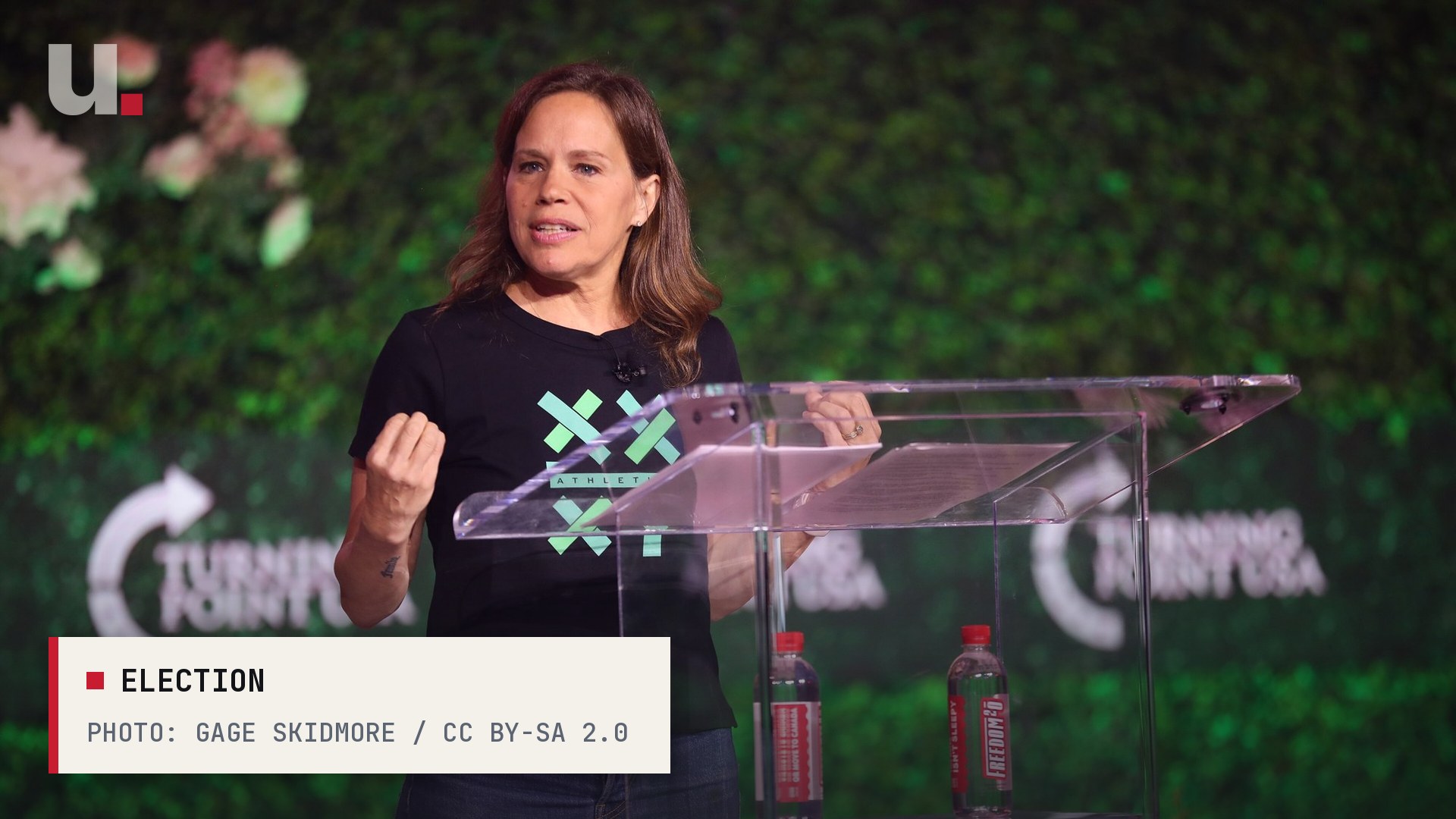
Jennifer Sey, the former national gymnastics champion who founded XX-XY Athletics, put it this way on 𝕏: “For the first time, voters — not legislators, not athletic associations — are deciding whether school sports should remain sex-based.” Two of the four, she noted, are “deep blue.”
The Supreme Court handed this to voters
This fight comes four months after the biggest ruling on the issue yet. On June 30, in West Virginia v. B.P.J., the Supreme Court upheld West Virginia’s and Idaho’s laws keeping biological males off girls’ teams. Justice Brett Kavanaugh wrote for a six-justice majority that the word “sex” in Title IX “cannot plausibly be interpreted to refer to anything other than biological sex.”
But the Court only said states may protect girls’ sports. It didn’t say they must. Kavanaugh closed by quoting the Court’s 2025 Skrmetti decision: “we leave questions regarding its policy to the people, their elected representatives, and the democratic process.” The opinion counted 27 states that have already done that through their legislatures. In states where Democrats run the legislature, the people are now doing it themselves.
Washington: Initiative 638
Washington’s measure started as an initiative to the Legislature, one of three that Let’s Go Washington founder Brian Heywood is urging voters to pass this fall. Lawmakers didn’t act on it, so it went to the ballot.
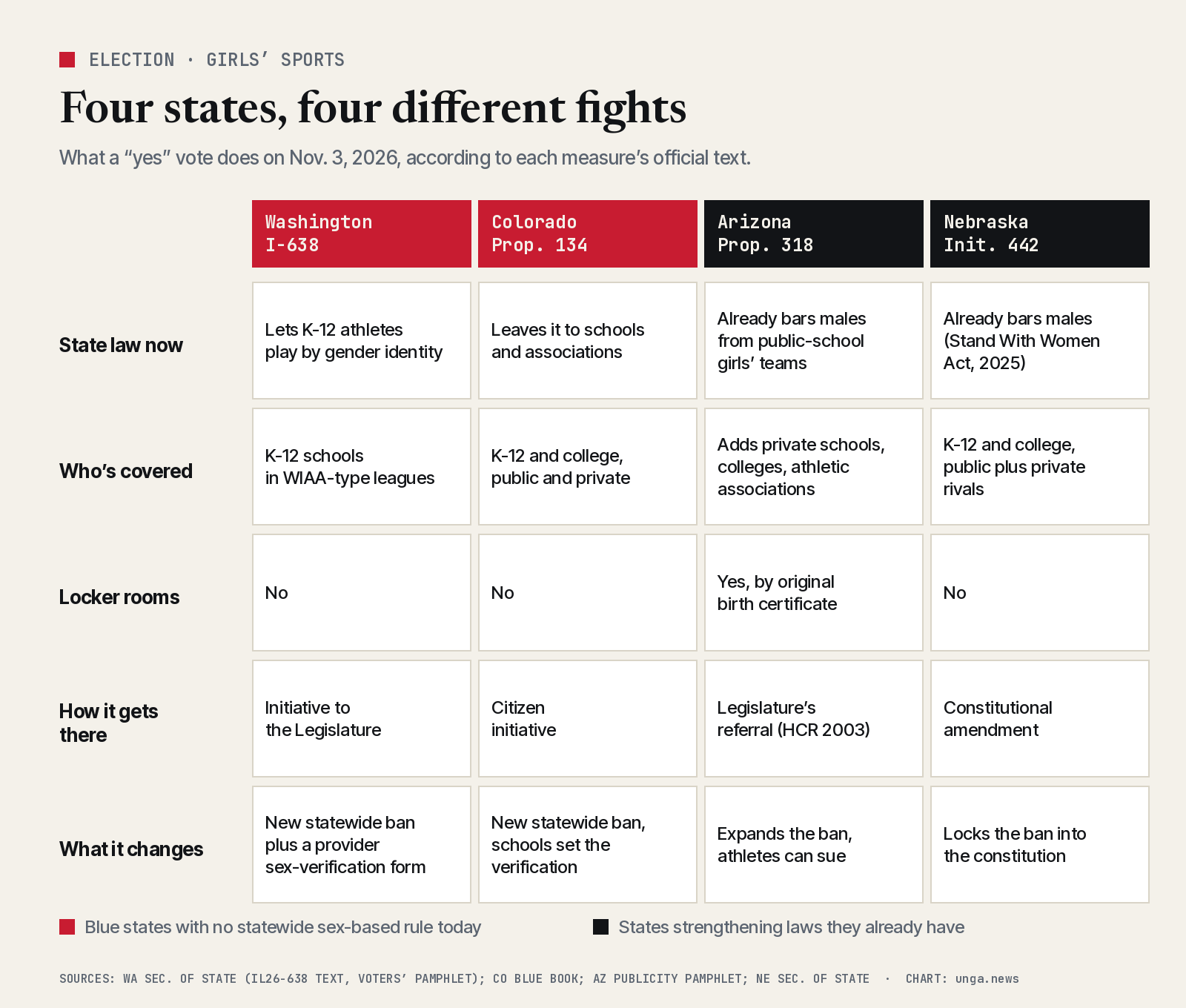
The full text would require school districts and leagues like the WIAA to “prohibit biologically male students from competing with and against female students” in athletics meant only for girls, for individual events and team sports alike. Girls who want to compete would turn in a statement from their own health care provider verifying their sex, “based on reproductive anatomy, genetic makeup, or normal endogenously produced testosterone levels.”
That verification line is where opponents have aimed their fire. The Washington Post told its 𝕏 audience the state “could require genital exams for girls.” The initiative’s own findings answer that: Washington already requires a routine physical before a student plays sports, and the measure says that existing physical is how sex gets verified. Sey’s reply was blunt: “In the 27 states with laws protecting girls’ sports, there are no ‘genital checks.’”
The state’s own fiscal note calls the cost to the Office of Superintendent of Public Instruction “minor,” mostly for updating guidance.
Colorado: Proposition 134
Colorado’s citizen initiative, which would be called the “Protect Women and Girls Sports Act,” goes further than Washington’s on who it covers. It reaches every K-12 school, public, charter or private, plus Colorado colleges and universities, and both interscholastic and intramural sports.
Every team would have to be labeled male, female or coed. Female teams “shall not be open to a male student or participant.” Girls could still join a boys’ team when no girls’ team exists. The measure defines a female as “a person whose biological reproductive system is organized around the production of ova,” and it bars state agencies and accrediting groups from punishing a school for keeping girls’ teams for girls. The education commissioner would enforce it starting Jan. 1, 2027.
Unlike Washington’s, it doesn’t spell out how sex is verified. Schools write their own policies.
Sey says the other side is spending big. Left-wing groups “including the ACLU and Planned Parenthood have spent $4.5M to defeat prop 134,” she wrote. She also posted on Sunday that polling shows the measure has majority support.
Arizona: Proposition 318
Arizona already keeps males off girls’ teams at public schools and the private schools that play them. Proposition 318 closes the gaps. The Republican-led Legislature sent it straight to voters as House Concurrent Resolution 2003, a route that doesn’t need the governor’s signature.
Starting Jan. 1, 2027, it would cover all private schools and every athletic association that sponsors school sports. It defines sex as a person’s biological sex “as recorded at birth” on an original birth certificate. And it’s the only one of the four that reaches the locker room: schools and athletic associations “may not authorize any individual to use a restroom, locker room, shower room or other private space that is not designated for that individual’s sex.”
It also has teeth. A girl “deprived of an athletic opportunity” by a school or association that knowingly breaks the law could sue for damages, including for “psychological, emotional or physical harm,” plus attorney fees.
Nebraska: Initiative 442
Nebraska already has the rule. Gov. Jim Pillen signed the Stand With Women Act in June 2025. Initiative 442, the Fairness for Girls amendment, would write it into the state constitution, where a future Legislature couldn’t quietly undo it.
The amendment requires schools to designate every team as male, female or coed, and says teams for “females, women, or girls shall not be open to students of the male sex.” It covers public schools, public colleges and private schools that compete against them, and it is “self-executing,” meaning it takes effect without new legislation.
Supporters argue in the state’s voter pamphlet that males competing against girls cost them “scholarships, medals, or tournament advancement.” Opponents call it “unnecessary” since a law already exists.
What it means
Think of the Supreme Court ruling as the referee saying the rule is legal. Tuesday is the first time voters in blue states get to decide whether their own schools actually play by it.
If Washington and Colorado pass theirs, the argument that keeping boys out of girls’ sports is a red-state obsession goes out the window. And the Camas girls who protested this fall would get the rule they asked for, written by voters instead of a sports association.
Sources
- Washington Secretary of State — Initiative IL26-638 full text: “An act relating to defending equity in interscholastic sports”
- Washington Secretary of State — 2026 Voters’ Pamphlet: IL26-638 explanatory and fiscal impact statements
- Colorado General Assembly — Proposition 134 final text, “Protect Women and Girls Sports Act” (2025-2026 #109)
- Colorado General Assembly — 2026 Blue Book analysis: Proposition 134
- Arizona Secretary of State — 2026 General Election Publicity Pamphlet: Proposition 318 (HCR 2003)
- Nebraska Secretary of State — 2026 Ballot Measures Informational Pamphlet: Initiative Measure 442
- Office of Gov. Jim Pillen — Governor Pillen Signs the Stand With Women Act
- Supreme Court of the United States — West Virginia v. B.P.J., No. 24-43 (decided June 30, 2026)
- KATU — Camas girls’ cross-country team protests after transgender athlete joins midseason (WIAA statement)
- Jennifer Sey on 𝕏 — “For the first time, voters — not legislators, not athletic associations — are deciding…” (Oct. 29, 2026)
- Jennifer Sey on 𝕏 — “In the 27 states with laws protecting girls’ sports, there are no ‘genital checks.’” (Oct. 29, 2026)
- Protect Kids Colorado on 𝕏 — “Equal opportunity. Fair competition.” Yes on 134 video (Nov. 2, 2026)
- The Washington Post on 𝕏 — “Washington state could require genital exams for girls in school athletics.” (Oct. 27, 2026)