

A Brain Chip Helped a Grandmother Talk Again. Now Nvidia Wants to Make It Instant
An Austin company’s implant turns a Michigan woman’s brain signals into speech. A new deal with Nvidia aims to shrink the cart of computers behind it into a box on her wheelchair.
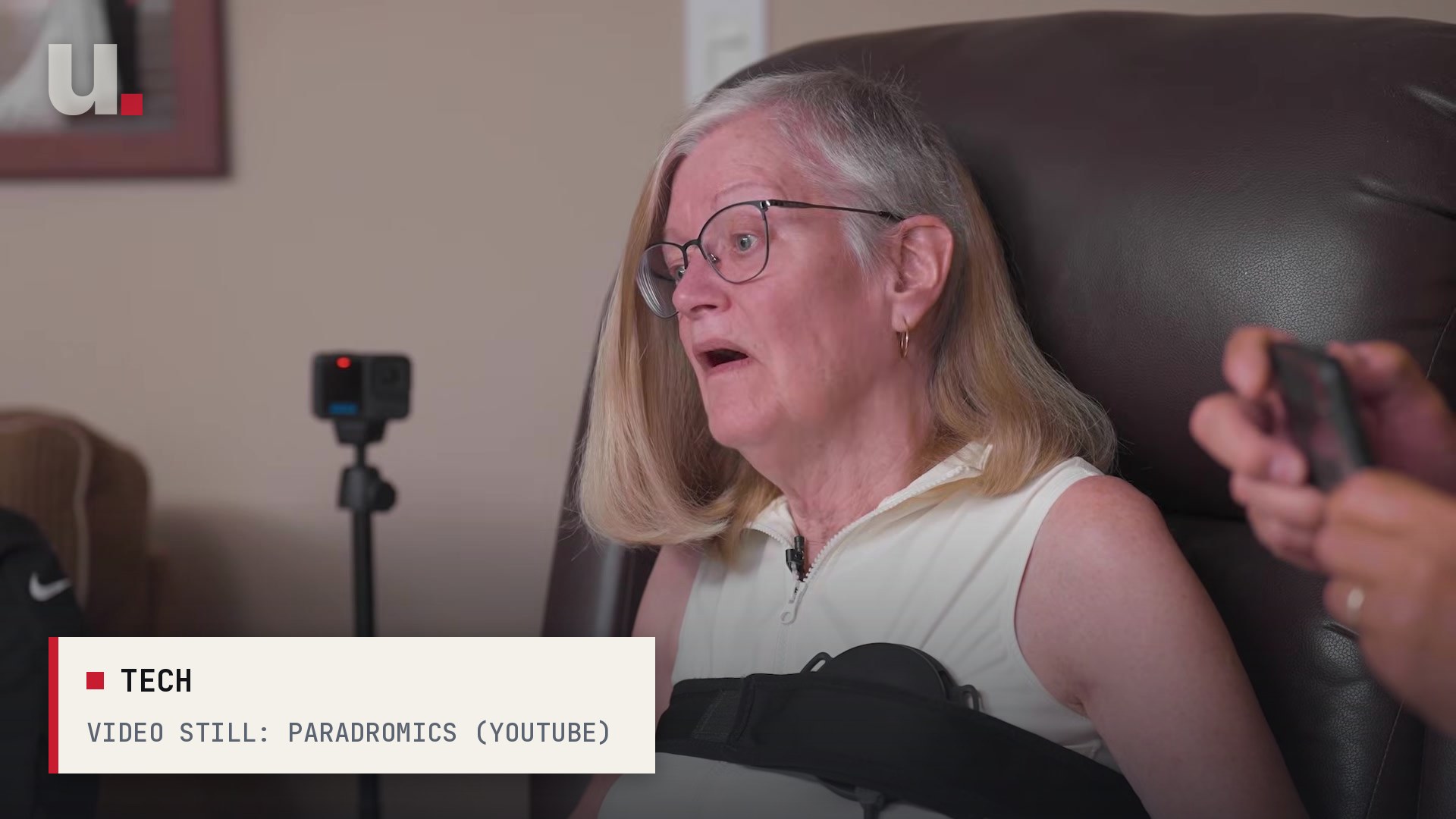
A grandmother in Michigan has a chip in her brain about the size of a dime. A disease is slowly stealing the muscles she needs to talk, and most people outside her family can no longer understand her. So researchers asked her a question through the implant: what is one piece of advice you would give your grandchildren?
The computer read the signals firing in her brain and spoke her answer out loud. “Pray continuously.”
That moment came from Paradromics, a brain-implant company out of Austin, Texas, which released the video in September. On Monday the company announced a deal with Nvidia, the chipmaker whose processors run most of the SI boom, to make that voice faster, smaller and eventually portable. Paradromics summed up the goal in one line on its 𝕏 account: “From thought to speech in under 10 milliseconds.”
Right now her voice lives on a cart
The woman is identified only as Mary, a Michigan grandmother in her 60s with a progressive motor neuron disease, the family of illnesses that includes ALS. According to Paradromics, she has severe trouble forming words and keeps only limited speech. Her husband can usually follow her. Almost nobody else can.
Surgeons placed the Connexus implant in June as the first patient in an early study the FDA cleared in November 2025. The device has more than 400 tiny electrodes that listen to individual brain cells. When Mary tries to say something, those cells still fire even though her mouth and throat won’t cooperate. Software learns which patterns go with which words, puts the words on a screen and speaks them in a synthesized voice.
In September the company said she had moved past repeating sentences researchers fed her and started choosing her own words. Her first free sentence, decoded with no errors, was “Okay, I have a lot to say.” She answered open-ended questions. She called her grandchildren on a live phone call, asked them questions and answered with the voice the system made for her.
The catch is the hardware behind it. As WIRED, which first reported the Nvidia deal, described it, the decoding takes a whole cart of electronics that has to plug into a wall. Mary has to stay within reach of that cart to talk. Leave the room, and she leaves her new voice behind.
Shrinking the cart to a box
That is the problem Nvidia is being brought in to fix. Paradromics will move its speech software onto Nvidia’s Jetson, a small, low-power computer built for machines that have to think on the spot, and Holoscan, Nvidia’s software for crunching live sensor data in real time. CEO Matt Angle told WIRED that a year from now the cart should become a small box that sits on Mary’s wheelchair. Eventually, he said, the electronics could be small enough to fit in a phone.
“High data rate brain computer interfaces are the ultimate application for edge computing,” Angle said in the announcement. Edge computing means the thinking happens right next to the person instead of in a distant data center. For a patient, that means the voice keeps working with no internet connection.
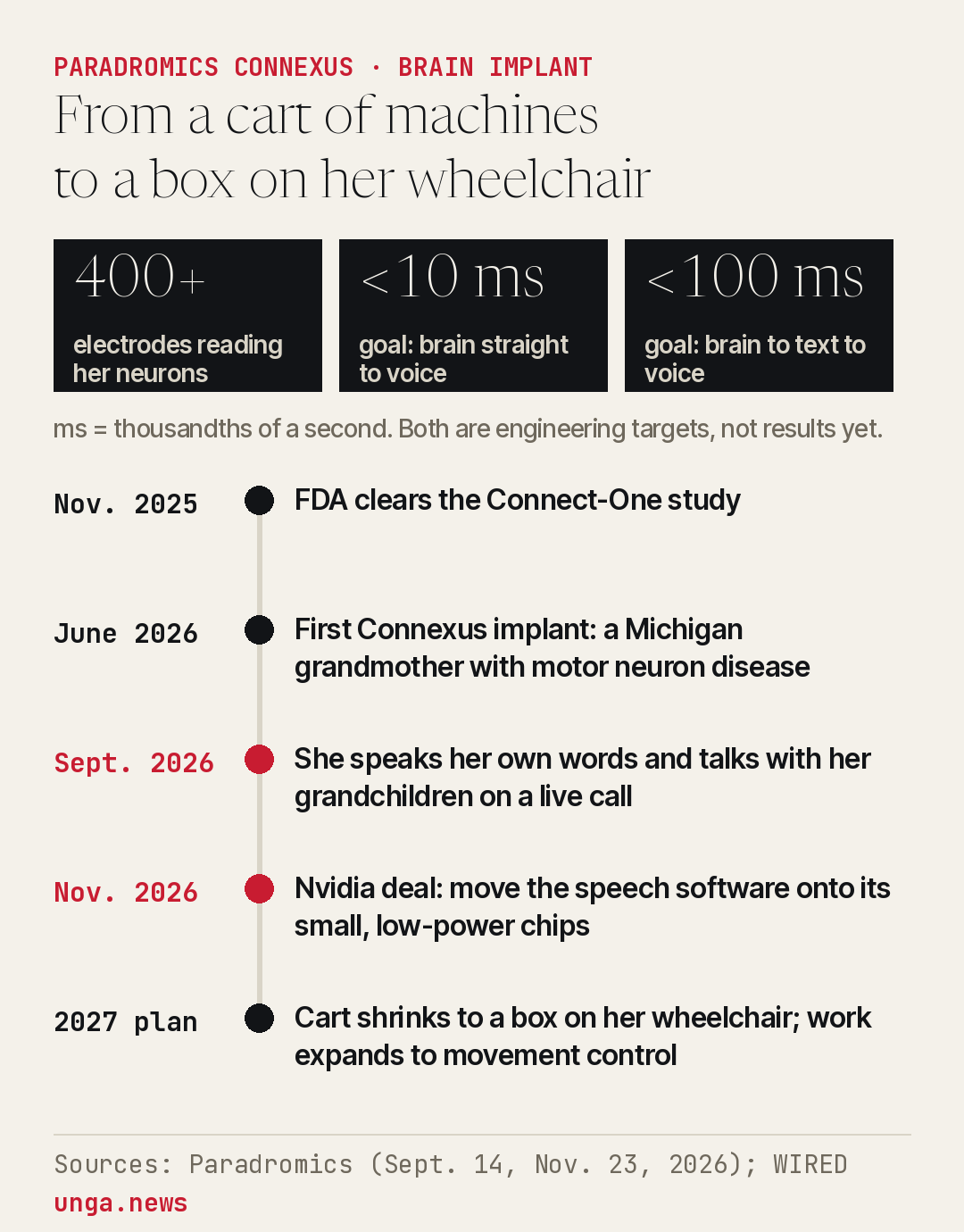
Speed is the other half of the deal. The roadmap sets two targets. One path goes straight from brain signals to a spoken voice, aiming for under 10 milliseconds of computing and data-transfer time. The other turns brain signals into text first, runs that through a language model, then reads it aloud, aiming for under 100 milliseconds. Ten milliseconds is one-hundredth of a second, so both targets are fast. They are engineering goals for the computer’s share of the work, though, not a measured result, and not the same as how long a listener waits to hear a clear word.
Why does a few thousandths of a second matter? “Even small delays can make communication feel unnatural,” Nvidia’s David Niewolny told WIRED. Anyone who has talked over a laggy video call knows the feeling: you start, stop, talk over each other, and give up. For someone whose only voice runs through a computer, that lag is the difference between a conversation and a dictation.
The brain changes, so the software has to keep up
There is a quieter problem the companies are also going after. Brain signals drift over time, and a decoder trained in June may slip by December. The plan includes software that retrains itself in the background while the patient keeps using it, so the voice gets better instead of worse. Paradromics’ chief scientist Vikash Gilja told WIRED the SI models could also make the synthesized voice sound more expressive and more like a real person.
Nvidia says it won’t have access to anyone’s brain data through these partnerships. The chipmaker is working with other implant companies too, including Synchron. The announcement landed the same day Nvidia’s board brought Jensen Huang back as chief executive, and Wall Street cheered that news with a huge rally.
Some caution is in order. Connexus is still an investigational device. The Connect-One study is an early feasibility trial built to gather safety data, and every result so far comes from one patient, reported by the company. Elon Musk’s Neuralink made brain chips dinner-table talk and has pushed the whole field forward. Paradromics is betting that speech is where an implant can change lives first.
Built here
This is what American medicine looks like when it works. An Austin startup, a federal study, surgeons at University of Michigan Health, UC Davis and Mass General Brigham, and an American chipmaker are all aimed at one goal: letting people who have lost their voices talk to their families again. The work starts this year with moving the speech software over to Nvidia, testing how much power it draws and getting it to research partners. Motor control, meaning moving a cursor or a robotic arm with thought, comes in 2027.
Mary already gave the advice she wanted on record. When her doctor asked what she would tell someone thinking about joining the study, the implant spoke for her: “Don’t be afraid. It’s a wonderful experience to be able to help others by your participation in the research study.”
Sources
- Paradromics (Business Wire) — Paradromics Advances High-Performance AI Computing for Brain-Computer Interfaces with NVIDIA (Nov. 23, 2026)
- Paradromics — Paradromics Achieves Real-Time Speech with Connexus BCI (Sept. 14, 2026)
- Paradromics on YouTube — Paradromics’ First Participant: Real-Time Speech
- Paradromics on 𝕏 — Paradromics on 𝕏 — From thought to speech in under 10 milliseconds
- WIRED — Nvidia Is Powering Brain-Computer Interfaces Now (Nov. 23, 2026)