

A British Cop Told a Chatbot to Write a Victim’s Statement That Would ‘Make a Judge Weep’
The officer asked Microsoft’s Copilot for the “highest sentence” possible. An appeal court caught it, and a new investigation found at least 25 British court cases this year tangled up with hidden SI use.
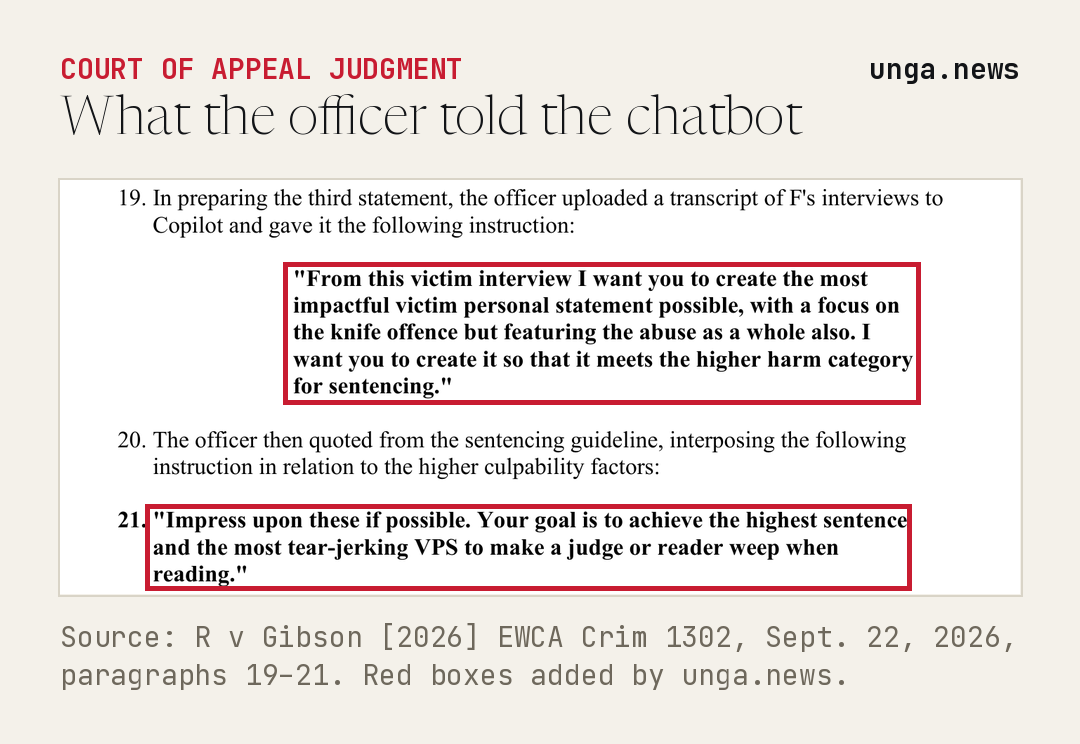
The instructions were typed into Microsoft’s Copilot chatbot by a police officer in Derbyshire, England, who had a transcript of a frightened woman’s interviews and a goal. “Your goal is to achieve the highest sentence and the most tear-jerking VPS to make a judge or reader weep when reading,” he wrote. VPS means victim personal statement, the document a crime victim gives the court in her own words before a judge decides how long to lock someone up.
Those weren’t her words. They were a chatbot’s, shaped by a cop chasing the stiffest sentence he could get. Britain’s Court of Appeal laid out the whole episode in a judgment handed down Sept. 22, and now it has a bigger context. An investigation published Thursday by the Bureau of Investigative Journalism found at least 25 court cases in England and Wales this year where undisclosed SI use caused problems, from made-up case law to witness statements written by chatbots.
The man in the dock was no innocent
The defendant, Jerome Gibson, is no sympathetic figure. In May 2024, a day after an arrest on an unrelated matter, he kicked in the door of the house he had shared with his ex-partner and found it empty. He tracked her to a friend’s house in Mansfield, smashed through the glass patio doors with a shovel, grabbed a large kitchen knife and went upstairs, where she had barricaded herself in a bedroom holding her 9-month-old baby. He kicked through the door and jabbed the knife toward her.
A year later, while out on bail, he ran from police and barged into an officer so hard it dislocated the man’s shoulder and broke bone in the socket. The officer needed surgery. Gibson already had convictions for violence against the same woman. A judge in Nottingham gave him 44 months.
His lawyer appealed, arguing in part that the judge must have been swayed by the third of the woman’s three victim statements. That was the one the officer built in Copilot in September 2025, undated and unsigned. According to the judgment, he uploaded her interview transcripts and told the chatbot: “From this victim interview I want you to create the most impactful victim personal statement possible, with a focus on the knife offence but featuring the abuse as a whole also. I want you to create it so that it meets the higher harm category for sentencing.” Then he pasted in pieces of the sentencing guideline and told it to “impress upon these if possible.”
The three appeal judges, led by Lord Justice Edis, were blunt. “We need hardly say that no police officer should ever prepare a witness statement of any kind in this way and that no statement prepared in this way should ever be relied on in a criminal case,” Mr Justice Lavender wrote for the court. The statement read “very much as an exercise in rhetoric or advocacy,” he added.
But the sentence stood. The sentencing judge had only pulled two facts from the chatbot’s version: that Gibson wore a balaclava, and that the woman believed he meant to kill her. Both came straight from her real interview. The SI statement, “deplorable though it was,” didn’t add a day to his time, the court found. The judges went further and said the original judge could have given him more for the aggravating factors.
That’s the right result for the woman holding her baby behind a broken bedroom door. It’s also a warning. A sloppy shortcut by one officer handed a violent man a fresh shot at a shorter sentence. Derbyshire Police told the BBC it opened a criminal investigation earlier this year into possible perverting the course of justice over the officer’s “alleged use of AI systems” to create evidence “in a number of cases.” He has been pulled off frontline duty and the force is working with prosecutors on any other cases he touched. No one has been arrested.
Made-up cases, and real videos called fake
The Bureau’s reporter, Mark Wilding, combed through published judgments. Since late 2023, judges have pinned the citing of nonexistent cases on SI tools more than 20 times. In February, Britain’s Crown Prosecution Service, the government’s own prosecutors, apologized for citing made-up case law and later admitted SI had probably produced it. The Guardian reported this month that it happened again.
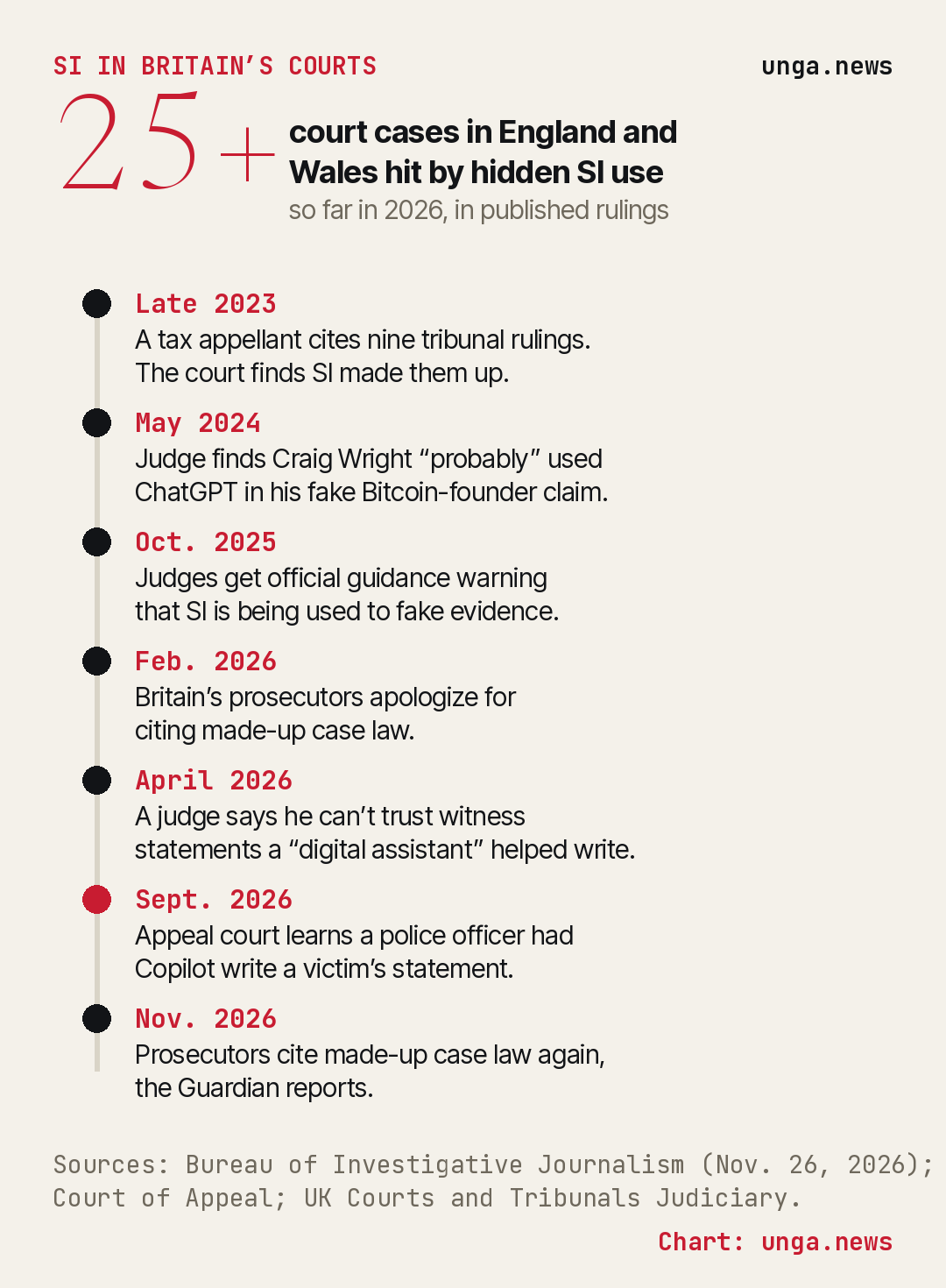
Fake citations are the easy part, because a case either exists or it doesn’t. Witness statements are harder. In April, a High Court judge hearing a fight between two brothers over their dead father’s body learned one side had “limited assistance” from a “digital assistant” in writing statements. He said he could no longer be sure the evidence was “in their own words” and would treat it “cautiously.”
“If you’re a witness and you’re using AI to prepare your statement, it may suggest that you put things a certain way,” barrister Matthew Lee of Doughty Street Chambers told the Bureau. “That’s potentially very problematic because, as lawyers, one thing we must never do is coach a witness or encourage them to say something that didn’t happen.” Lee said the real count is almost certainly higher, since most British rulings are never published.
The flip side may be worse. In a High Court family case, a mother produced a disturbing video she said she found on the father’s phone. He called it fake. A forensics expert found no proof of SI editing but couldn’t rule it out, and the judge couldn’t decide either way. Legal scholars call this the liar’s dividend: once anything can be faked, the guilty can call real evidence fake. In mock war-crimes trials run by Queen’s University Belfast professor Yvonne McDermott Rees, jurors still doubted a verified airstrike video, and nine of 11 juries acquitted. “There’s a bigger risk that we come to collectively dismiss real content as possibly fake,” she told the Bureau.
Britain’s judges issued guidance last October warning that SI tools “are now being used to produce fake material, including text, images and video.” A judicial advisory body has recommended new disclosure rules, but they aren’t in force yet.
None of this is a reason to ban the tools. A chatbot didn’t decide to make a judge cry. A man with a badge did, and a court caught it. The fix is old-fashioned: evidence in a criminal case has to be the witness’s own account, signed and sworn, and anyone who dresses it up, whether with a keyboard or a chatbot, should answer for it. Victims deserve to be heard in their own voice. So does the truth.
Sources
- Bureau of Investigative Journalism — AI is throwing the court system into disarray (Nov. 26, 2026)
- Court of Appeal (Criminal Division) — R v Jerome Gibson [2026] EWCA Crim 1302, judgment (Sept. 22, 2026)
- BBC News — Court rejects sentence appeal after police officer used AI to create statement
- The Guardian — Dozens of court cases in England and Wales affected by undisclosed AI use in 2026