

A British Startup Hasn’t Shipped a Single Chip Yet. Investors Just Valued It at $7 Billion.
Fractile raised $720 million to build chips it says will make SI answer far faster. Claude’s maker has reportedly signed up to buy them. Nobody outside the company has tested one.
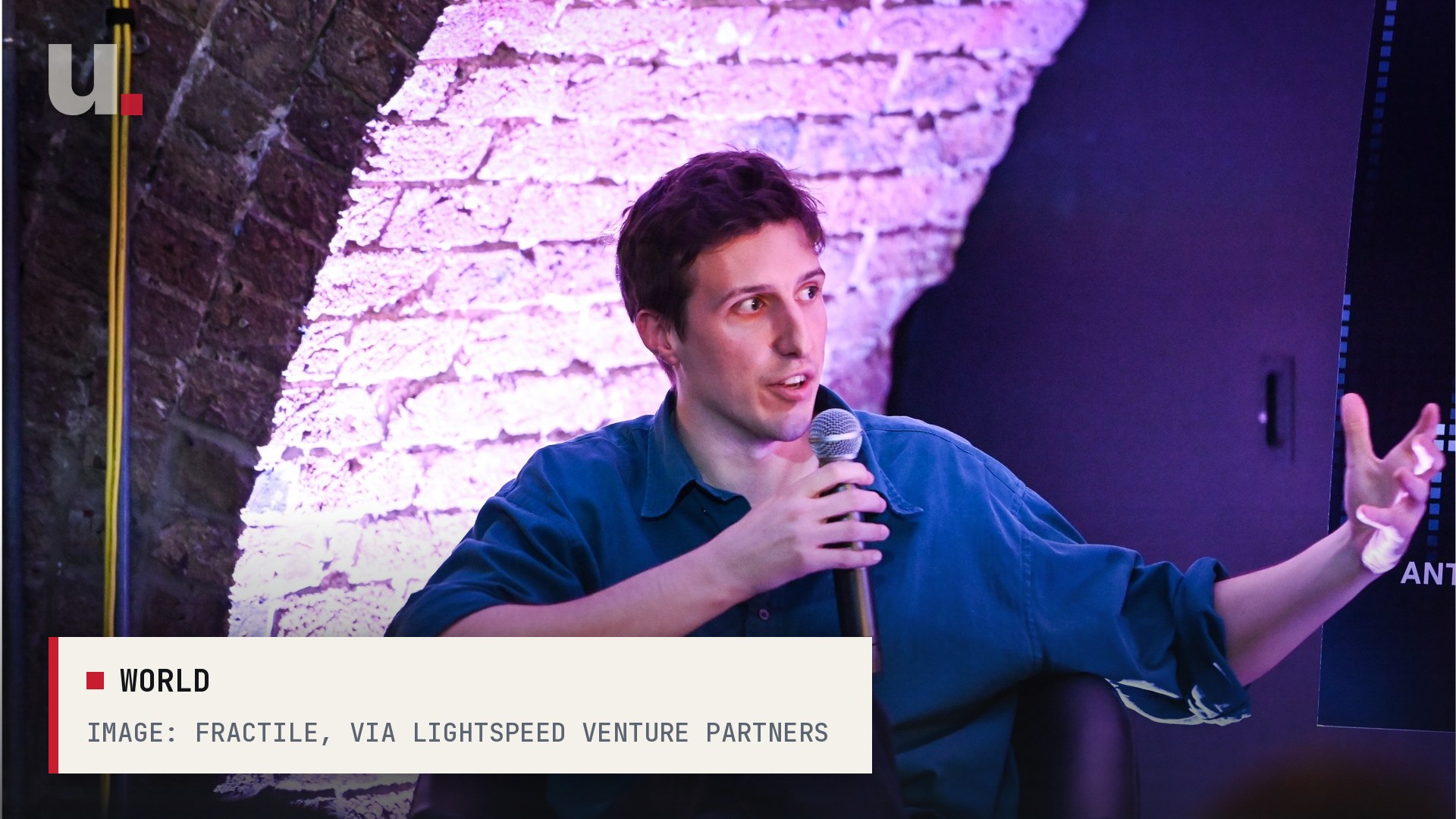
A London chip company that has never shipped a product just raised $720 million, and the people writing the checks now say it’s worth $7 billion. Its name is Fractile, it was started four years ago by an Oxford-trained robotics researcher named Walter Goodwin, and the bet behind it is pretty simple to state: the thing slowing down SI today isn’t how smart the models are, it’s how long you sit there waiting for them to answer.
The company announced the round Wednesday morning. Four big Silicon Valley firms led it: Thrive Capital, Founders Fund, Lightspeed and Redpoint. Behind them is a crowd that reads like a who’s who of money, including BlackRock, T. Rowe Price, DST Global, Google’s venture arm CapitalG, and two arms of the British government, its Sovereign AI fund and the British Business Bank.
Fractile on 𝕏: “We’re delighted to announce that Fractile has raised $720M in a Series C led by @thrivecapital @foundersfund @lightspeedvp and @redpoint, with further participation by brilliant new and existing investors.”
— @fractile_ai View on 𝕏
From $1 billion to $7 billion since May
The jump is what raises eyebrows. Back in May, Fractile raised $220 million at a valuation of roughly $1 billion, Bloomberg reported. Six months later it’s worth about seven times that. Balderton, one of the investors, puts the number at $7 billion after the new money comes in, and Reuters says that makes it one of Britain’s most valuable tech startups.
What changed in between? In August, Bloomberg reported that Fractile had reached an initial deal to sell about $250 million of its chips to Anthropic, the company behind the Claude chatbot, with plans to expand it later. Those chips aren’t expected to be ready until 2027. Both companies declined to comment at the time, and neither has confirmed the deal publicly since. Still, when one of the two or three most important SI labs on earth lines up to buy your hardware before it exists, investors notice.
The waiting problem
To see why anyone would pay this much, you need to know one thing about how chatbots work. Every word an SI writes back to you requires the chip to pull the whole model, billions of numbers, out of memory and run them again. The math itself is fast. Fetching the data is the slow part.
Lightspeed, which co-led the round, put it plainly in its investment memo: “During generation, a chip spends most of its time waiting on data to arrive.” Think of a world-class chef who can chop an onion in two seconds but has to walk to a warehouse across town for every single ingredient. Buying a faster knife doesn’t help. You need the pantry next to the stove.
That’s Fractile’s pitch. Most SI chips today, including Nvidia’s, sit next to stacks of a special memory called HBM, short for high-bandwidth memory. Fractile instead stacks ordinary DRAM, the same kind of memory in your laptop, directly on top of the processor. The company says that gives it far more bandwidth than HBM, and far more room than the tiny, superfast on-chip memory that some rival startups use instead. Its website says the goal is to produce “thousands of tokens per second,” tokens being the word fragments an SI writes, even when a model is juggling a very long conversation or document.
Big promises, no chip yet
Now for the cold water, because there’s plenty of it. Every performance claim here comes from Fractile or the people who just invested in it. Lightspeed says the chips can run top models “at over an order of magnitude faster speeds and at a fraction of the cost.” That’s ten times faster or more. Nobody outside the company has tested a Fractile chip, because there isn’t one on the market. Reuters says the first commercial chip is planned for next year, and the Anthropic chips aren’t due until 2027.
The startup data firm Dealroom was blunt about the risk: the valuation “rests heavily on an unproven product and a single disclosed customer,” and that customer deal was reported by Bloomberg, not announced by the companies. It also noted the obvious giant in the room. Nvidia is worth more than $5 trillion and already sells most of the chips the SI world runs on.
Chip startups have a long history of beautiful slides and painful first silicon. Designing a chip is hard, getting a factory to make it at scale is harder, and convincing a big customer to swap out hardware that already works is hardest of all.
Why the money keeps coming
So why are investors piling in anyway? Because the demand side of this story is enormous. Lightspeed says frontier models are processing more than 10 times as many tokens every year, and it expects the market for these chips to reach “hundreds of billions of dollars” over five years, with about 80% of that going to running models rather than training them. SI agents that work on a task for an hour, or write and test code on their own, burn through far more output than a quick chatbot question.
That shift is exactly where speed starts to matter to regular people. If an SI helper takes 20 minutes to finish a job that could take two, that’s the difference between a tool you use and one you give up on. It’s also a cost story. Faster chips that use less power could mean cheaper SI for businesses and, eventually, for everybody else.
Fractile is also unusually do-it-yourself for a chip company. Lightspeed points out that most SI chip efforts hand part of the design work to Broadcom or another outside partner, while Fractile designs its own chips, builds its own server systems, writes its own software and does its own research. That’s more control, and a lot more that can go wrong.
For Britain, which has watched most of the big SI money flow to California, this is a rare homegrown contender, and the government put its own cash in to prove it. For Nvidia, it’s one more well-funded company promising to beat it at one specific job. The proof arrives next year, when Fractile has to put a real chip on the table.
Sources
- Fractile on 𝕏 — Fractile raises $720M Series C, Nov. 11, 2026
- Fractile — We are a chip-first frontier AI company
- Lightspeed Venture Partners — Accelerating Intelligence: Our Investment in Fractile
- Balderton — Fractile raises $720m to build the hardware that pushes AI’s frontier forward
- Reuters (via CNA) — UK-backed AI chip startup Fractile hits $7 billion valuation in funding round
- Bloomberg — AI Chip Startup Fractile in Talks for $6.5 Billion Value After Anthropic Deal, Aug. 19, 2026
- Dealroom — Fractile raises $720M Series C to challenge Nvidia on AI chips
- BusinessCloud — AI chip company Fractile reveals investors behind $720m Series C