

A Decoy Dan, Up to 20,000 Affidavits, Three Scanner Excuses: The Midterm Anomalies Officials Haven’t Explained
In several of the closest midterm races, the margin is smaller than the stack of ballots still in question. Here is every documented anomaly from Alaska to Westchester, what officials have said and what they still haven’t explained.
Three days after the polls closed, the midterm that was supposed to be over in one night still is not. Two U.S. Senate seats, two governor’s races and a string of House races are uncalled. In several of them, the leader’s margin is smaller than the stack of ballots that have not been accepted, scanned or explained.
That is not proof of fraud. It is a list of questions. Here is every anomaly we could document from official records, court filings, sworn statements and on-record posts, what the people in charge have said about each one, and what they still have not explained.
1. Alaska: the other Dan Sullivan, and a second spoiler
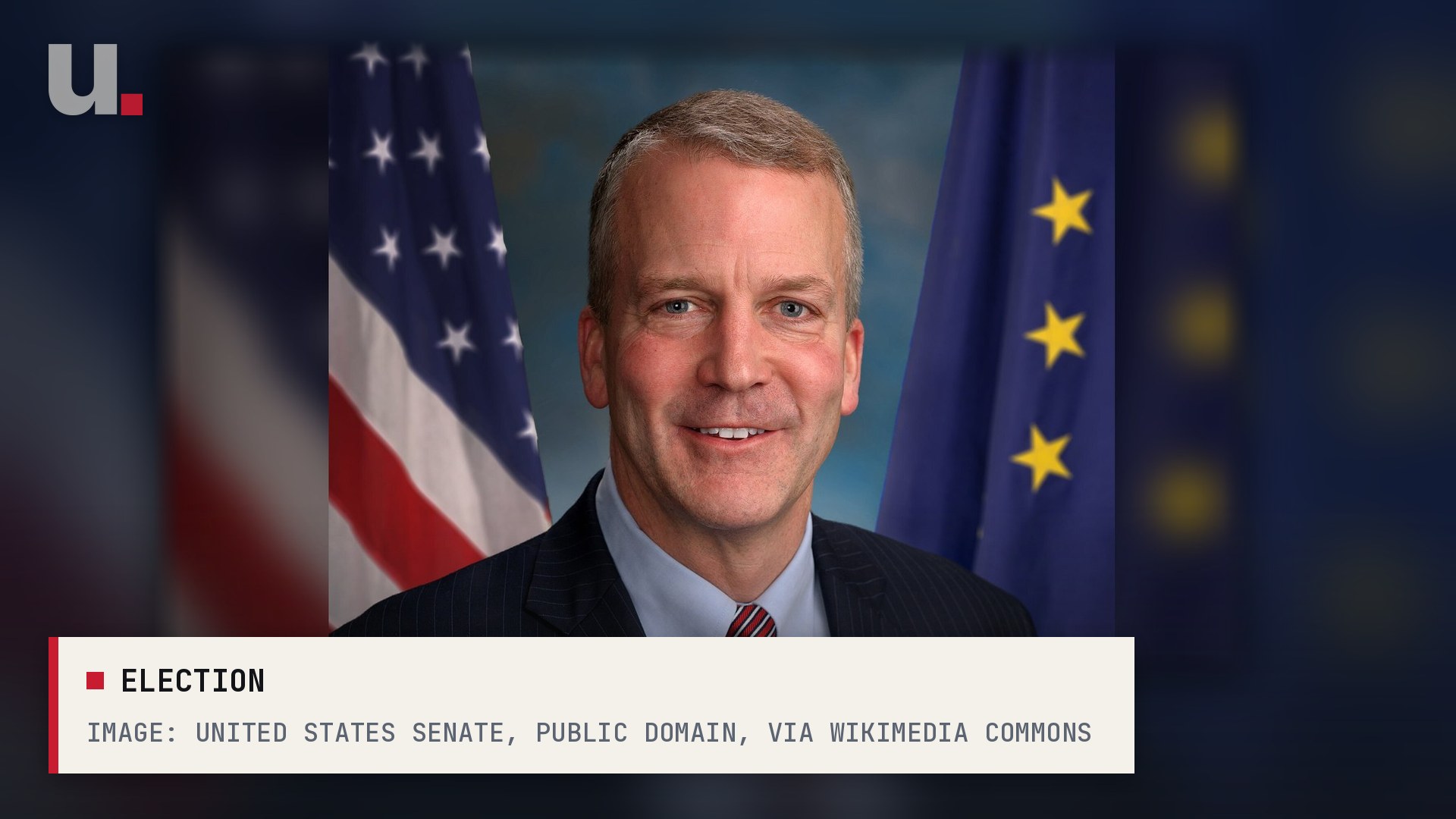
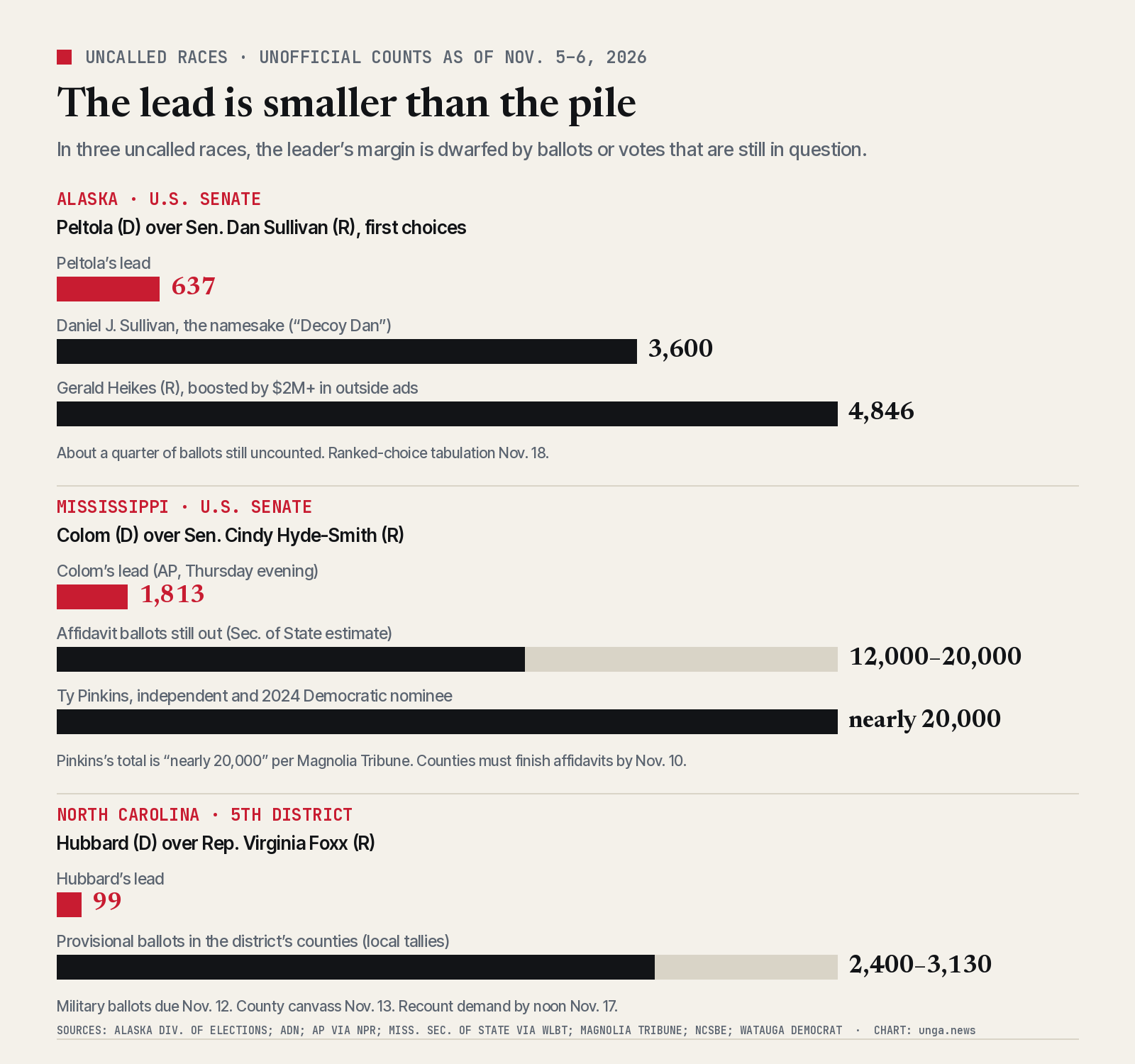
Democrat Mary Peltola leads Republican Sen. Dan S. Sullivan by 637 first-choice votes, 102,962 to 102,325, in the Alaska Division of Elections’ latest unofficial count. About a quarter of the ballots are still out. Ranked-choice tabulation is set for Nov. 18, and the state plans to certify Nov. 25.
Two names further down the ballot are the story. Daniel J. Sullivan, the retired Petersburg teacher at the center of the Justice Department’s “Decoy Dan” probe, took 3,600 votes, more than five times Peltola’s lead. Alaska’s own elections director ruled in June that he filed “with a purpose to confuse or mislead,” before state courts put him back on the ballot. The New York Times reported Oct. 28 that Peltola aides and Democratic Senatorial Campaign Committee staff worked on a “ballot composition project.” Peltola’s campaign and the DSCC deny any role in recruiting him.
Republican Gerald Heikes took 4,846. Political groups spent more than $2 million on ads boosting him, the Anchorage Daily News reported, including one entity heavily funded by the progressive Sixteen Thirty Fund. The ads pitched Heikes as the more conservative choice and told voters to rank only him. Heikes said two FBI agents served him a subpoena tied to the federal case. He also said the groups behind the ads used his likeness to make SI-generated images.
Why would a group bankrolled by progressive money urge conservative voters to rank a perennial candidate and nobody else? Nobody behind those ads has explained it. In ranked choice, a ballot that ranks only Heikes drops out once he is eliminated. It never reaches Sullivan.
President Trump weighed in Thursday on Truth Social: “The vote totals for the Fake Dan Sullivan, plus the other ‘slug’ that the Dems put on the Ballot, should be immediately given to the REAL Dan Sullivan, and the Election is over - He easily wins.” The Sullivan campaign said its analysis of the ballots counted so far shows he would win the ranked-choice rounds by 328 votes, while noting tens of thousands of ballots are still uncounted. Peltola’s campaign called that path “fictitious.”
The legal clock is the anomaly no one in charge has addressed. A federal judge dismissed the Justice Department’s suit to hold certification over the namesake’s votes the weekend before the election. DOJ appealed the same day. The Ninth Circuit’s schedule doesn’t call for DOJ’s opening brief until Dec. 14 or the state’s answer until Jan. 11, ADN reported. That’s weeks after Alaska certifies and after the new Senate is sworn in on Jan. 3. Marc Elias, who received a DOJ target letter this week, wrote that DOJ “lost — badly.” No charges have been filed in the criminal investigation.
2. Mississippi: a former Democratic nominee, and up to 20,000 affidavits
Democrat Scott Colom led Sen. Cindy Hyde-Smith 466,775 to 464,962 in the Associated Press tally Thursday evening, a gap of 1,813 votes with about 96% of the expected vote counted. The race is uncalled.
That third-place finisher is the first anomaly. Ty Pinkins ran as an independent and drew nearly 20,000 votes, Magnolia Tribune reported. He was the Democratic nominee for Senate in 2024. He told CNN that 77% of his votes came from traditionally Republican counties and that polling showed 70% of his voters were Republicans. “I think what we did in this race as an independent campaign we did the opposite of a spoiler,” he said. He added that he is “happy that we drew votes from Cindy Hyde-Smith,” and that he now hopes Colom wins.
The second is the pile. Secretary of State Michael Watson told WLBT that 12,000 to 20,000 affidavit ballots, Mississippi’s version of provisional ballots, could still be uncounted. “Our current acceptance rate, which is another important piece there, is 76%,” he said. Watson said the number is likely higher than usual and pointed to voter roll maintenance as the reason. Mississippi now gives counties commercial address data (first from Experian, since replaced by another platform), the Postal Service’s change-of-address file and Social Security death records to find voters who may have moved or died. Voters flagged that way are moved to inactive status, not purged, and can still cast an affidavit ballot.
“The key piece there is when you vote affidavit, it will catch that error. That is the safety net,” Watson said. “And the most important part here is we’re making sure we’re cleaning up our voter rolls to make sure there isn’t voter fraud.” Watson told Magnolia Tribune there were roughly 21,000 affidavits in 2024, a presidential year that typically draws 300,000 to 350,000 more voters than a midterm. State Republican Chairman Mike Hurst called this year’s number a considerable uptick.
Hyde-Smith’s lawyers sent all 82 counties a demand Thursday to separate and preserve every affidavit ballot, accepted or rejected, with the full custody trail. Colom’s lawyers wrote back that those demands “have no basis in Mississippi law,” and his campaign said separating the ballots would violate voters’ privacy. Colom himself told volunteers that the affidavit vote “is always moving in Democratic favor in Mississippi.” Why would a campaign confident in the count object to keeping the envelopes in a separate box? That hasn’t been explained either. Counties have until Nov. 10 to resolve the affidavits. Mississippi has no automatic recount.
3. Westchester: three explanations, and the bags still aren’t done
Ballot scanners in 44 of Westchester County’s 45 municipalities rejected Election Day ballots, and voters were told to drop them into orange emergency bags. Officials have now given three different reasons.
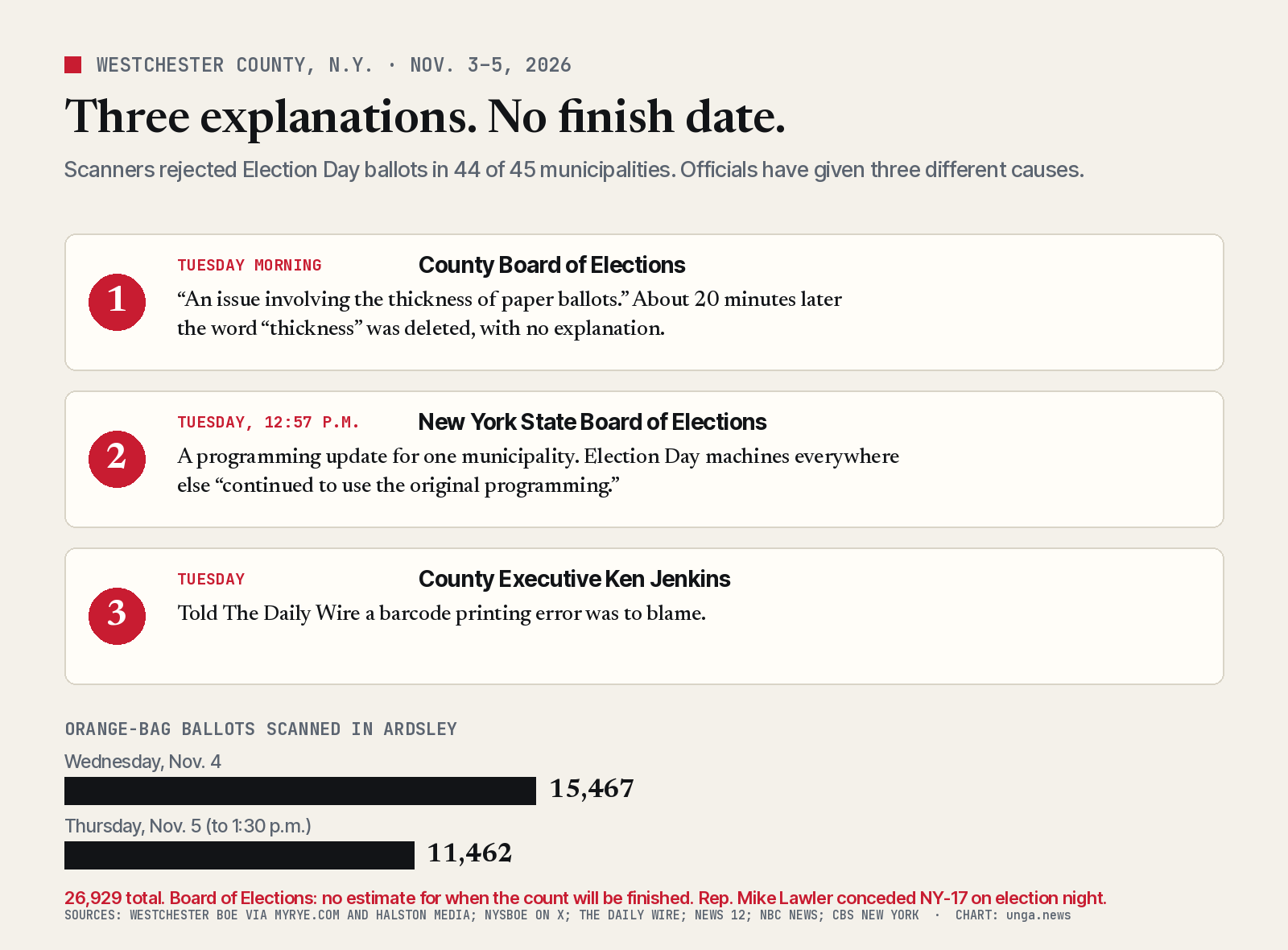
At about 8:15 Tuesday morning the county Board of Elections blamed “an issue involving the thickness of paper ballots.” About 20 minutes later it reissued the statement with “thickness” deleted and gave no reason, MyRye.com documented. That afternoon the state Board of Elections blamed a programming update made for one municipality. Machines everywhere else, it said, “continued to use the original programming and therefore could not recognize and accept the ballots.” County Executive Ken Jenkins told The Daily Wire it was a barcode printing error.
New York State Board of Elections on 𝕏, Nov. 3, 2026: statement blaming a programming update for the Westchester scanner failures.
— @NYSBOE View on 𝕏
Who approved a programming change that late, and why did it reach only one town’s machines? The state has not said. Jenkins has promised a bipartisan review. Meanwhile, the county had scanned 26,929 emergency ballots by 1:30 p.m. Thursday, and the Board of Elections gave no estimate for when it will finish. One county official told MyRye.com to expect about 160,000 Election Day ballots in all. Republican Rep. Mike Lawler conceded New York’s 17th District to Democrat Cait Conley on election night, before the first orange bag was opened.
4. The phantom paper jam, and other machines that quit
Fulton County, Ga. The county had to rescan or recover 1,069 early ballots from two broken scanners, WSB-TV reported. One scanner at the Hugh C. Conley Recreation Center showed a paper jam that wasn’t there and was pulled from service. Another at Mechanicsville Library failed after a voter’s wheelchair rolled over its power cord, and it could not be restarted. The county board voted 3-1 to rescan in public view. Voters also got fake texts sending them to the wrong polling place, and the county says it didn’t send them.
Lubbock County, Texas. One early-voting machine failed, was replaced, and then the same problem hit the same location again. “At this point, I’m not even sure exactly how this happened,” elections administrator Troy Havard told KCBD. The county rescanned all 5,681 ballots from that site. The Secretary of State’s legal division also ordered 1,700 limited ballots rescanned and hand-adjudicated. Results came in late.
Jefferson County, Texas. The county pulled three touchscreen machines after voters reported problems with their selections. County clerk Aaron Kelley told the National Association of Counties the machines were tested and no errors were found.
Broward County, Fla. A new feature meant to make sure voters in split precincts got the right ballot flagged some correct ballots as wrong instead. Supervisor Joe Scott said the delay lasted about 20 minutes and some voters left. “We definitely should have done more robust testing,” he said.
Every one of these was blamed on equipment or software, not on a person. Every one of them happened on the machines voters are told to trust.
5. Kansas: the late ballots lawmakers tried to stop
Republicans in the Kansas Legislature passed Senate Bill 4 in 2025 to require mail ballots to arrive by 7 p.m. on Election Day. A Douglas County judge blocked it in July, and the Court of Appeals refused to lift that order on Oct. 2. So ballots postmarked by Election Day still count if they arrive by Friday, today. The court has never ruled on whether the law is constitutional.
Late returns have already widened Democrat Cindy Holscher’s lead over Senate President Ty Masterson in the governor’s race, from about 5,500 to 7,045 votes, the Wichita Eagle reported from Secretary of State data. In Johnson County alone more than 6,000 provisional ballots still have to be researched. The county pushed its share of the state’s mandatory close-race hand audit to Nov. 9, citing “the expanded scope of the required audits.” Election Commissioner Connie Schmidt called it the biggest audit in Kansas history: 125,000 to 130,000 ballots counted by hand. “No one really knows who won,” she said.
6. The close-race board
Minnesota’s 1st: Rep. Brad Finstad trails by 321 in a seat he won by 17 points two years ago and Trump carried by 12. He is taking Minnesota’s free recount after the Nov. 19 canvass. North Carolina’s 5th: Rep. Virginia Foxx won eight of 10 counties and trails by 99, with 2,400 to 3,130 provisionals and military ballots still out. Tennessee’s 4th: Rep. Scott DesJarlais won nine of 11 counties and trails by 280 after the new Nashville slice gave his opponent a 25,831-vote edge. Florida’s 27th: Rep. María Elvira Salazar leads by 1,116, inside the automatic recount line. Her opponent demanded that Miami-Dade’s elections chief recuse herself, and Salazar said he is “behaving like an election denier.” Colorado’s 4th: Rep. Lauren Boebert trails by 3,266 in the latest count, 184,024 to 180,758. Douglas County, which she won in 2024, now favors her opponent by 21,788.
7. The law that would have closed the front door
Texas alone processed 2,900,357 “new valid” voter registrations between the 2022 and 2024 deadlines, 56.5% of its transactions against 25.3% nationwide, in the Election Assistance Commission’s federal survey. Not one applicant had to show a birth certificate or passport. Texas’s own after-the-fact check flagged 2,724 “potential noncitizens” on the rolls, and the state referred 117 cases to the attorney general in September.
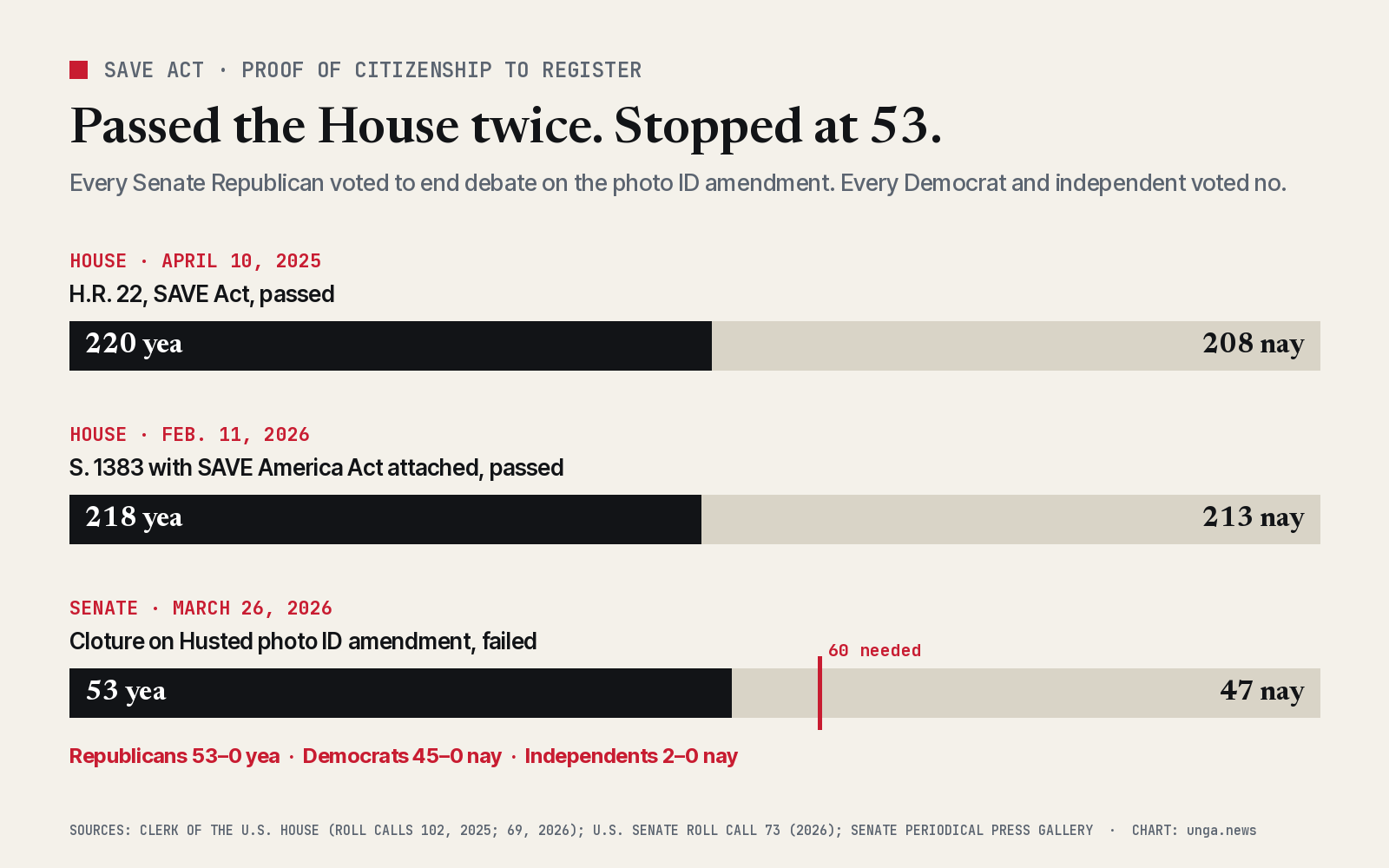
The SAVE Act would require documentary proof of citizenship to register for federal elections. The House passed it 220-208 in April 2025 and passed the SAVE America Act version, with photo ID, 218-213 in February. In the Senate, a motion to end debate on the photo ID amendment failed 53-47 on March 26. It needed 60 votes. All 53 Republicans voted yes. All 45 Democrats and both independents voted no.
Voters plainly want it. On the same ballot that elected Democrat Sherrod Brown, Ohioans wrote photo ID into their constitution by 1.38 million votes. Five states passed citizens-only voting measures. Senate Democrats who blocked the bill have not explained why voters in Ohio, North Carolina, Nevada and Kansas elected Democrats and backed ID or citizenship rules on the same ballot.
Ohio also produced one of the most-shared numbers on 𝕏 this week. Democrat Amy Acton won the governor’s race by 364,388 votes, while Republican Frank LaRose won the auditor’s race by 72,150, getting 270,375 more votes than Vivek Ramaswamy, the Statehouse News Bureau reported. Posts asked how the same electorate split that hard. The official county abstracts will show how many voters skipped each race. Until counties certify, the split is a question, not a finding.
8. The monitors, and who reads their notes now
On Election Day, Assistant Attorney General Harmeet Dhillon sent more than 1,000 Justice Department monitors and observers to all 50 states. Biden’s DOJ watched 64 jurisdictions in 24 states in the 2022 midterms, NPR reported. The day before, DOJ announced charges against 63 people for election crimes. Two days after the election, Dhillon resigned. DOJ said before the vote that it would review the monitors’ reports and “act where appropriate.” It has not said who will run the Civil Rights Division or who now reads those reports. Author Naomi Wolf wrote on 𝕏 that she had sent “full documentation” of New York counting conditions to Dhillon, “but sadly she has just resigned.”
9. What the integrity voices are saying, and what still needs proof
Lara Logan, the former 60 Minutes correspondent whose show’s 100th episode was a live election-integrity special featuring Tina Peters, posted Thursday that “the midterm steal started right after Trump was re-elected.” She wrote that the plan “was documented” and that she had discussed it months ago “with someone who is in possession of this plan/document.” She listed registering voters without proof of citizenship, fights over voter-roll cleanup and mail ballots, and the stalled SAVE America Act as parts of it.
Lara Logan on 𝕏, Nov. 5, 2026: “So the midterm steal started right after Trump was re-elected with a plan to split the conservatives & turn them against each other.”
— @laralogan View on 𝕏
Several items on her list are on the record in this report: the registration form, the roll-cleanup fights and the Senate vote. The document itself has not been published, and we have not seen it. Peters, the former Mesa County clerk, said on Logan’s 100th episode that she was twice offered a way out if she would back down. “And I just wouldn’t do it,” she said.
Flynn, replying to Brian O’Shea on Friday, wrote that “fraud is clear” and that the core failure was a voter ID bill that never got through Washington. He pointed to Florida as a state that tried to fix it and “turned out okay.” Wolf has asked election boards to release ballot images and voter rolls for public review, noting that “almost no races are formally concluded.” That part is simply true. Not one of the races in this report is certified.
What happens next
Today: Kansas’s last day for late mail ballots. Saturday: Miami-Dade’s unofficial returns are due, and a FL-27 machine recount could be ordered. Nov. 9: Johnson County’s hand audit. Nov. 10: Mississippi affidavit deadline. Nov. 13: North Carolina canvass. Nov. 18: Alaska ranked-choice tabulation. Nov. 19: Minnesota canvass and the Finstad recount clock. Nov. 25: Alaska certification, weeks before the Ninth Circuit hears DOJ’s appeal.
No official has offered a single explanation for all of this. Each county has its own reason: a power cord, a deleted word, a programming update, commercial address data, a court order. Taken one at a time, each sounds small. Taken together, it’s a midterm where officials still can’t say when the count will finish, why the machines failed or who is reading the federal monitors’ notes. Voters are entitled to those answers before anyone certifies anything.
Sources
- Alaska Division of Elections — 2026 general election summary report, unofficial results: Peltola 102,962, Sullivan 102,325, Heikes 4,846, Daniel J. Sullivan 3,600
- Anchorage Daily News — Trump weighs in on Alaska’s tight Senate race: Truth Social quote; $2M+ in ads boosting Heikes incl. Sixteen Thirty Fund-backed entity; Ninth Circuit schedule (Dec. 14 / Jan. 11); certification Nov. 25 (Nov. 5, 2026)
- Alaska’s News Source (KTUU) — Peltola and Sullivan campaigns project wins while a quarter of ballots are outstanding (Nov. 5, 2026)
- U.S. District Court, D. Alaska — United States v. State of Alaska, Complaint with Exhibit A: Division of Elections letter finding the namesake filed “with a purpose to confuse or mislead” (Oct. 22, 2026)
- NPR / Associated Press — Mississippi results: Colom 466,775 – Hyde-Smith 464,962, race uncalled (Nov. 5, 2026)
- WLBT — Secretary of State Michael Watson: 12,000–20,000 affidavits; 76% acceptance; voter roll maintenance; “That is the safety net” (Nov. 5, 2026)
- Magnolia Tribune — Thousands of affidavit ballots could decide Mississippi Senate race: Watson on ~21,000 in 2024; Hurst on uptick; roll-maintenance data (Nov. 6, 2026)
- Magnolia Tribune — Pinkins says he played spoiler to Hyde-Smith, not Colom: nearly 20,000 votes; “happy that we drew votes from Cindy Hyde-Smith” (Nov. 5, 2026)
- Lex Politica / Cindy Hyde-Smith for U.S. Senate (via NRSC) — Demand letter to all 82 counties to separate and preserve affidavit ballots (Nov. 5, 2026)
- MS NOW — Dueling letters: Colom lawyers say preservation demands “have no basis in Mississippi law” (Nov. 5–6, 2026)
- Mississippi Today — Colom: affidavit vote “always moving in Democratic favor”; no automatic recount (Nov. 5, 2026)
- New York State Board of Elections on 𝕏 — Statement: Westchester failure from programming update for one municipality (Nov. 3, 2026)
- MyRye.com — Westchester BOE statement at ~8:15 a.m. citing “thickness of paper ballots,” corrected ~8:35 a.m. with “thickness” removed (Nov. 3, 2026)
- MyRye.com — Westchester BOE scan figures; county official’s ~160,000 Election Day ballot estimate (Nov. 5, 2026)
- Halston Media — Nearly 27,000 emergency ballots scanned in Westchester: 15,467 Wednesday, 11,462 Thursday to 1:30 p.m. (Nov. 5, 2026)
- The Daily Wire — 44 of 45 municipalities; Jenkins blames barcode printing error (Nov. 3, 2026)
- News 12 Westchester — Vote counting continues, no estimate on completion; bipartisan investigation (Nov. 5, 2026)
- WSB-TV — County says 1,069 ballots in need of rescan in Fulton County (Nov. 3, 2026)
- 11Alive — Fulton County election board addresses scanner issues impacting roughly 1,000 early votes; 3-1 vote
- KCBD — Lubbock County results delayed by machine error; 5,681 ballots rescanned; Havard: “not even sure exactly how this happened” (Nov. 4, 2026)
- National Association of Counties — Counties keep elections on track: Broward ballot-check glitch; Westchester “thickness” statement removed; Fulton scanners and fake texts; Jefferson County, Texas, machines pulled (Nov. 5, 2026)
- Wichita Eagle — Late returns expand Holscher’s lead from ~5,500 to 7,045 as audit begins (Nov. 5, 2026)
- KMBC — Johnson County audit moved to Nov. 9; 6,000+ provisionals; 125,000–130,000 ballots hand-counted; Schmidt quotes (Nov. 5, 2026)
- Kansas Court of Appeals — Kansas Appleseed v. Schwab, No. 130,839: Order denying renewed motion to stay (Oct. 2, 2026)
- Colorado Secretary of State / Douglas County (via DouglasCou — CO-4 unofficial: Laubacher 184,024 – Boebert 180,758; Douglas County Laubacher +21,788 (Nov. 5, 2026)
- U.S. Election Assistance Commission — 2024 EAVS Comprehensive Report, Ch. 3, Table 3: Texas 2,900,357 new valid registrations (56.5%)
- Texas Secretary of State — Texas Secretary of State refers 117 cases for investigation of noncitizen voting (Sept. 15, 2026)
- Office of the Clerk, U.S. House — Roll Call 102 (2025): H.R. 22, SAVE Act, 220–208
- Office of the Clerk, U.S. House — Roll Call 69 (2026): S. 1383, 218–213
- U.S. Senate Periodical Press Gallery — March 26, 2026: cloture on Husted amendment #4732 to S. 1383, SAVE America Act, not invoked 53–47
- Statehouse News Bureau — Ohio results: Acton +364,388; LaRose auditor +72,150 and 270,375 more votes than Ramaswamy (Nov. 5, 2026)
- Harmeet Dhillon on 𝕏 — Election Day: 1,000+ monitors and observers to all 50 states (Nov. 3, 2026)
- U.S. Department of Justice — Charges involving 63 individuals for election-related crimes (Nov. 2, 2026)
- Fox News — Harmeet Dhillon resigns as assistant attorney general for civil rights (Nov. 5, 2026)
- NPR — The Justice Department begins notifying counties where it wants to monitor elections (2022: 64 jurisdictions in 24 states)
- Lara Logan on 𝕏 — “So the midterm steal started right after Trump was re-elected…” (Nov. 5, 2026)
- Tina Peters on 𝕏 — Clip from Going Rogue with Lara Logan, Episode 100: offered twice to back down (Oct. 24, 2026)
- Gen. Michael Flynn on 𝕏 — Reply to Brian O’Shea: “Fraud is clear”; voter ID; Florida “turned out okay” (Nov. 6, 2026)
- Naomi Wolf on 𝕏 — “Almost no races are formally concluded”; release ballot images and rolls (Nov. 5, 2026)
- Naomi Wolf on 𝕏 — Sent documentation to Dhillon, “but sadly she has just resigned” (Nov. 5, 2026)