

A Federal Prosecutor Puts Elizabeth Warren on Notice: You Can’t Punish Americans for Backing Trump
Before she even takes the Banking Committee gavel, a Texas U.S. attorney has ordered Warren to preserve every record tied to her planned probes of Trump’s private associates. She has until Nov. 23 to confirm it in writing.
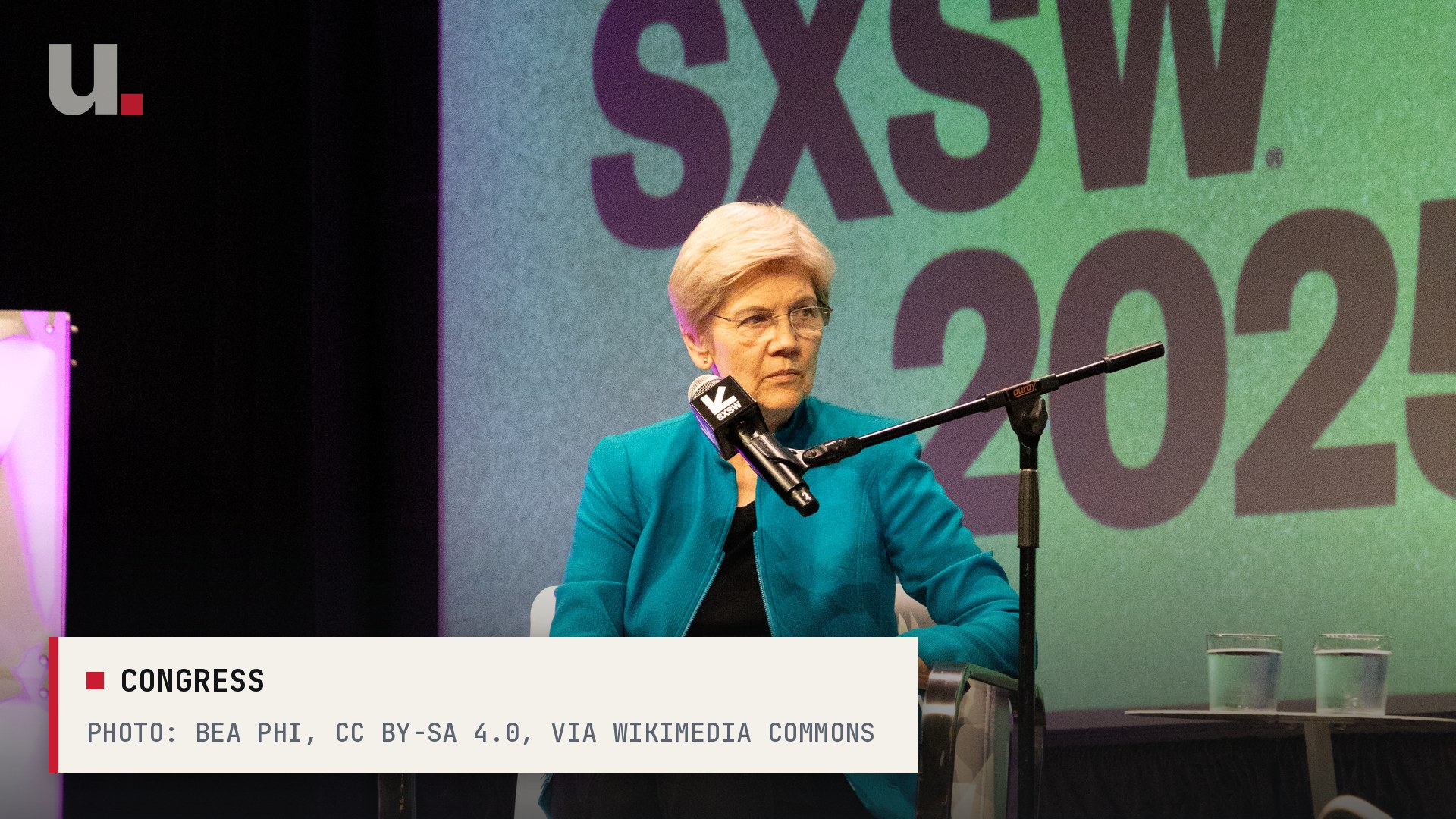
Elizabeth Warren hasn’t been handed the Senate Banking Committee gavel yet. She already has homework from the Justice Department.
On Sunday, Aaron Reitz, the U.S. attorney for the Southern District of Texas, sent the Massachusetts Democrat a two-page “preservation demand.” It orders her to keep every document, email, text and file tied to what he calls her “intent to weaponize congressional investigations” against private Americans whose offense is being close to President Trump. Then he posted the whole thing on 𝕏, and Trump reposted it on Truth Social a few hours later.
U.S. Attorney Aaron Reitz on 𝕏, Nov. 15, 2026: “Congressional investigations can’t be used to punish Americans for exercising their 1A rights. My first arrow shot.”
— @USAttyReitz View on 𝕏
The arrow imagery isn’t an accident. The letter is full of tomahawks, scalps, warpaths and war cries, a dig at a senator who spent years claiming Native American ancestry. But underneath the jokes sits a serious legal argument, and Warren has until 6 p.m. on Nov. 23 to answer it in writing.
Warren’s own words, read back to her
Reitz built his case almost entirely out of things Warren said in public.
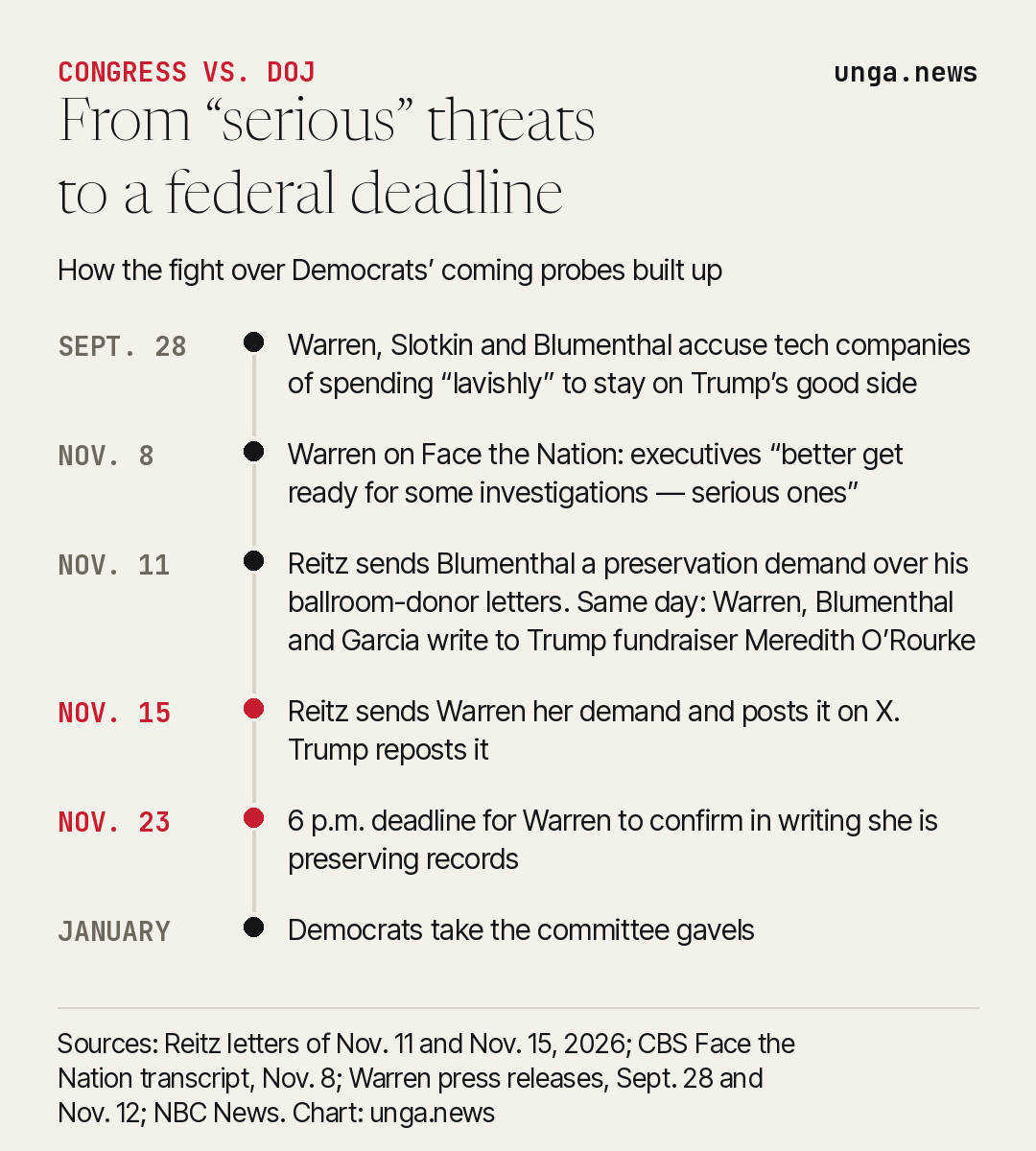
He starts with her Nov. 8 interview on CBS’s Face the Nation, one week after the midterms. Host Margaret Brennan noted that Warren, the “expected incoming Senate Banking Committee chair,” wants “big tech CEOs, Wall Street executives, and giant corporations who may have broken the law to face consequences.” Warren agreed and added that those people “better get ready for some investigations—serious ones.” In the same interview she attacked a White House that, in her telling, said “if you make a nice contribution to Donald Trump’s ballroom then there won’t be any enforcement of the law.”
“The context sends a strong smoke signal,” Reitz wrote. “You intend to target private individuals close to President Trump.”
He then quotes her Time magazine op-ed, where she wrote that Trump “has attempted to reengineer the federal government into a corruption machine designed to rake in profits for himself, his family, and his cronies.” And he points to two letters she signed. On Sept. 28, with Sens. Richard Blumenthal and Elissa Slotkin, she accused technology companies of having “spent lavishly to stay on the good side of President Trump.” On Nov. 11, with Blumenthal and Rep. Robert Garcia, she wrote to Meredith O’Rourke, a top Trump fundraiser and National Park Foundation board member, demanding information about the money behind the White House ballroom and other projects.
That last one is the key to Reitz’s whole theory. O’Rourke isn’t a cabinet secretary or an agency. She is a private citizen. So are the donors. The letter argues that hauling people in front of a committee because of who they support is not oversight at all.
Warren’s agenda for the committee is no secret. A Warren aide told CNBC last week that tech CEOs, administration officials, Trump family crypto businesses and Wall Street executives should all prepare to answer the committee’s questions and preserve their documents. Reitz simply turned the same request around on her.
Where Congress’s power runs out
The meat of the letter is one paragraph on page two.
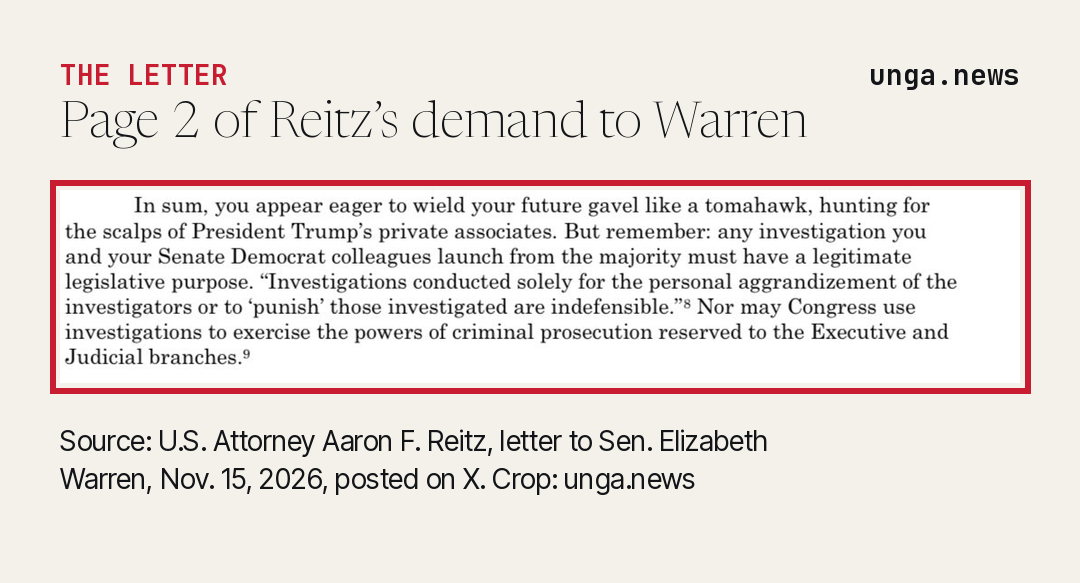
The quote about “personal aggrandizement” comes from Watkins v. United States, the 1957 Supreme Court case that reined in the House Un-American Activities Committee. Reitz also cites Trump v. Mazars, the 2020 ruling that put limits on congressional subpoenas for a president’s personal records, and NAACP v. Alabama, the 1958 case that protected a civil rights group’s members from having their names forced into the open by the state. Congress can investigate to write laws, the argument goes. It can’t run a prosecution, and it can’t punish Americans for whom they associate with.
“The American people are entitled to freely associate without their elected officials terrorizing them with aggressive, harassing government action,” Reitz wrote. “Your war cries directed at private American citizens and entities for associating with President Trump may run afoul of this constitutional right.”
The subject line cites two federal civil rights laws, 18 U.S.C. 241 and 242, which cover conspiracy against rights and depriving people of their rights under color of law. The demand covers Warren, her staff, employees, agents, consultants, campaign personnel and anyone working with her. Failing to preserve records, Reitz warned, “may result in sanctions, adverse-inference instructions, or other penalties, and may carry significant legal consequences.”
To be precise about what this is: a preservation demand is not a subpoena, and it is not a charge. It is a formal notice to hold on to evidence. Notices like it can come before an investigation, and that is exactly why nobody on the receiving end treats them lightly.
Third senator, same message
Warren isn’t the first. Reitz sent Blumenthal a similar demand on Nov. 11 over his letters to donors to the roughly $400 million ballroom project, writing, “I’m taking the first step to stop this abuse of power.” Slotkin got one too. The same day as the Blumenthal letter, the White House warned congressional Democrats that some of their planned probes could cross the line into crimes.
The department has his back. Acting Deputy Attorney General Trent McCotter, the No. 2 official at Justice, answered Reitz’s Blumenthal post by writing that “the First Amendment expressly prohibits Congress from infringing the speech and association rights of Americans,” and that “DOJ will defend against threats to those rights, period.” A department spokesperson told NBC News it “routinely requests that records be preserved when public officials take such extreme actions.”
Blumenthal answered with a preservation letter of his own and a vow that he “will not be intimidated.” Warren’s office didn’t respond to requests for comment Sunday night.
Reitz knows this terrain. He was chief of staff to Sen. Ted Cruz and ran the Justice Department’s Office of Legal Policy before becoming U.S. attorney in Houston in July. He has now put three Senate Democrats on notice before any of them holds a new gavel.
Come January, Warren and Blumenthal will have subpoena power and the majority to back it. What they won’t have anymore is the luxury of promising to make Trump’s friends pay without anyone writing it down. Every vow on Sunday television is now part of a file, and a federal prosecutor has asked them to keep their copy.
Sources
- U.S. Attorney Aaron Reitz on 𝕏 — “My first arrow shot” (Nov. 15, 2026), with the full letter to Sen. Warren
- CBS News — Full transcript of “Face the Nation with Margaret Brennan” (Nov. 8, 2026)
- Sen. Elizabeth Warren — Warren, Garcia, Blumenthal Probe Top Trump Fundraiser Meredith O’Rourke Regarding the President’s Vanity Projects (Nov. 12, 2026)
- Sen. Elizabeth Warren — Warren, Lawmakers Open Investigation into Republicans’ Massive Trump Tax Subsidies for Big Tech’s AI Spending (Sept. 28, 2026)
- NBC News — U.S. attorney warns Sen. Elizabeth Warren against investigating Trump associates (Nov. 16, 2026)
- NBC News — U.S. attorney demands Sen. Richard Blumenthal preserve documents from his inquiry into White House ballroom (Nov. 11, 2026)
- Fox News — US attorney and Senate Dem spar in dueling letters demanding records preservation (Nov. 12, 2026)
- CNBC — Elizabeth Warren set to take over the Senate banking committee. Here’s what she plans to do (Nov. 9, 2026)