

A Foreign Court Eyed U.S. Troops in Afghanistan for 20 Years. Its Judges Just Closed the Case.
International Criminal Court judges shut the original Afghanistan investigation, the one that claimed power over American soldiers and CIA officers. Not one warrant was ever sought for an American. Only the Taliban case survives.
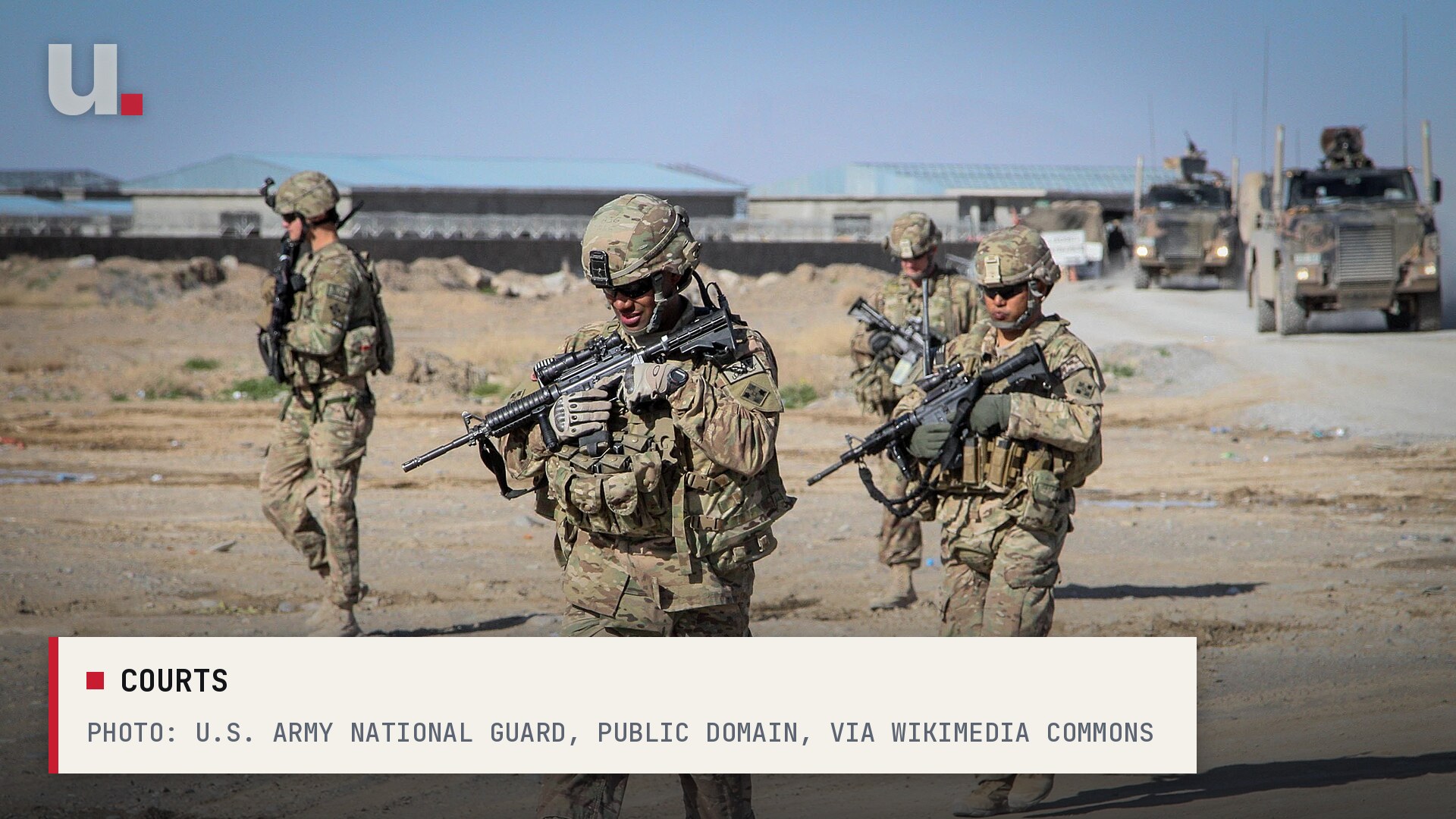
For twenty years, a court in the Netherlands kept an open file that claimed the power to judge American soldiers and CIA officers for what they did in Afghanistan. On Thursday, the court’s own judges closed it.
A three-judge panel of the International Criminal Court ordered the court’s registrar to shut the record of its original Afghanistan investigation, the case that once named U.S. troops and U.S. intelligence officers among its possible targets. The nine-page decision was dated Nov. 12 and made public Friday. What survives is a separate, newer case aimed only at the Taliban.
The judges didn’t write a word praising the American soldiers who served there. They didn’t have to. Their reasoning boils down to this: after all these years, the prosecutors had nothing left to show.
Ten years of looking, six years of investigating
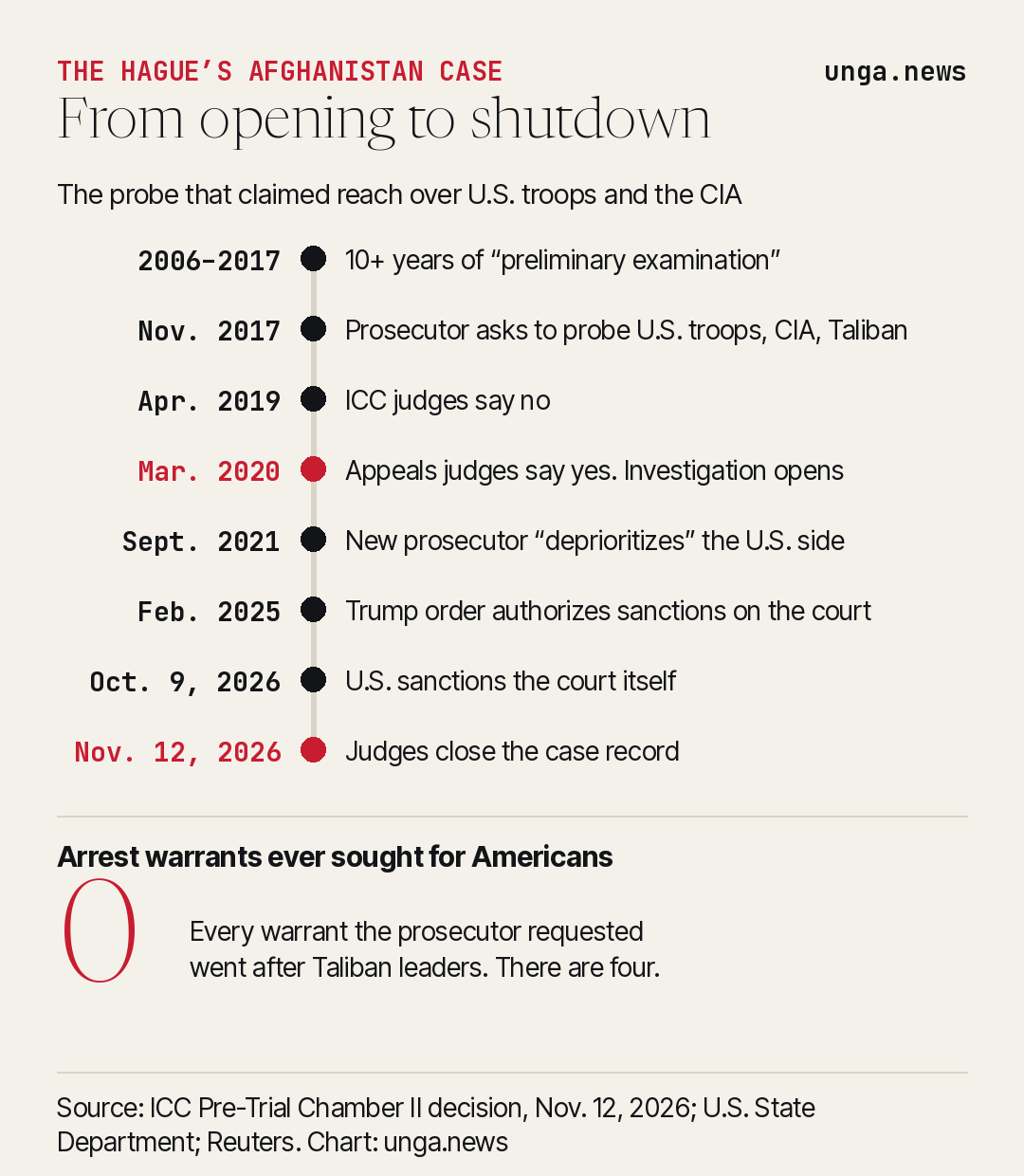
The case has a long paper trail. The court’s prosecutors spent more than a decade on what they called a “preliminary examination” of Afghanistan. In November 2017, then-prosecutor Fatou Bensouda asked for permission to open a full investigation. Her request covered the Taliban and Afghan government forces, and it also covered U.S. troops in Afghanistan and CIA personnel at secret detention sites in Afghanistan and other countries.
In April 2019, a panel of the court’s judges said no. In March 2020, the court’s appeals judges overruled them and opened the investigation anyway. The scope they approved was sweeping: alleged crimes on Afghan soil since May 1, 2003, the date the treaty took effect for Afghanistan, plus linked crimes committed in other member countries going back to July 2002.
The United States never signed on to any of it. America is not a member of the court and has never accepted its authority over Americans. The court’s theory was that because Afghanistan had joined, anyone who fought there could be hauled in, including the soldiers sent there after 9/11.
That theory ran into reality fast. In September 2021, the court’s next prosecutor, Karim Khan, announced he would “deprioritise” the parts of the investigation dealing with American forces, citing the difficulty of gathering evidence. The U.S. side sat dormant from then on. Khan himself was pushed out of the court earlier this year over sexual misconduct allegations, according to the Associated Press and Reuters.
The judges’ own words
The closing order is blunt about why. The panel, led by presiding Judge Rosario Salvatore Aitala, wrote that the investigation “started more than six years ago after more than 10 years of preliminary examination,” and that in all that time prosecutors had filed only “a limited number” of requests for arrest warrants.
Every one of those requests went after the Taliban. Four Taliban figures now face warrants, including the group’s supreme leader, Haibatullah Akhundzada, and its chief justice, Abdul Hakim Haqqani, for persecuting women, girls and political opponents after the 2021 takeover. Not one warrant was ever sought for an American.
The judges pointed to “significant limitations to the Prosecution’s ability to conduct its investigations and secure evidence,” and said those limits were “further compounded by the time elapsed” since the alleged crimes. When the panel asked the prosecutors what they were still working on, the answer listed three lines of inquiry: Taliban crimes against women and girls, Taliban persecution of other Afghans, and crimes by the Islamic State’s Afghan branch since 2016. American personnel were not on the list.
The two Taliban lines already belong to the new case, called Afghanistan II, which the court opened on Oct. 20 after six member countries, among them France, Spain and Mexico, asked it to look at the Taliban’s treatment of women. As for the Islamic State branch, the judges noted prosecutors had not sought charges against a single suspect. Their conclusion: “the Prosecution has not shown to be able to effectively carry out any further investigative or prosecutorial activities in the Situation in Afghanistan.” Record closed.
Washington stopped asking nicely
The order lands one month after the Trump administration did something no American government had done before. On Oct. 9, the State Department sanctioned the court itself, not just its people. Thirteen current and former judges and prosecutors were already under U.S. sanctions under an executive order President Trump signed in February 2025. The new designation blocks the court’s property under U.S. jurisdiction and bars Americans from doing business with it, with a 180-day window for some services while member countries work out a fix.
Secretary of State Marco Rubio’s statement that day left no room for confusion. “President Trump will never allow the International Criminal Court to prosecute Americans,” he said. “Servicemembers defending their country, Border Patrol agents protecting our nation, and elected leaders ensuring our national security” were, in his words, exactly who the court’s backers wanted to reach. “Either the ICC will end its threats, or we will end the ICC.”
The judges’ order never mentions the sanctions, and nobody should pretend it proves cause and effect. But the timing speaks for itself. For years the court’s defenders insisted the Afghanistan file was a serious, living investigation. A month after Washington put real pressure on the institution, the court’s own judges looked at that file and found nothing worth keeping open.
Not the end of the fight
Two honest caveats. First, the prosecutor’s office told Reuters it has already appealed the closure, so the court’s appeals judges get the last word. Second, the court’s rules say a closed record can be reopened if prosecutors later decide to resume. The court’s founding treaty also still claims power over anyone accused of atrocity crimes on a member country’s soil, which is why, as Reuters put it, it is unclear whether this step will settle American fears.
That is the real issue, and closing one file doesn’t fix it. A court that America never joined still says it can reach Americans. Rubio’s Oct. 9 statement put the burden on the court’s member countries, many of which rely on American troops for their own defense, to rein it in.
Still, the people who served in Afghanistan deserve to hear this plainly. More than 2,400 American service members died in that war, and hundreds of thousands more rotated through it. For years a foreign court held a case over their heads that their own country never agreed to. As of this week, the judges running that court have closed it, and the only people still facing its warrants are the Taliban.
Sources
- International Criminal Court — Public redacted version of ‘Decision closing the situation in the Islamic Republic of Afghanistan’, Pre-Trial Chamber II (Nov. 12, 2026)
- U.S. Department of State — Imposing Sanctions on the International Criminal Court, Secretary Marco Rubio (Oct. 9, 2026)
- Reuters via Military Times — Judges close part of ICC Afghanistan investigations that could look at US troops (Nov. 13, 2026)
- Associated Press — International Criminal Court limits Afghanistan investigation to Taliban crimes (Nov. 13, 2026)
- CBS News — U.S. sanctions International Criminal Court, vowing to dismantle it “brick by brick” without changes (Oct. 9, 2026)