

A Free Open-Source App Will Cancel Your Subscriptions and Chase Your Invoices, but Asks First
n8n’s new Nod runs its own browser on your computer, works on real websites, and checks with you before it pays, sends or deletes anything.
Everybody has the list. Cancel the streaming trial you forgot about. Download the invoice from the supplier site that still looks like 2009. Chase the client who hasn’t paid. None of it is hard, and all of it eats an afternoon. On Wednesday the company behind the popular automation tool n8n put out a free program that says it will just do those jobs for you, on real websites, from your own computer. It’s called Nod, and the pitch is right there in n8n’s own launch post: “Ask it to prep your calls, collect invoices or cancel a subscription.”
A helper with its own computer
Most chat assistants stop at advice. You ask how to cancel a gym membership and you get five numbered steps you still have to do yourself. Nod is built to skip that part. According to the n8n announcement, written by Ophir Prusak and dated Nov. 10, Nod is “a personal agent with its own computer and browser: you tell it what you need, and it works in your apps and on websites until the job is finished.”
In practice, the “own computer” is a private virtual machine that runs inside your Mac or Windows PC, with a browser Nod drives itself. It can work in the apps you hook up, like Gmail, Calendar, Drive and Slack, and on sites that have no hookup at all, which is most of the internet a regular person deals with.
The company’s own examples are refreshingly unglamorous. Cancel a subscription, turn down the retention offers and ask for a refund. Watch a price and ping you when it drops. Find a hotel and book it once you say go. Sign in to supplier portals every month, grab the invoices and file them for your accountant. Pull numbers off a dashboard that won’t export them and drop them in a weekly report.
n8n’s launch post for Nod, with its 86-second demo of the agent working in its own browser.
— @n8n_io View on 𝕏
It asks before it spends your money
The scary part of handing chores to software is obvious. You don’t want it paying the same bill twice, emailing the wrong person or deleting something you needed. n8n clearly thought about this, because most of its launch copy is about guardrails.
The rule, in the company’s words: “Before Nod sends, pays, posts or deletes anything you didn’t ask for, a separate check confirms you asked for it. A web page or an email can’t give Nod orders.” That second sentence matters more than it sounds. One of the known tricks against these agents is hiding instructions in a web page or an email, hoping the bot reads them and obeys. Nod is designed to treat that text as content, not commands.
Passwords get the same care. Saved logins and cards are encrypted on your machine, and the company says Nod types them in through private forms the model itself can’t read. So the SI deciding what to click never actually sees your card number.
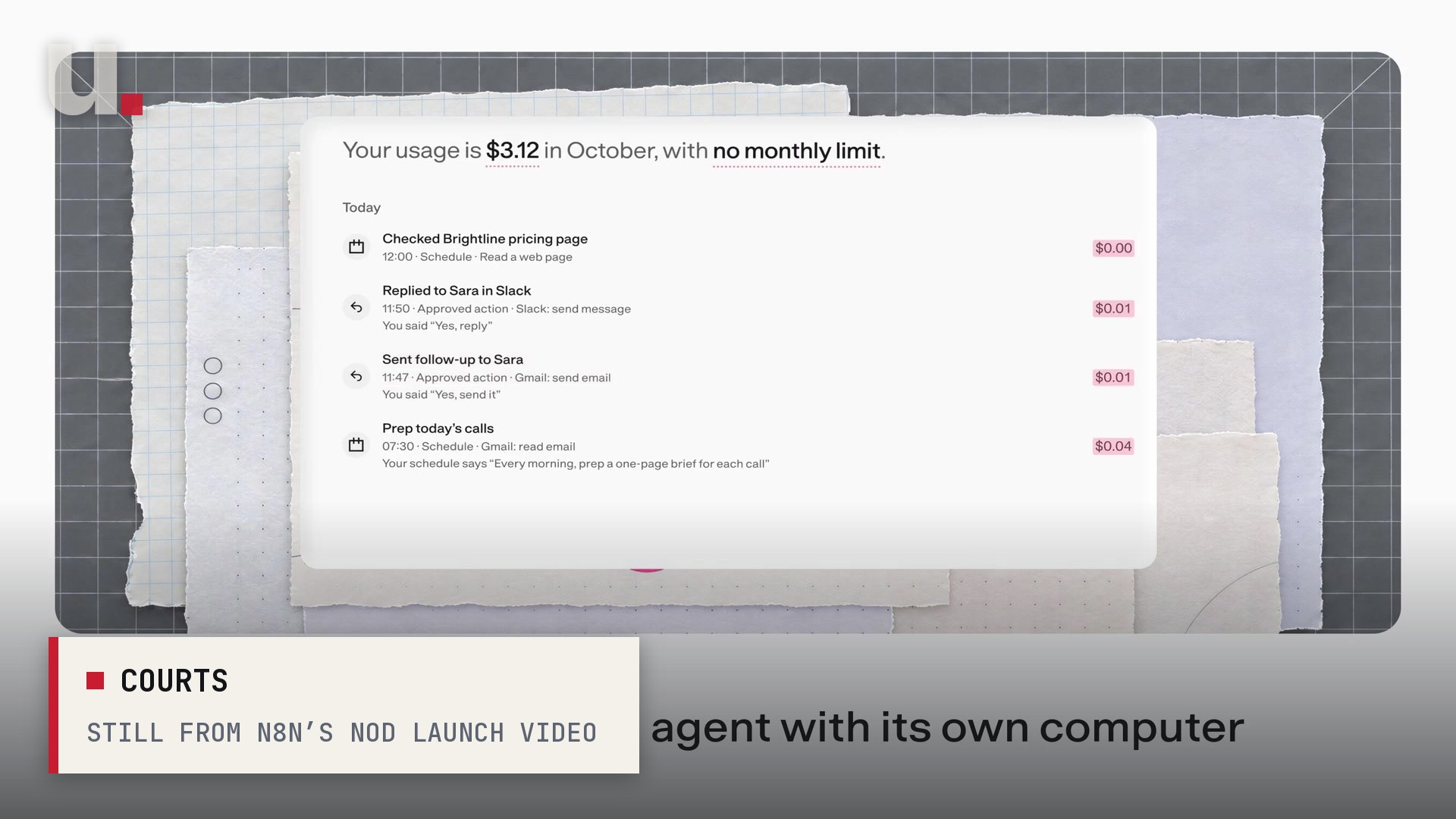
And everything gets written down. Nod logs every sign-in, every card use and every action it takes in your apps, along with what each task cost. In the demo video, one screen shows a month of chores, a few replies and some call prep, totaling $3.12.
The catch is in the fine print, and they printed it
Here’s where I give n8n credit. A lot of companies bury the limits. This one puts them on the front page. Nod is a “research preview,” and its own docs say to “expect rough edges and breaking changes.”
The docs also admit the safety check isn’t magic. That check is itself an SI model’s judgement, so it can be wrong. The company tested it on 240 decisions and reports that its two top-end picks got every one right, while a cheaper, smaller model let 8 unsafe actions through. That’s the company’s test, not an outside audit, but the takeaway for a regular user is plain enough: if you hand this thing your card, don’t pick the budget brain.
A few other practical limits are worth knowing before you download:
It doesn’t come with its own SI. You bring a provider, like OpenAI, Anthropic, Google or a couple dozen others, and that provider bills you. You can also point it at a free open-source model running on your own machine. The app itself is free.
It only works while your computer is awake. If Nod is running on your laptop and the lid is closed, your Friday recap doesn’t go out. People who want it running around the clock can put it on their own server instead.
Your data doesn’t stay 100% home. Files, memory and saved logins live on your machine, but whatever a task needs still goes to the model provider you chose.
It can cost more than you think. n8n says some early testers found tasks pricier than expected, and that its recent updates brought costs down “substantially.” The newest release, version 0.6.2 posted Nov. 11, lists cheaper background checks and a separate line for background spending. With a paid API model, Nod shows each task’s cost and stops at a monthly limit you set.
Why a workflow company built a one-person app
n8n made its name with workflow automation for teams, the kind of thing a business sets up once and shares across a group. Nod is the opposite. The company calls it “a single player” tool: one person, their accounts, their chores, whether that’s a small business or a household.
It’s also deliberately separate. You don’t need an n8n account, and the company says Nod “doesn’t change the direction of n8n.” It came out of n8n Labs, a new internal team for experiments outside the main product. The code is public on GitHub under the Apache 2.0 license, which means anyone can read exactly what rules it follows, change them or run their own copy. When I checked, the project had about 450 stars.
Should a regular person try it?
If you’re comfortable installing apps and you’ve got one boring, repeat job, probably yes, with sensible caution. Start small. Have it download a monthly statement or watch a price before you let it cancel anything or touch a card. Read its log after the first few runs. Set a spending cap.
But the direction is clear. The useful SI of the next year probably won’t be the one that writes the best poem. It’ll be the one that sits through the cancellation maze, says no to the 50-percent-off offer, and gets your money back while you eat dinner.