

A Group Born in August Poured $20 Million Into Democratic Races. Voters Don’t Know Who Paid.
A watchdog’s FEC complaint alleges United Futures Inc. was a straw donor that hid the real givers behind super PACs in Kansas, Alaska and Mississippi. The group says the claims are false.
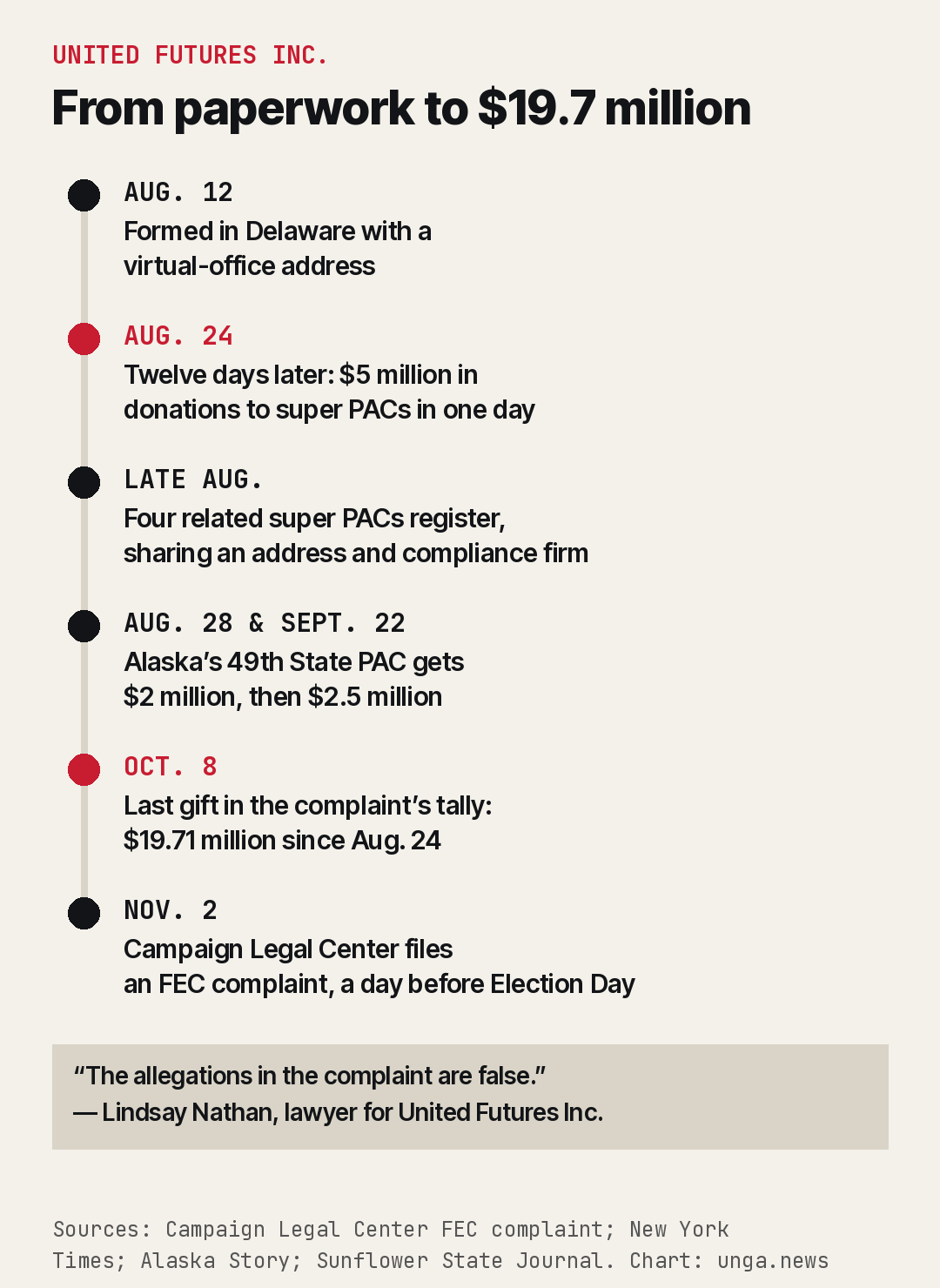
On Aug. 12, somebody filed paperwork in Delaware for a company called United Futures Inc. It had no website. Its address on the forms was a virtual office. Twelve days later it started writing checks, and on that first day alone it gave away $5 million.
By the time voters went to the polls, the brand-new outfit had become one of the biggest political givers of the 2026 election. A Washington Post analysis puts its spending at nearly $20 million in about two months, all of it aimed at helping Democrats in Kansas, Alaska and Mississippi. The New York Times counted at least $26 million, including money behind independent Dan Osborn in Nebraska.
Here is the part that should bother anyone who cares about clean elections, no matter which party they vote for. Voters in those states could see the name United Futures on campaign finance reports. They could not see who actually put up the money. They still can’t.
A watchdog calls it a shell
On Nov. 2 the Campaign Legal Center, a nonpartisan campaign finance watchdog, filed a complaint with the Federal Election Commission. It alleges that United Futures was a “straw donor,” a middleman set up so the real givers could pour money into super PACs without their names ever appearing.
That matters because of how the law works. Super PACs can raise unlimited sums, but they have to tell the public who gave. A nonprofit corporation generally does not have to name its donors. Route the cash through the nonprofit first, and the super PAC’s report shows only the nonprofit’s name. Federal law bans giving money in someone else’s name, and the complaint argues that is exactly what happened here.
“By illegally concealing who supplied this funding, the people behind this straw donor scheme denied voters the transparency they needed to make informed choices in the 2026 election,” the group said in its filing summary.
The complaint documents $19.71 million in contributions from United Futures between Aug. 24 and Oct. 8. It names four super PACs it says knowingly took part: United Futures PAC, Mississippi Forward PAC, Vote Kansas and 49th State PAC in Alaska. According to the complaint, all four were set up in Delaware within the same 10-day stretch, shortly after United Futures itself. They share a mailing address, a compliance firm and a registered agent. And “most tellingly,” the complaint says, they got all or nearly all of their money from United Futures.
The watchdog called it “utterly implausible” that those super PACs did not know who was really behind their money.
Follow the checks to Kansas
The Kansas trail shows how this played out on the ground. Federal records show Vote Kansas got a single $3.2 million contribution from United Futures on Aug. 31, listed at a Chicago address, and that was all the money it reported raising. The Sunflower State Journal traced that address to an unassuming brownstone on the city’s north side.
With that money, Vote Kansas paid a Missouri firm $359,500 for canvassing, paid the Kansas Democratic Party about $20,000 for a software subscription and hired roughly 15 staffers, the Sunflower State Journal reported. Some of those workers also showed up on the payroll of Adam Hamilton’s Senate campaign, and volunteers at Hamilton events wore “Vote Kansas” stickers. The complaint raises the question of whether some of that spending was coordinated with a candidate, which would be a separate problem under federal law.
Hamilton won, becoming the first Democrat Kansas has sent to the Senate since 1932. Nobody has accused him of wrongdoing. But his own campaign website once warned that dark money “is drowning out the voices of normal voters.”
Separately, United Futures PAC sent $6.25 million to another committee, People Over Politics Action Fund, which spent about $14.7 million supporting Hamilton, according to the Sunflower State Journal.
In Alaska, 49th State PAC took $2 million from United Futures on Aug. 28 and another $2.5 million on Sept. 22. That was about 90% of everything it reported raising, according to the Alaska Story. The PAC was backing Mary Peltola’s Senate bid.
Who is behind it?
The one name on the paperwork is Alana Mounce, the incorporator. She is a veteran Democratic operative who held senior political roles, including work on Kamala Harris’s 2024 presidential campaign. She did not respond to the Times. Who supplied the millions remains unknown.
United Futures denies it all. “The allegations in the complaint are false and we look forward to addressing them through the FEC’s process,” its lawyer, Lindsay Nathan, told the Times.
There is already one correction in the record. The complaint accused United Futures PAC of failing to report more than $7.5 million it sent to other committees. The Times reported that roughly $7.6 million of that actually came from the nonprofit, not the PAC, and that the filings are being amended. So part of the paper trail was wrong on the group’s own reports, which is not exactly a vote of confidence in its bookkeeping.
The watchdog says the bigger issue is the playbook, not one group. “It’s less about this specific group. It’s more about the tactic,” spokesperson Brendan Quinn said. “The sheer amount and its tactics combined make it particularly galling.”
Don’t expect a fast answer
An FEC complaint is an accusation, not a verdict. The commission has to review it, the accused get to respond, and nothing is proven until the agency or a court says so.
The bigger hurdle is the FEC itself. The six-member commission needs four votes to act, and right now only two seats are filled. Until more commissioners are confirmed, it cannot open an investigation or punish anyone. Complaints like this one simply sit and wait.
That leaves voters in the dark at the exact moment it counts. The races are over. The ads ran, the doors got knocked, and the votes were cast. Whoever wrote the checks behind United Futures got what they paid for without anyone knowing their names.
Dark money is not a one-party habit, and both sides have leaned on nonprofits that never name their donors. The Times found that six of the 20 biggest donors of the 2026 cycle were dark-money groups, according to the Election Law Blog’s summary. But the speed here stands out. A company with no website and a rented address went from Delaware paperwork to one of the top political donors in the country in under two months.
If the real donors wanted their names out there, they had every chance to give to those super PACs directly. They didn’t. Regulators should find out why.
Sources
- Campaign Legal Center — CLC Alleges Straw Donor Scheme Illegally Funneled $19.7 Million to Super PAC Network
- The Washington Post — Democratic group illegally hid its donors, watchdog alleges in FEC complaint
- Sunflower State Journal — FEC complaint filed against dark money group that helped bankroll campaign for Hamilton
- Alaska Story — Millions from opaque Delaware corporation flowed to pro-Peltola PAC, federal complaint alleges
- Federal Election Commission — Vote Kansas, Schedule A receipts
- Election Law Blog — A New Democratic-Tied Dark-Money Group Draws Scrutiny Over Midterm Spending (NYT excerpt)