

A Hidden Bug in a Popular Bitcoin Vault Let Thieves Guess Keys and Take $100 Million
For five years, a COLDCARD hardware wallet quietly made secret keys that were far easier to crack than promised. Its maker just laid out the whole failure, and says owners of affected wallets need to move their money now.
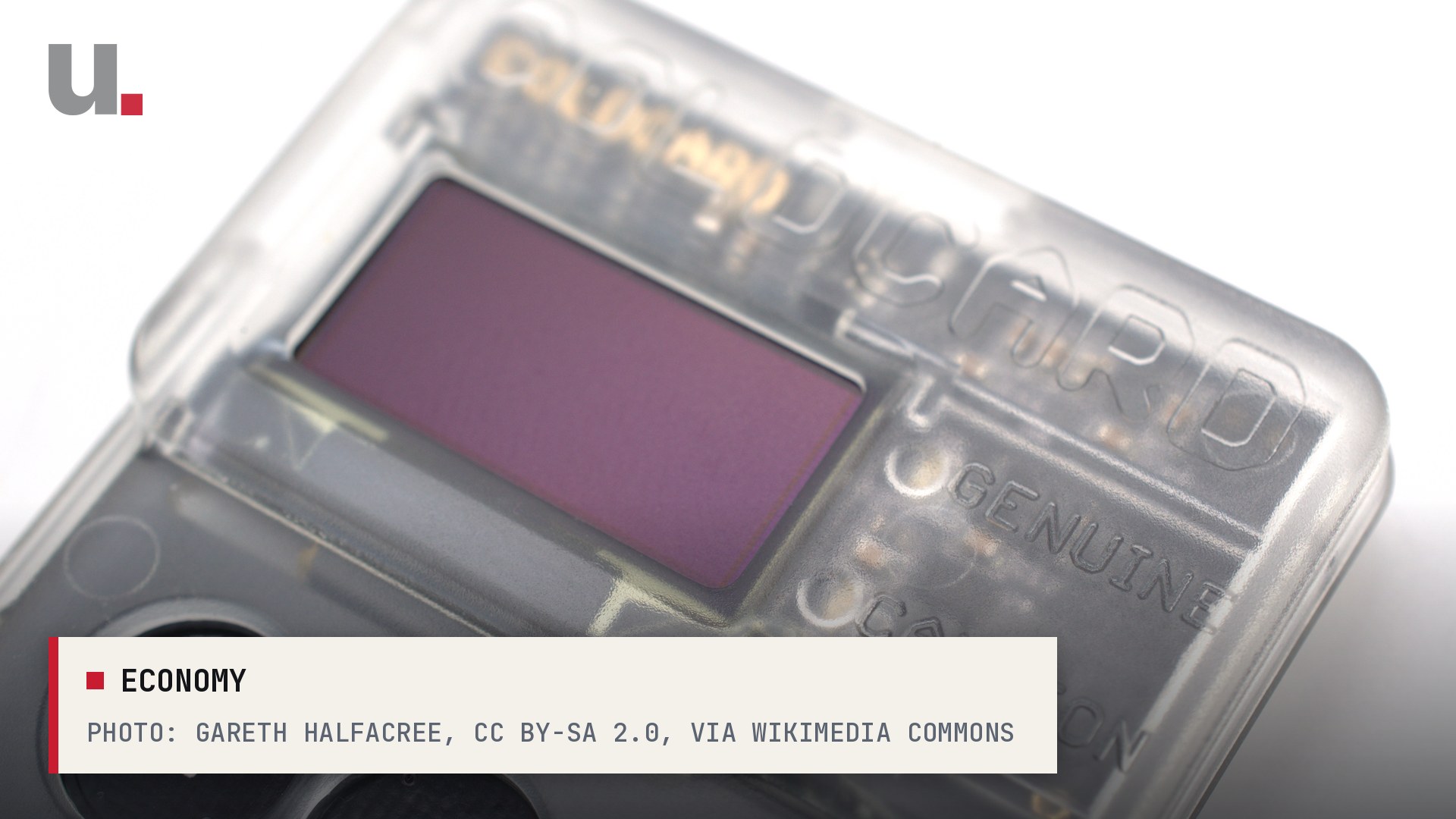
For five years, thousands of bitcoin owners did everything the experts told them to do. They took their coins off the exchanges, bought a COLDCARD, one of the most respected “cold storage” wallets in the business, and wrote their secret recovery words on paper. The whole point of a device like that is simple: your money stays yours, and nobody can touch it without the key.
It turns out the key was a lot easier to guess than anyone knew. This week, the Canadian company that makes the device, Coinkite, published an 18-page postmortem admitting that from March 29, 2021, to July 30, 2026, its firmware created wallet keys with a cheap software number generator instead of the true hardware randomness built into the chip. Thieves figured that out, rebuilt people’s private keys on their own computers and emptied the wallets.
Galaxy Research, which tracked the thefts on the blockchain and talked directly with 190 victims, confirmed 1,778.84 bitcoin stolen from more than 8,600 addresses. At bitcoin’s price this week, that’s well over $100 million.
One setting, five years, nobody noticed
The failure wasn’t a hack in the movie sense. Nobody broke into a device, and nobody needed to hold one. According to Coinkite’s report, a single configuration setting in its firmware, combined with a guard in a helper library that didn’t do its job, quietly sent the wallet’s “roll the dice” step to a general-purpose software generator called Yasmarang. The real hardware generator was sitting right there in the code. It just never got called.
Everything looked normal. The device still spat out perfectly valid recovery words. It still signed transactions. The company’s own tests checked that the words were well formed, and they were. As the report puts it, “Every check Coinkite ran answered a nearby question rather than the critical one.”
Here’s why that matters in plain English. A bitcoin key is supposed to have 128 bits of security, which means a thief would need to try about 340 trillion trillion trillion combinations. That number is so big no computer could ever work through it. Coinkite now estimates that keys made on its older Mk2 and Mk3 models had only about 40 bits, around 1.1 trillion guesses. A powerful computer can grind through that. The newer Mk4, Mk5 and Q models landed at about 72 bits, far stronger but still nowhere near the promise on the box.
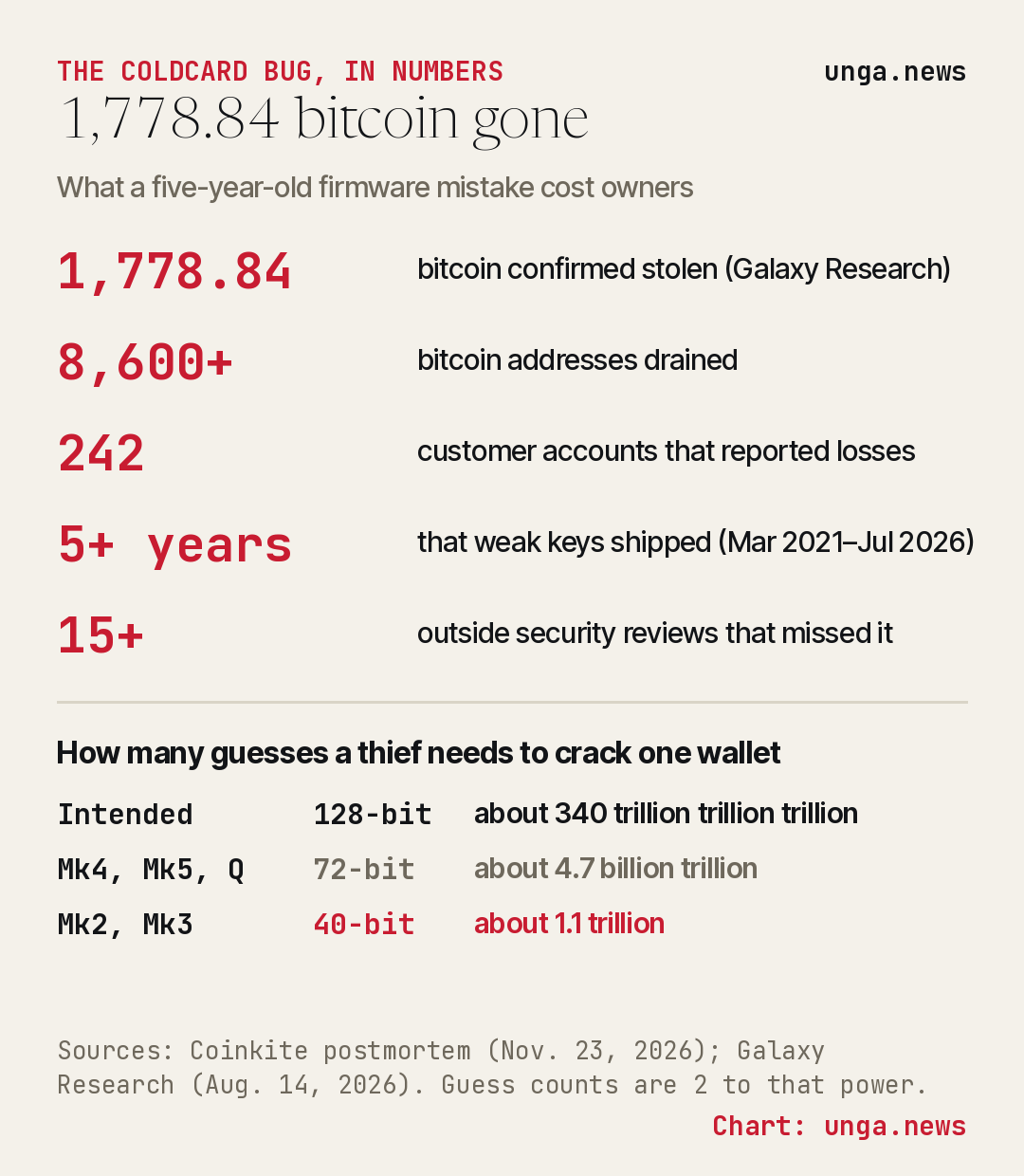
The thefts started July 29. Users noticed the next day, Coinkite found the bug that same day, and fixed firmware went out July 31. But a firmware update can’t save a key that was already made weak. Anyone whose wallet was created on the affected versions has to make a brand-new one and move the money.
Fifteen sets of eyes, and the newest SI tools too
This is the part that should make every tech company nervous. Coinkite says that between 2021 and 2026 it documented at least 15 independent review and security-research efforts on its products, including paid outside audits and specialist hardware testing from rival Ledger’s security lab. None caught it. A June 2026 review that specifically listed weak random numbers in its scope concluded the path was sound.
Even a two-month review using OpenAI’s cybersecurity tools, which produced 85 possible findings and led to several fixes, missed the one bug that mattered. After the flaw went public, some SI models found it quickly and others didn’t, depending on how they were asked and what they could see.
The timeline in the report raises an uncomfortable question without answering it. China’s Kimi K3 model released its full weights on July 27. The first thefts began two days later. Coinkite is careful here: its finding says who discovered and exploited the defect “is unknown,” and that SI-assisted discovery “is a plausible hypothesis, not an attribution.” We don’t know who did this, and neither does anyone else yet. But the race between people using these tools to find holes and people using them to plug holes is already here, and the bad guys only have to win once.
A company that owned it, and a lesson for everyone holding their own coins
Give Coinkite credit for one thing: it didn’t hide behind lawyers. The report is modeled on a federal crash investigation, lays out its own failures in black and white and opens with an apology. “The losses suffered by customers are real and, for some, life-changing. We are sorry,” the company wrote when it released the document.
COLDCARD on 𝕏 — publishing its full postmortem on the seed-generation incident: “The losses suffered by customers are real and, for some, life-changing. We are sorry.”
— @COLDCARDwallet View on 𝕏
What it hasn’t done is decide on any payback. The report lists a compensation or assistance plan as still open with “no decision.” Coinkite has also publicly asked whoever holds the stolen coins to return them through counsel. Law enforcement is investigating, and the Canadian Centre for Cyber Security has its own case open. Blockchain trackers are watching the thieves’ wallets, and most of the stolen coins haven’t moved.
None of this is an argument against owning your own money. Self-custody is still the whole reason bitcoin exists: no bank can freeze it and no bureaucrat can seize it. But freedom comes with responsibility, and this is the hard way to learn the old bitcoin motto: don’t trust, verify.
Coinkite says one group came through untouched. People who made their wallet with at least 50 real, private dice rolls entered by hand were not weakened by the bug. The company now urges anyone holding serious money to stack protections on top of the device: genuine dice rolls, a strong extra passphrase, or a wallet that needs more than one key to spend.
If you own a COLDCARD, check the company’s security status page today. If your wallet was made on an affected version, update the firmware, create a new wallet and move your coins. And never type your recovery words into a website or hand them to anyone, including someone claiming to be from Coinkite offering to help. Scammers love a crisis like this one.
Sources
- Coinkite — COLDCARD Seed-Generation Incident: Postmortem (Nov. 23, 2026)
- Coinkite — Technical deep dive into the entropy issue
- COLDCARD — Current COLDCARD security status
- Galaxy Research — Coldcard Exploit Abates as Total Losses Climb to (at Least) 1,700 BTC (Aug. 14, 2026)
- COLDCARD on 𝕏 — COLDCARD on 𝕏 — publishing the full seed-generation postmortem