

A Humanoid Robot Just Sorted Car Parts on Real Mercedes Lines. Google’s SI Got It Right 96% of the Time.
Apptronik’s Apollo robot, running new Google DeepMind software, prepped parts on active Mercedes-Benz production lines in Hungary and Germany. Google says it learned the job in weeks.
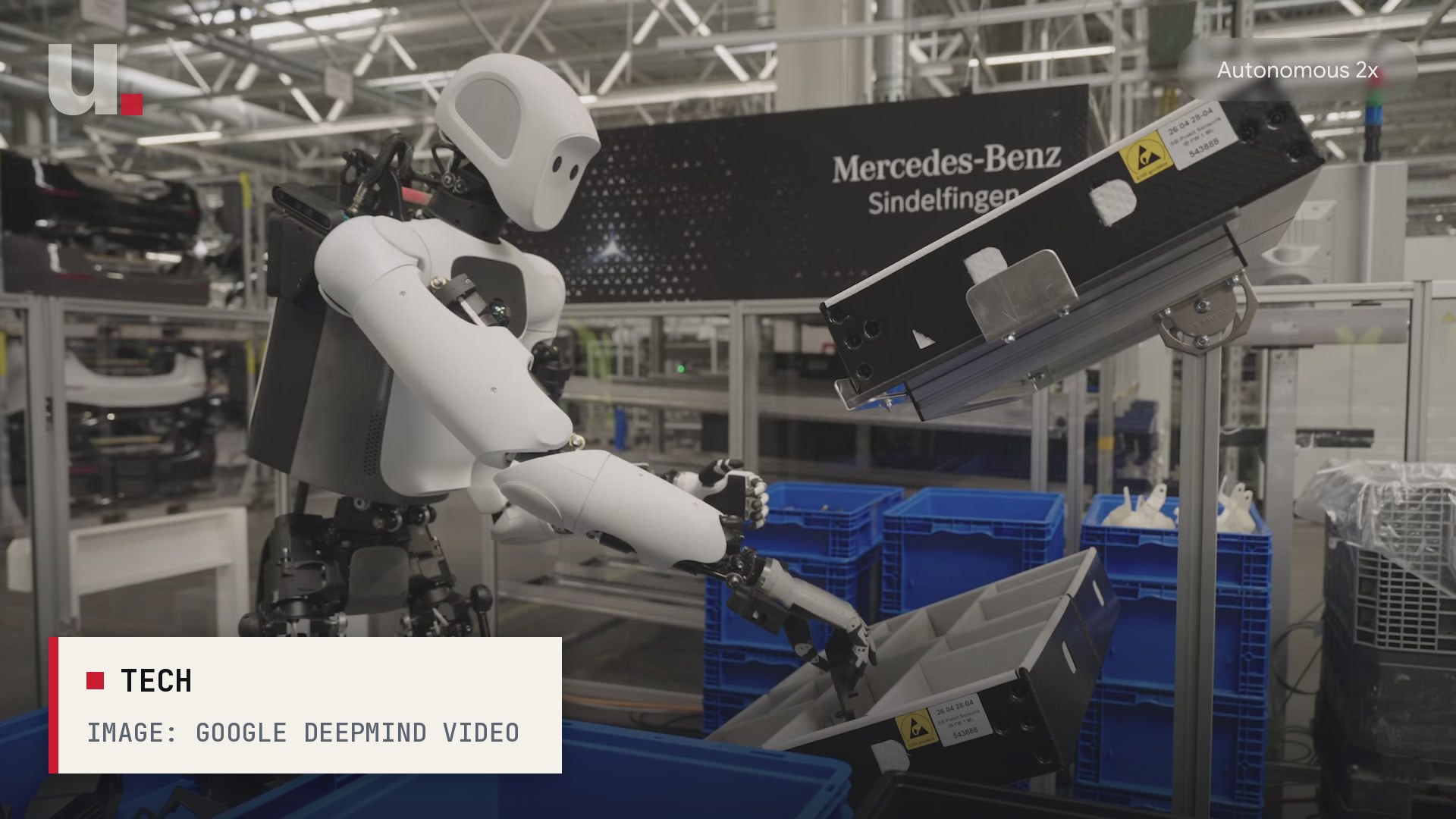
Walk into a car plant and you will see people doing a job most of them would happily hand off. Before a car reaches the next station on the line, somebody has to dig the right brackets out of big bins and set them into trays in the exact order that car needs. It is the same reach, grab and place, hour after hour. On Tuesday, Google showed a humanoid robot doing that job on real Mercedes-Benz lines, and getting it right 96% of the time.
The robot is Apollo 2, built by the Texas company Apptronik. The brain running it is new software from Google DeepMind called Gemini Robotics 2.5, which the company calls its most capable robot model yet. Google says it is now rolling out to its robotics partners, the companies that build the machines.
Inside the Mercedes test
Google, Apptronik and Mercedes-Benz ran the trial on active production lines at two plants, one in Kecskemét, Hungary, and one in Sindelfingen, Germany. This was a working factory floor, not a staged lab demo.
The job is called kitting. Google describes it as “the repetitive, physically taxing task of sorting individual parts from bulk bins into organized trays in the exact order needed for each vehicle on the line.” In the video, Apollo reaches into a blue supply bin, picks up a metal bracket and drops it into a sequencing tray, then does it again. Google says the robot was also “correcting for any gaps,” which means that when a slot in the tray came up empty, it noticed and filled it.
Two pieces of Google software split the work. One keeps track of the whole job, a bit like a foreman who knows which part comes next. The other controls the robot’s hands and arms. Google says the pairing gives Apollo “the ability to think, reason over multiple steps, and take action adapting to changes.”
The result was a 96% success rate. Google is careful to call it a “proof-of-concept,” and it is. Four misses in a hundred is a long way from the near-perfect record a car plant expects before it trusts a machine with real production. But it is a real number from a real line, and that is rarer in this business than it should be.
Apptronik’s co-founder and CEO, Jeff Cardenas, put it plainly. “This is what we built Apollo for: useful work alongside people in real industrial settings,” he said in Google’s announcement. He said the robot’s skills improved “dramatically in just a few weeks” of extra training and carried over “to Mercedes-Benz production with very little drop-off. This is the foundation for bringing humanoid robots to industrial and commercial environments at scale.”
That “few weeks” line may be the most important thing in the whole announcement. The old way of putting a robot in a factory was to program every motion by hand, then do it all over again when the part or the bin changed. A robot that can be taught a new job in weeks, and keep that skill when it moves from a test bench to a live line, is a very different kind of tool.
Tongs, bows and a pipette
The car plant was the headline test, but Google says it put the new software through more than 200 different tasks. The list sounds like a kitchen, a gift shop and a science lab rolled together: serving food with tongs, tying a bow on a gift box and using a pipette to move liquid. Those are hard for robots. Tongs mean using a tool. A ribbon is floppy and never sits the same way twice. A pipette punishes a shaky hand.
Compared with Google’s earlier robot software, the company says the new version succeeds 30% to 100% more often, depending on the type of task, and finishes the job 20% to 30% faster. It also runs on very different machines. Apollo 2 has a five-finger hand with 22 separate points of movement, while the Franka Duo setup Google also tested uses simple two-finger grippers. The same software drives both.
Teaching a robot to say no
A chatbot that gives a bad answer wastes your time. A robot that makes a bad move can hurt somebody. Google spent a good chunk of its announcement on safety, and the numbers it shared are worth knowing.
The company says the new software reasons about hazards while it works and steers around them in real time. In Google’s testing, that raised the rate of tasks finished safely by 33% when obstacles were in the way and by 43% when people were nearby. That second number is the one to watch, because the whole pitch for humanoids is that they work in spaces built for humans, next to humans.
Google also tested what happens when someone tries to trick a robot into doing something dangerous by dressing up the request so it sounds harmless. It is releasing a free, open test for that problem, called ASIMOV-Jailbreak, with hundreds of disguised unsafe requests across dozens of scenes. Google says its newest model resisted those tricks 99.5% of the time, up from 82% for its earlier robot reasoning model. Because the test is open, other companies can run their own robots against it, and outsiders can check Google’s claim.
Who does the boring part
The obvious question for anyone who works on a line is what this means for their job. Google’s answer is that the robot takes the “monotonous prep work” so technicians can “focus on complex build tasks.” That is the company’s framing, and it has a point. Kitting is the kind of task that wears out backs and shoulders and that plants already struggle to staff.
It is also true that once a robot can do one dull job at 96%, the next version will be aimed at 99%, and then at the job next to it. Nobody at Google or Apptronik is claiming that today. But a humanoid that learns in weeks could also make it cheaper to build things here instead of overseas.
For now, Gemini Robotics 2.5 is going to robot makers, not to the public, and Mercedes has not said whether Apollo will move beyond the trial. Google did not say what the software costs or when it will be widely available. What it did show is a robot standing on a German assembly line, reaching into a bin and getting the part right 96 times out of 100.
Sources
- Google DeepMind — Gemini Robotics 2.5 accelerates real-world general dexterity
- Google DeepMind — Gemini Robotics
- Google DeepMind — Gemini Robotics 2 brings whole-body intelligence to robots