

A Jury Just Convicted China’s Huawei of Stealing American Tech Secrets, Seven Years After Trump Charged It
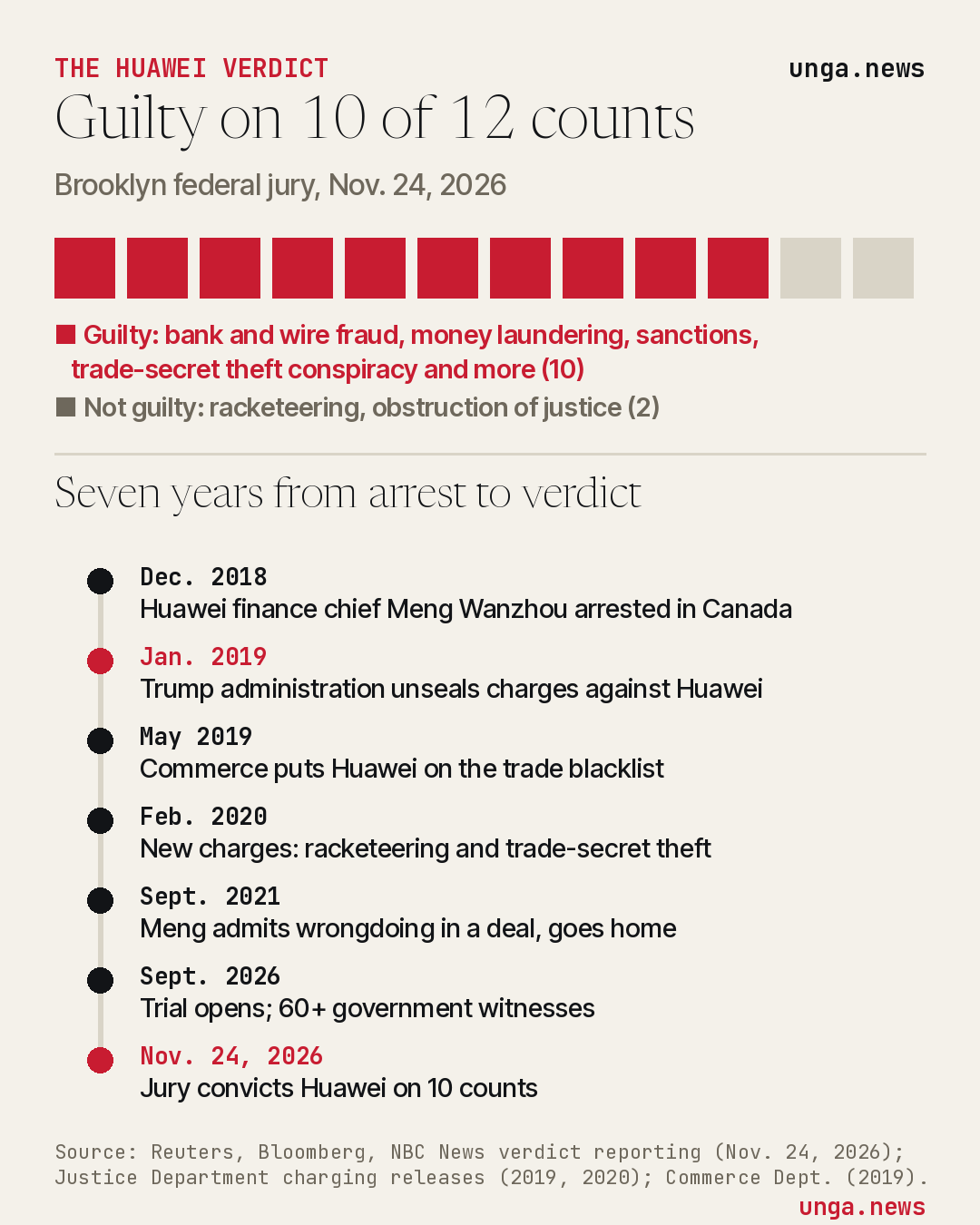
A Brooklyn jury found Huawei guilty on 10 of 12 counts, including bank fraud over its Iran business and a plot to steal trade secrets from U.S. companies. Jurors cleared it of racketeering.
For years, Washington warned that Huawei, China’s biggest tech company, played dirty to get ahead. On Tuesday a jury of ordinary New Yorkers agreed.
A federal jury in Brooklyn found Huawei guilty on 10 of the 12 criminal counts it faced, including bank fraud, wire fraud, money laundering, conspiring to defraud the United States and conspiring to steal trade secrets from American companies. The verdict came after an 11-week trial and about four days of deliberations, Bloomberg reported. It is a rare thing in American courts: a foreign corporation, not just a few of its employees, convicted of federal crimes.
The jury did not give prosecutors everything. Huawei was acquitted of racketeering conspiracy, the charge that treated the company as a criminal enterprise, and of conspiring to obstruct justice. Huawei grabbed onto that. Still, the core of the government’s story held up. A company with more than 200,000 employees in about 170 countries now stands convicted of lying to banks and conspiring to take what wasn’t its own.
A case Trump’s team started
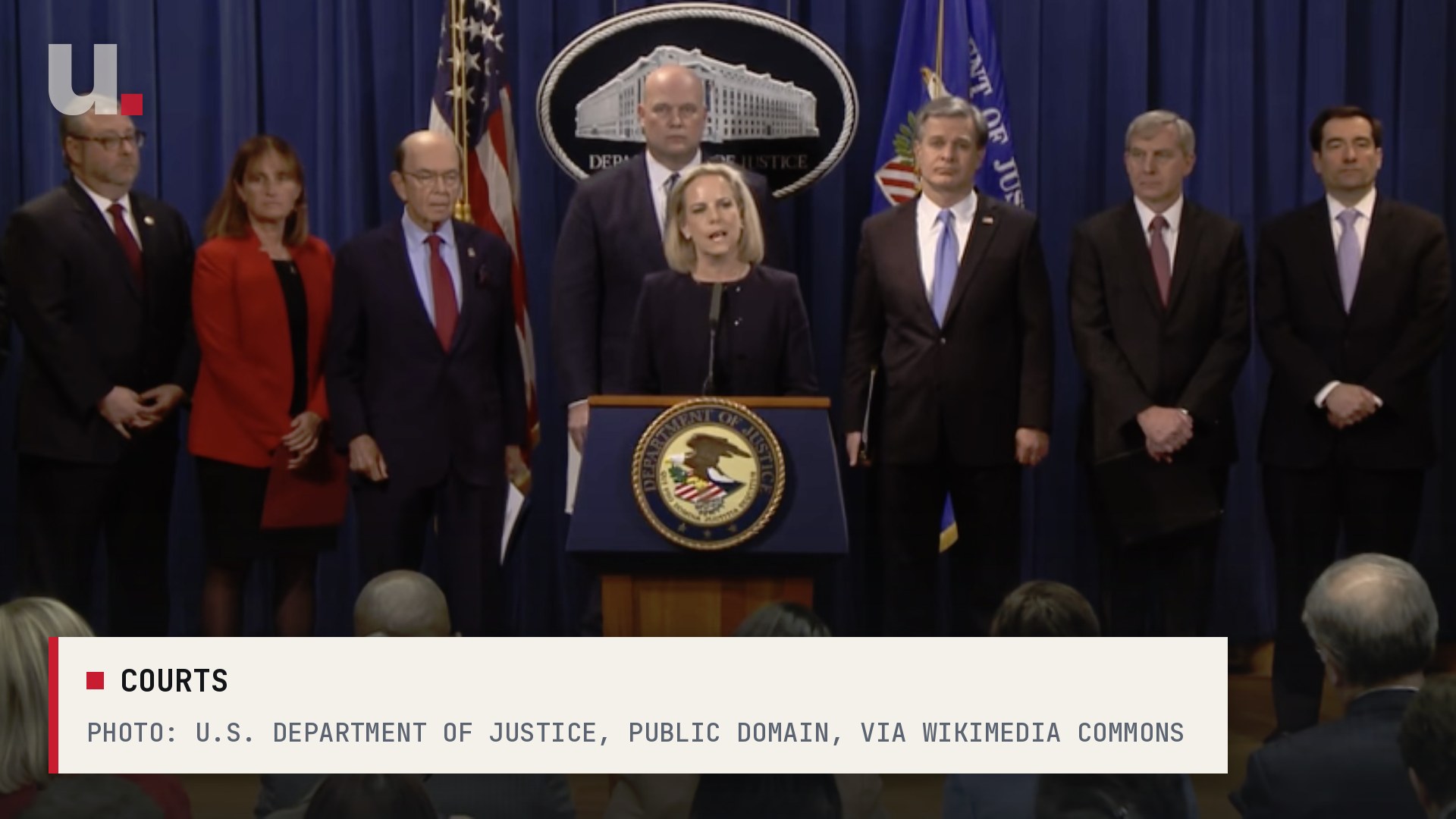
This prosecution goes back to December 2018, when Canadian authorities arrested Meng Wanzhou, Huawei’s finance chief and the daughter of its founder, on an American warrant. A month later, in January 2019, Trump’s acting attorney general Matthew Whitaker, Commerce Secretary Wilbur Ross, Homeland Security Secretary Kirstjen Nielsen and FBI Director Christopher Wray stood together at the Justice Department to unseal the charges. That May, the Commerce Department put Huawei on its trade blacklist, cutting it off from American technology.
Plenty of people called that heavy-handed at the time, and Beijing called the whole case political from day one. Seven years later, a jury that heard more than 60 government witnesses decided the heart of the case was real.
Meng never faced a jury. She fought extradition in Canada for nearly three years, then signed a deal with prosecutors in 2021, flew home to China and got a hero’s welcome. But the statement attached to her agreement, in which she acknowledged that the company illegally did business in Iran, was shown to this jury.
Lying to banks about Iran
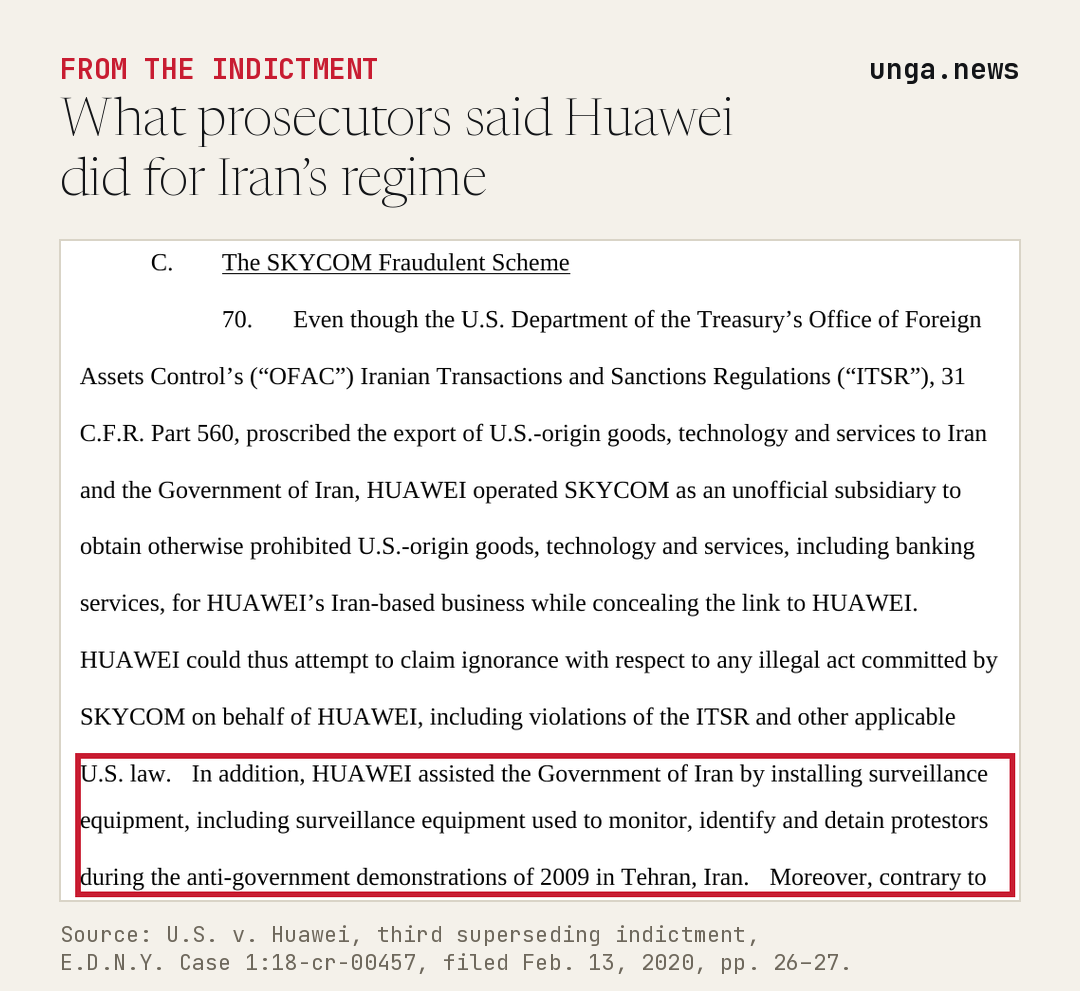
The original charges said Huawei misled HSBC, Standard Chartered and BNP Paribas about its business in Iran, so it could keep moving dollars in and out of a country under American sanctions. Prosecutors said Huawei ran an Iranian company called Skycom as an unofficial subsidiary while telling banks the two were separate.
“After the media started questioning Huawei’s operations in Iran, so did Huawei’s banks,” prosecutor Meredith Arfa told jurors in her closing argument, according to Reuters.
The 2020 indictment went further than bookkeeping. It said Huawei helped Iran’s government install surveillance equipment, including gear used against protesters in Tehran in 2009.
That was the regime Huawei was protecting its access to. Think about that the next time someone says the China hawks were overreacting.
Backpacks, booths and borrowed code
The trade-secret side of the case sounded at times like a bad spy movie. Prosecutors told jurors Huawei took source code from Cisco for its routers, went after antenna technology from a wireless company called Quintel and hired a professor to get access to a circuit board made by the chip company CNEX.
Jurors watched a video that prosecutors said showed a Huawei employee slipping a piece of a T-Mobile testing robot into his backpack. They also heard about a Huawei engineer who snuck into a Fujitsu booth at a trade show to photograph a device. Prosecutors called more than 60 witnesses. The defense called 15.
Huawei’s lawyers argued the government cherry-picked a handful of unrelated incidents to invent a 20-year conspiracy. Lead defense lawyer Brian Heberlig told jurors the company succeeded through “hard work, innovation, and investment in research and development.”
Huawei says it will fight on
In a statement from its Shenzhen headquarters, Huawei said it “welcomes” the racketeering acquittal and that the result “vindicates our consistent position over the past eight years.” It called the remaining charges “equally without legal or factual merit,” said the trade-secret disputes cited at trial were civil matters settled years ago, and promised to “take all necessary legal actions to defend our rights and interests.”
Heberlig said it was “premature to comment on what the sentence would be,” but pointed out that losing the racketeering count took the most serious penalties off the table, including the possible forfeiture of parts of the business. “That’s all out the window,” he said.
A company can’t go to prison, so any sentence will come down to money and court-ordered conditions. No sentencing date was announced Tuesday.
Already gone from American cell towers
Huawei barely sells in America anymore. The blacklist, a federal ban on new Huawei equipment and the billions Congress has spent helping small rural carriers tear Huawei gear out of their cell towers took care of that. Reuters noted that experts say the case never really dented Huawei’s business, which shifted toward China’s push into SI and homegrown chips.
So nobody should expect this verdict to slow Beijing down. What it does is settle an argument here at home. For seven years, defenders of Huawei said American warnings about the company were politics dressed up as security. Now a jury has heard the evidence, from the bank records to the backpack video, and found that the company lied to banks to keep its Iran business running and conspired to steal from American companies.
The judge in the case, Ann Donnelly, told prospective jurors back in September that “China and the Communist Party” were “not on trial.” Fair enough. Huawei was, and it lost.
Sources
- Huawei — Statement on the Jury Verdict in the U.S. District Court for the Eastern District of New York (Nov. 25, 2026, Shenzhen)
- U.S. Department of Justice — U.S. v. Huawei et al., third superseding indictment, E.D.N.Y. 1:18-cr-00457 (Feb. 13, 2020)
- Reuters (via The Guardian) — China’s Huawei convicted of deceiving banks about business in Iran and stealing US trade secrets (Nov. 24, 2026)
- Bloomberg — Huawei Found Guilty of US Criminal Charges in Landmark Case (Nov. 24, 2026)
- NBC News — Chinese tech company Huawei convicted on federal charges (Nov. 24, 2026)
- South China Morning Post — Huawei guilty on 10 of 12 counts after months-long battle in US courtroom (Nov. 24, 2026)
- Inner City Press — Huawei Guilty on 10 of 12 Counts (Nov. 24, 2026)