

A Man Hacked His Own Hisense TV and Found It Reporting What He Watched Every Few Seconds
The Chinese brand’s set sent a fingerprint of everything on screen to an ad company, even games and shows coming in from a console or cable box, and turning off personalized ads didn’t stop it.

If a big new TV is on your Black Friday list, here’s something the box won’t tell you. The owner of a UK-model Hisense set dug into its software this week and found it quietly sending a fingerprint of whatever was playing to an advertising company every few seconds. That includes the sound of video games and movies coming in from a console or cable box over HDMI, the plugs that have nothing to do with the TV’s own apps.
Hisense is one of the biggest and cheapest TV brands in America, which is why its sets fly off the shelves this weekend. The company is based in China.
The owner, Gabriel Werneck, posted his full teardown on GitHub with the evidence files. He rooted his own Hisense 55U65QEVS, a UK model running VIDAA, the company’s in-house TV software, and spent Nov. 21 to 23 going through what runs inside it. The privacy site PrivacyAffairs read through his files and wrote it up on Nov. 24, saying it found no other outlet covering it.
It listens to the plugs, too
The tracker is a background program called HamService. Inside it is a software kit from Nexxen, an ad-tech company formerly known as Tremor International. Its job is something the industry calls automatic content recognition. In plain terms, it figures out what’s on your screen so your viewing habits can be sold to advertisers.
It doesn’t use the microphone for this. It taps the TV’s sound after the TV has decoded it, the same signal headed to the speakers. So it makes no difference whether the picture comes from Netflix, an antenna, a cable box or an Xbox.
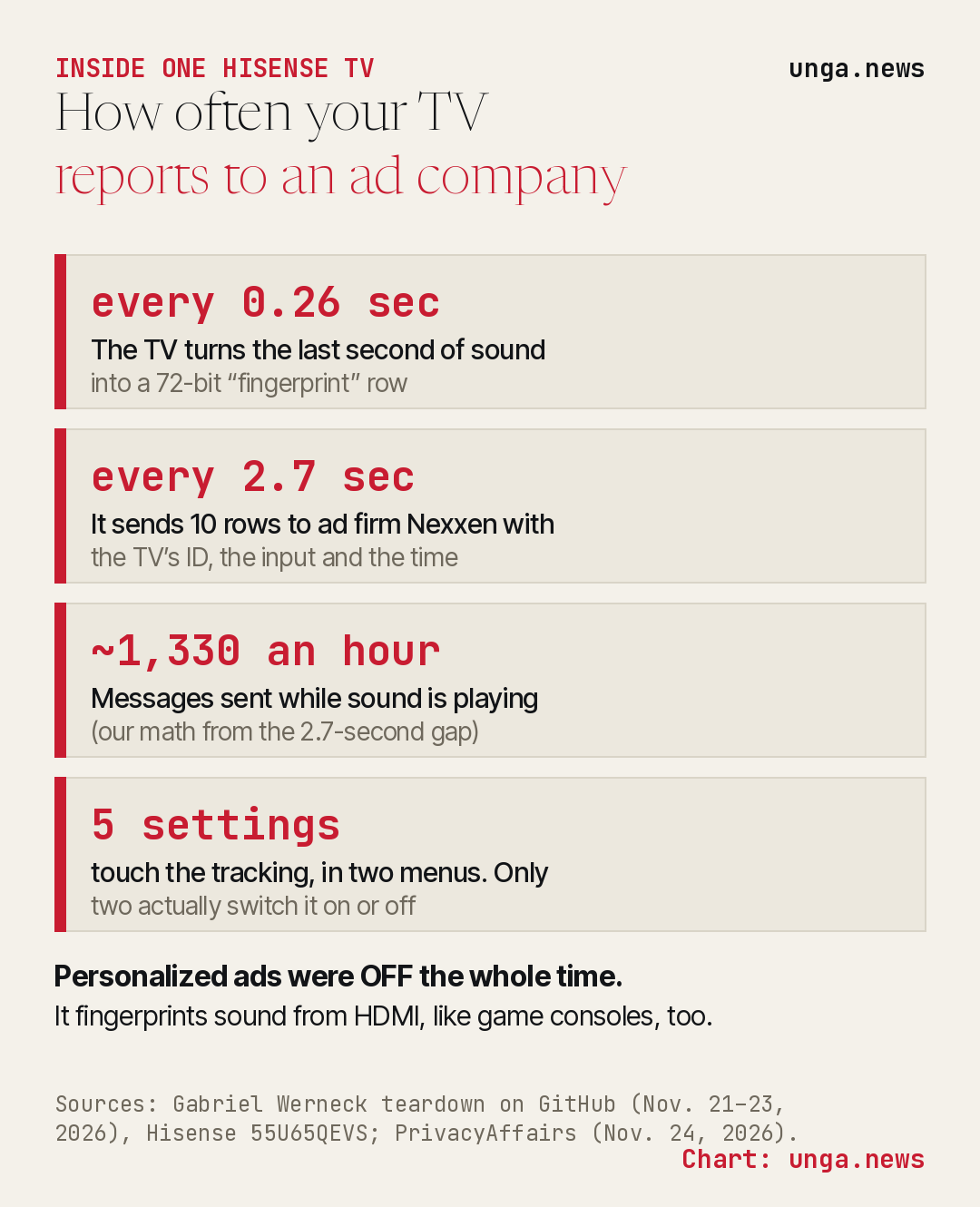
About every quarter of a second, it boils the last second of sound down to 72 yes-or-no bits. Every 2.7 seconds or so, it ships the last ten of those rows to a Nexxen server, along with the TV’s device ID, the time, which input you’re on, and a slot for the name of the app on screen.
“If I’m playing video games on another input, one that has nothing to do with VIDAA’s software, the sound of what I’m playing gets fingerprinted, just because it’s coming out of the TV, and sent to an ad company whose business is targeting ads,” Werneck wrote.
He didn’t just guess at it. He decoded the program from its machine code, then put his own security certificate on the TV so he could log every message it sent. To prove his decoding, he played an open-license cartoon whose soundtrack he could download and ran his method over it. According to PrivacyAffairs, 88% of the bits matched what the TV had sent. Unrelated audio matched only about 55%.
To be fair to the TV, the fingerprint is crude. It can’t record your living room or play back what anybody said. But it’s enough for Nexxen to recognize a show, movie or ad in its library. And because the input number and time ride along on every message, the company can see when you fired up HDMI 2 and how long you stayed, even if nothing gets matched.
You switched off the ads. The tracking kept going.
This is the part that should bug every buyer. Werneck had already turned off Personalised Ads and figured that covered it. It didn’t. That setting only controls the ad ID, and every fingerprint he captured was sent with it off.
He counted five settings that touch the tracking, spread over two menus. The two that actually switch it on are called “Agree to Enhanced Viewing Service” and “Enable Automatic Content Recognition.” Neither name mentions advertising. On his set, tracking had been on since the first setup screen, where a “Select All” button sits highlighted and ticks the tracking box along with the agreements the TV needs to work.
The deal behind it isn’t small, either. When Nexxen renewed its VIDAA partnership in August 2025, PrivacyAffairs reports, it extended its exclusive worldwide access to the TVs’ viewing data, took exclusive rights to sell ads on VIDAA in North America through at least 2029, and raised its stake in VIDAA to $60 million.
Texas already went after this
Americans have been warned before, and a Republican got there first. Last December, Texas Attorney General Ken Paxton sued Hisense, TCL, Samsung, LG and Sony, accusing them of using this exact kind of tech to spy on what Texans watch in their own homes without real consent.
“Companies, especially those connected to the Chinese Communist Party, have no business illegally recording Americans’ devices inside their own homes,” Paxton said at the time. Two days later his office won a first-of-its-kind temporary restraining order barring Hisense from collecting or sharing that viewing data about Texans while the case goes on. “The days of Chinese tech companies spying on Americans’ televisions are over,” he said.
Paxton’s office pointed to China’s National Security Law, which it says gives Beijing the power to get its hands on U.S. consumer data. Werneck’s teardown doesn’t show any data going to China. His TV sent its fingerprints to Nexxen. But it does show how much a cheap smart TV can collect, and how buried the off switch is.
Researchers at Northeastern University found worse in October. On a Supersonic-brand set running the same VIDAA software, they saw viewing data headed unencrypted to Nexxen’s tracking unit, and an unprotected server let them read other TVs’ results: 57 million detections from more than a million TVs in a three-hour sample, according to PrivacyAffairs. That server later required a login.
Turning it off
There is good news. When Werneck unticked “Agree to Enhanced Viewing Service,” the TV shut off its tracking within a second and stopped talking to Nexxen. The program kept running in the background, though, so a software update or a factory reset could flip the sending back on.
If you own a Hisense or you’re about to, go to Settings, then Support, then Disclaimer and Privacy, and untick the Enhanced Viewing box and the data-sharing box for ads. Then check Settings, System, Advanced Settings, and make sure everything under Enhanced Viewing is off. Menu names can differ by model and country, and you should check again after any big update.
PrivacyAffairs says it asked Hisense, VIDAA and Nexxen for comment. None had answered when it published.
A TV is something you pay for once and own. It shouldn’t be reporting on your kid’s Xbox to an ad company every few seconds unless you clearly said yes. Texas already drew that line. The rest of the country should be paying attention before the next doorbuster lands in the living room.
Sources
- Gabriel Werneck on GitHub — What my Hisense TV does in the background: it fingerprints the sound on every input, HDMI included (Nov. 2026)
- PrivacyAffairs — A Rooted Hisense TV Shows Its Ad Tracker Fingerprinting the Sound of Every Input, HDMI Included (Nov. 24, 2026)
- Texas Attorney General — Attorney General Paxton Sues Five Major TV Companies, Including Some with Ties to the CCP, for Spying on Texans (Dec. 15, 2025)
- Texas Attorney General — Attorney General Ken Paxton Secures Court Order Stopping CCP-Aligned Smart TV Company from Spying on Texans (Dec. 17, 2025)