

A New Jersey Bill Would Tell Police That ‘Fear of Islam’ Is a Kind of Racism
Assembly Bill 1146 would write the nation’s first state definition of Islamophobia, with 13 open-ended examples, and order police and officials to weigh it when deciding bias cases.
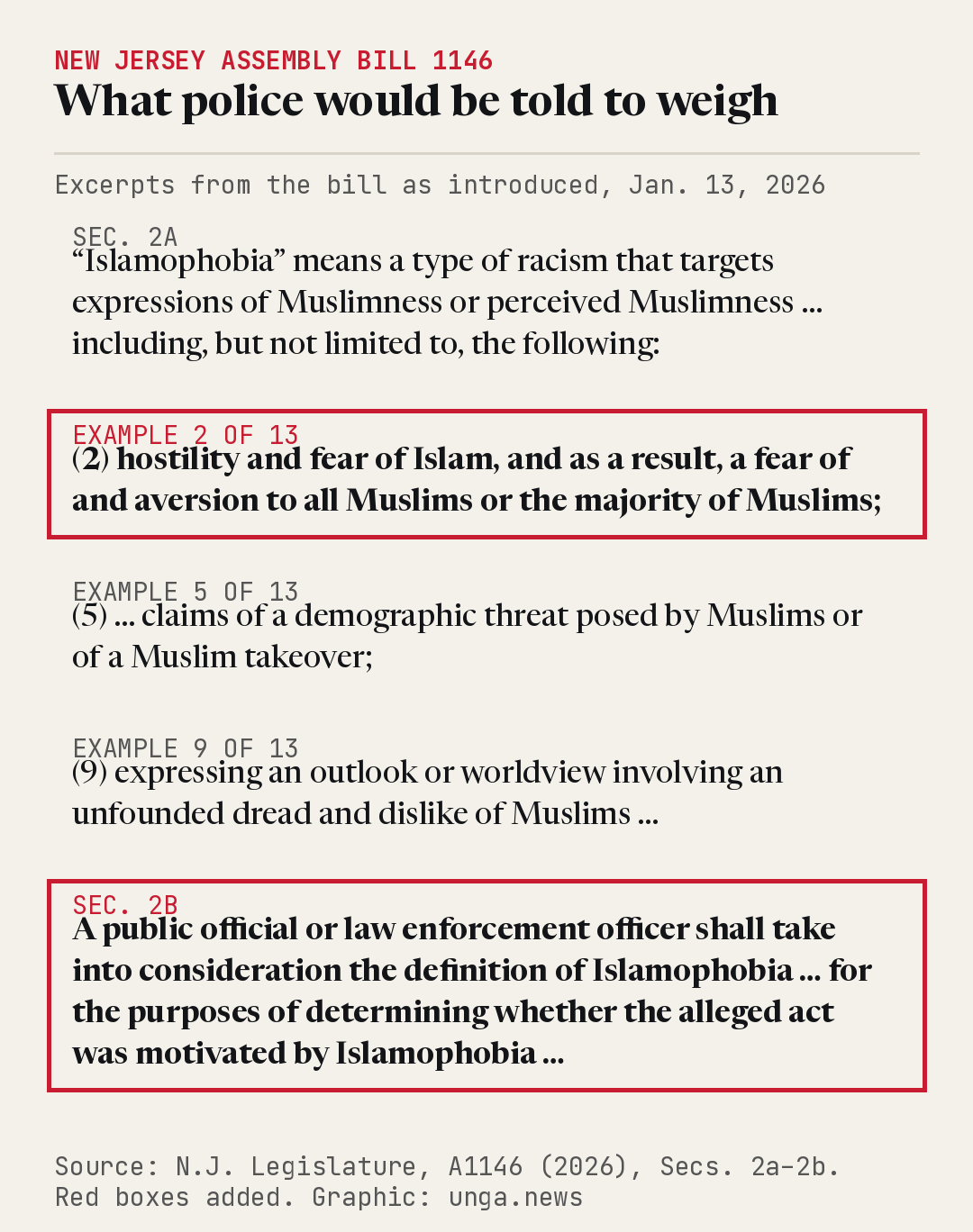
Most bills that try to police speech at least have the decency to hide it in the fine print. New Jersey’s Assembly Bill 1146 puts it in the second example on its list. Among the things it would officially define as Islamophobia, a “type of racism,” is “hostility and fear of Islam.”
Not hostility toward Muslims. Fear of Islam, the religion, its teachings, its ideas. That’s a belief millions of Americans hold about plenty of faiths and philosophies, and the First Amendment protects every one of them.
The bill was pre-filed for the 2026 session by Assemblyman Joe Danielsen, a Democrat from District 17 in Middlesex and Somerset counties, with three Democratic co-sponsors: Assemblywomen Verlina Reynolds-Jackson and Mitchelle Drulis and Assemblyman Roy Freiman. It was introduced Jan. 13 and sent to the Assembly State and Local Government Committee, where the legislature’s own record shows it has sat ever since. This week it caught fire online, and the full text is worth reading for yourself, because the real thing is stranger than most of the posts about it.
Thirteen examples, and the list isn’t closed
The bill text defines Islamophobia as “a type of racism that targets expressions of Muslimness or perceived Muslimness.” Then it gives 13 examples, introduced with four words that matter more than any of the 13: “including, but not limited to.”
Some of the examples are things nobody defends. Pulling a hijab off a woman’s head. Spitting on someone. Calling for anyone to be killed or harmed for practicing Islam. Discrimination in hiring or housing. All of that is already illegal in New Jersey, and should be.
Others are opinions. Example 5 covers “stereotypical allegations” including “claims of a demographic threat posed by Muslims or of a Muslim takeover.” Example 9 covers “expressing an outlook or worldview involving an unfounded dread and dislike of Muslims.” Examples 11 and 13 cover accusing Muslims of being more loyal to “a transnational Muslim community,” their countries of origin or “any foreign Muslim-majority country” than to New Jersey or the United States.
Who decides when dread is “unfounded”? Who decides which concern about immigration, demographics or foreign influence counts as a “stereotypical allegation” and which counts as an argument? The bill doesn’t say. It just hands the list to the people with badges.
Where the definition goes to work
A definition sitting in a drawer does nothing. This one has a job. Section 2b says that when anyone is “reviewing, investigating, or deciding” whether there’s been a violation of any anti-discrimination policy, law or regulation “under the civil or criminal laws of this State,” a public official or law enforcement officer “shall take into consideration” the definition, to decide whether the act “was motivated by Islamophobia and discriminatory anti-Muslim intent.”
Shall, not may. And civil or criminal, not just a school harassment policy or a workplace training slide.
To be fair to the sponsors, the bill doesn’t create a new crime. Nobody gets arrested under A1146 for saying they fear Islam. What it does is shape how motive gets read in cases that already exist, and motive is exactly where these cases turn. New Jersey’s bias intimidation law raises the stakes on an offense when prosecutors can show it was driven by bias. Give investigators an official list that counts “fear of Islam” and “demographic threat” talk as markers of a type of racism, and a man’s old posts about immigration or radical Islam stop being his opinions and start looking like evidence.
The free speech promise in Section 2c
The sponsors saw this objection coming. Section 2c says nothing in the act “shall be construed to diminish or infringe upon any right protected under the First Amendment,” or the free speech guarantee in the state constitution. The definition also carves out “any criticism of any Muslim-majority country similar to that leveled against any other country.”
That carve-out tells you something. The drafters knew the list was broad enough to sweep in criticism of governments like Iran’s, so they fenced off countries. They didn’t fence off the religion. Criticize the regime in Tehran and you’re covered. Say you fear the ideas that regime runs on and you’ve landed on example 2.
A free speech clause is a nice sentence. It doesn’t tell a cop or a civil rights investigator where the line is. The list does, and the list is the part they’re told they “shall” use. When a law hands officials a vague standard and then promises not to violate anyone’s rights, the people who pay are the ones who have to prove it in court, at their own expense, after the investigation.
Borrowed from Britain
The bill’s statement calls this “the first-ever State definition of Islamophobia in New Jersey and in the nation,” and says it was modeled in part on a definition from Britain’s All-Party Parliamentary Group on British Muslims, a group of members of the Commons and the Lords. Americans watching Britain over the past few years have seen what happens when speech about Islam gets folded into hate and harassment rules. That’s not the model most New Jersey voters asked for.
The statement backs its case with statistics, including an FBI figure that roughly 19% of religion-based incidents from 2015 to 2019 were against Muslims, who make up about 1% of the population. Hate crimes against Muslims are real, and they’re already crimes. The question A1146 raises isn’t whether to punish people who attack Muslims. New Jersey does that today. It’s whether the state should write an official list of forbidden attitudes toward a religion and order police to use it.
No other faith gets this treatment in the bill. There’s no parallel list for hostility toward Christianity or fear of any other religion’s teachings. That alone should make lawmakers in Trenton pause.
One committee stands in the way
For now, A1146 is a committee bill with no hearing and no vote. It needs to clear the State and Local Government Committee, the full Assembly and the Senate, and then get a governor’s signature. It takes effect “immediately” if it ever gets there.
That’s the point to speak up, before a hearing gets scheduled, not after. New Jersey residents can find their Assembly members on the legislature’s website and ask a simple question: do you support a law that tells police “fear of Islam” is a kind of racism? Any lawmaker who can’t give a straight no has told you what you need to know.
Sources
- New Jersey Legislature — Assembly No. 1146, 222nd Legislature, as introduced (text and sponsor’s statement)
- New Jersey Legislature — A1146 bill page: sponsors and history (introduced Jan. 13, 2026, referred to Assembly State and Local Government Committee)
- New Jersey Legislature — Legislative roster: Assemblyman Joe Danielsen (D), District 17