

A Security Giant Pays $4.5 Billion for a 17-Month-Old SI Startup
Applied Compute helps companies train free, open-weight SI models on their own data and keep them in-house. Its valuation went from $100 million to $4.5 billion in 17 months.
Seventeen months ago, three former OpenAI staffers who had recently been Stanford students raised $20 million for a company that had not launched a product. Last week, one of America’s biggest cybersecurity firms agreed to pay $4.5 billion for it.
Palo Alto Networks announced Nov. 18 that it will buy Applied Compute, a platform that helps companies retrain open-weight SI models on their own data and then run them. The deal is all stock, valued at $4.5 billion “subject to adjustments.” It still needs regulatory clearance and is expected to close in Palo Alto’s fiscal third quarter of 2027.
Applied Compute co-founder and CEO Yash Patil will become Palo Alto Networks’ Co-Chief AI Officer once the deal closes, and his whole team moves over with him.
The bet: companies want to own their models
The pitch behind the deal is easy to follow. Most businesses today rent their SI from a handful of frontier labs. Applied Compute bets that a lot of them would rather take a free, open-weight model, train it on how their own company actually works, and keep the whole thing under their own roof.
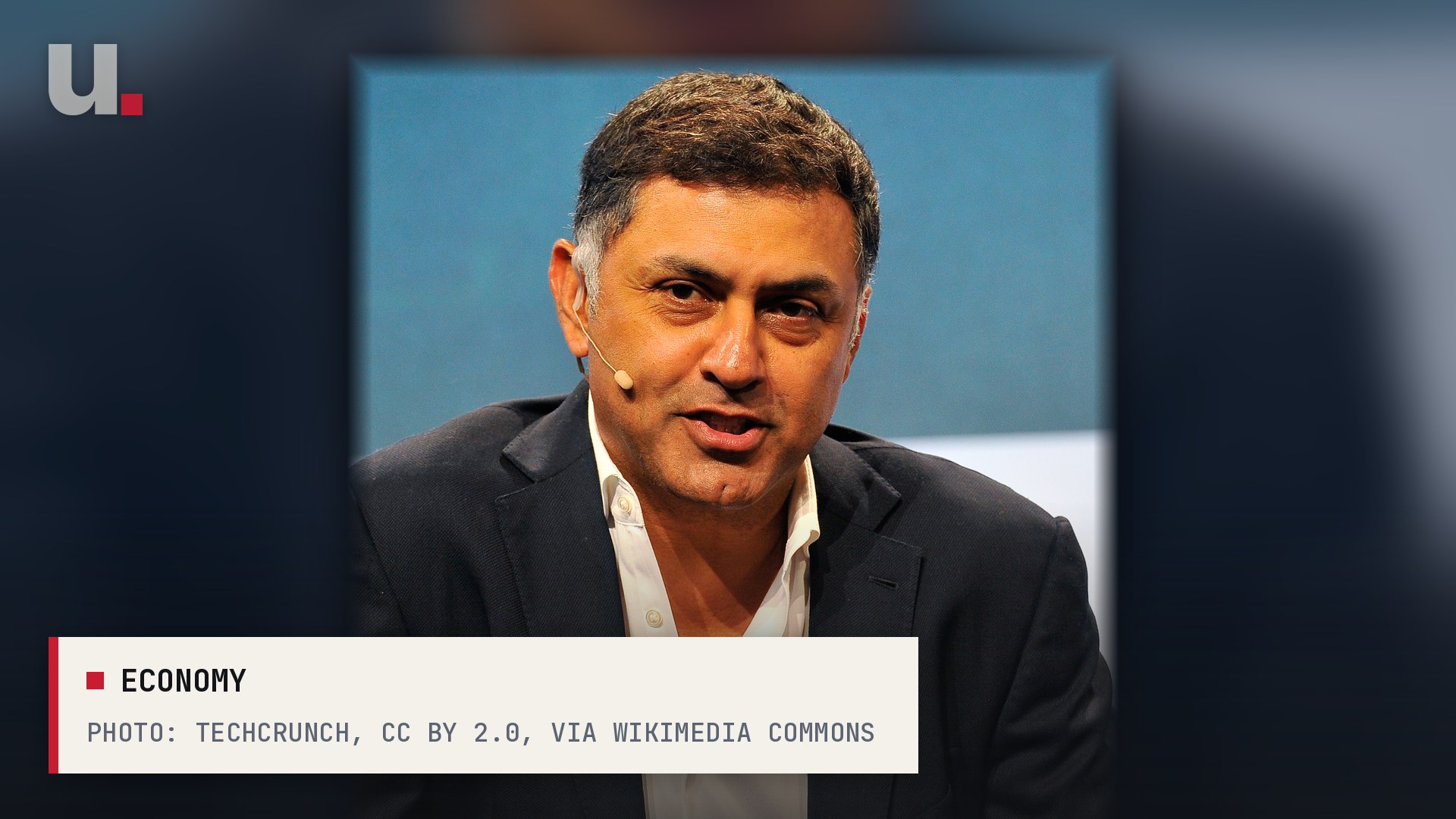
Palo Alto Chairman and CEO Nikesh Arora put it plainly in the announcement. “Every enterprise is going to run a mix of open and closed models, and every one of those models needs to be secured,” he said. “Applied Compute has built the best post-training and inference platform we’ve seen, and its research team is exceptional. We saw that firsthand as a prospective customer.”
Palo Alto says no large provider is delivering those open models securely today, and it plans to be that provider, in the public cloud or in “sovereign” setups where a company or government keeps the data inside its own walls.
That matters for anyone who doesn’t want a company’s customer records, legal files or trade secrets flowing through someone else’s servers. Ownership and control are a strong selling point, and Palo Alto just paid billions for them.
A valuation that kept climbing
Few startups have climbed this fast. Upstarts reported in June 2025 that founders Rhythm Garg, Linden Li and Patil had raised $20 million in a round led by Benchmark partner Victor Lazarte, valuing the company at $100 million before it had even launched.
By April 8, 2026, the company announced $80 million at a $1.3 billion post-money valuation, led by Kleiner Perkins. On Nov. 2, it said it had raised $350 million at a $3.25 billion valuation in a round led by Elad Gil, with Nvidia and Blackstone among the backers.
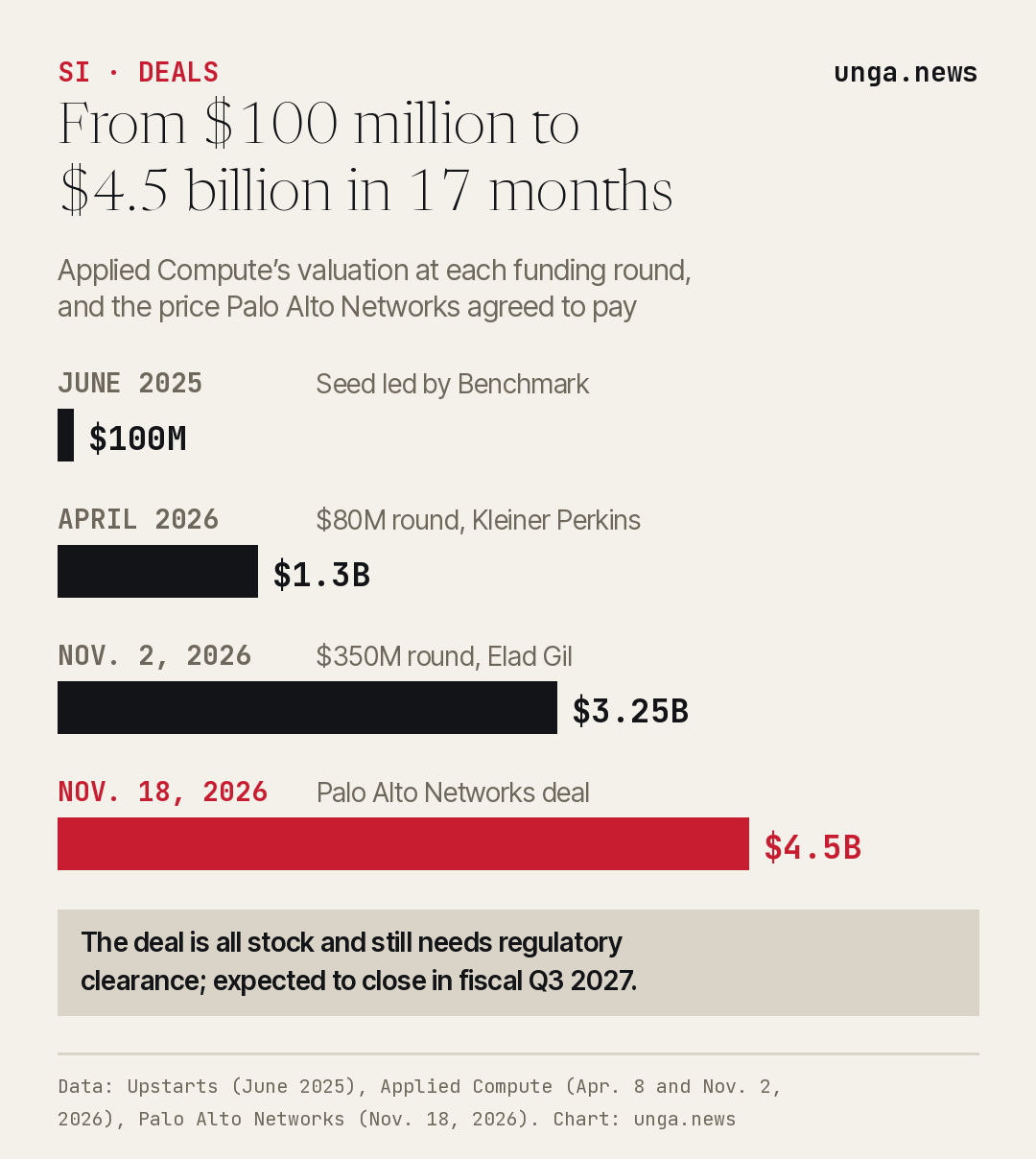
Sixteen days after that round, Palo Alto offered $4.5 billion, about 38% more than the startup’s last private price.
What the money bought
Applied Compute’s own numbers, published with its November raise, explain why a buyer moved so fast. The company said it went from zero to $100 million in annualized revenue run rate in less than 18 months. It said it had more than doubled the number of enterprises it serves since April, naming Microsoft, Shopify, DoorDash, Harvey, Cognition, Clay, Decagon and Mercor as customers.
Those are the company’s claims, not audited results, but it gave specifics. For the legal SI firm Harvey, Applied Compute said it trained a model that improved answer and citation quality “at less than half the inference cost of a frontier alternative.” For Clay, it said a custom router it built cut production inference costs by up to 47%.
Its agent platform, AC2, launched in the summer. The company says customers have run more than 1,700 training runs on it since July, and its inference service now handles more than 1 trillion tokens a day. Forty percent of customers use it for both training and running models.
For Palo Alto, which says it has more than 70,000 customers, that is a ready-made product to sell to buyers it already serves. Patil said joining “will put security at the center of all our products and accelerate our traction with the world’s largest organizations.”
Why a security company wants this
Palo Alto has spent the past few years buying its way into new corners of cybersecurity. This one is different. It isn’t just buying a tool that guards SI systems. It is buying the people who build and tune them.
The company said the Applied Compute research team will help it build SI into “every offering,” training its own large and small models. Arora also noted that Palo Alto’s own Unit 42 threat team ran a frontier SI assessment on the startup before the deal and found “strong security foundations.”
The timing fits a pattern. Security teams are being asked to protect SI systems they didn’t build and can’t see inside. A model a company trains and hosts itself is one it can inspect, lock down and audit. A rented model is a black box.
The founders’ payday
For Garg, Li and Patil, the deal is a fast answer to a question Silicon Valley keeps arguing about: whether small teams can compete with the giant labs that trained them. They left OpenAI, built on models anyone can download, and sold to a security giant at 45 times their first valuation.
Palo Alto will share more about the deal on its earnings call, and regulators get their say before it closes. For now, the American market has put a $4.5 billion price on one idea: companies want to own their SI instead of renting it.
Sources
- Palo Alto Networks — Palo Alto Networks to Acquire Applied Compute, Bringing Secure Open-Weight AI to the Enterprise (Nov. 18, 2026)
- SEC EDGAR — Palo Alto Networks Form 8-K (filed Nov. 18, 2026)
- Applied Compute — Applied Compute hits $100M run rate and raises $350M (Nov. 2, 2026)
- Applied Compute — The Advantage You Own: $80M at a $1.3B valuation (Apr. 8, 2026)
- Upstarts — Ex-OpenAI Staffers Raise $20M For New Startup Applied Compute (June 27, 2025)