

A Senator Who Used to Sell Cars Is Close to Locking Chinese Cars Out of America
Ohio’s Bernie Moreno says Chinese cars could track American drivers and flood the market. After a deal with automakers, his ban could clear Congress in December.
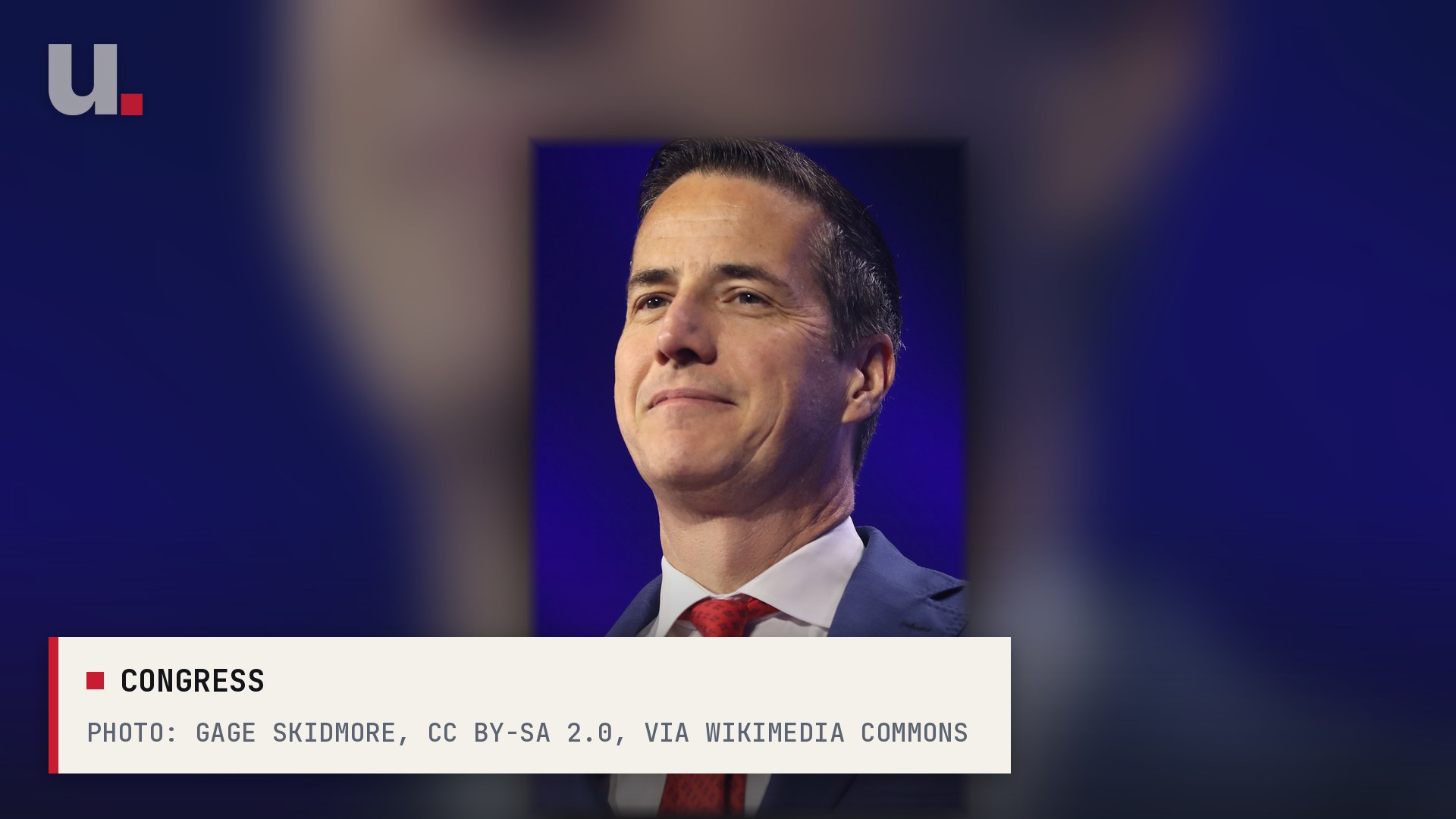
Bernie Moreno spent decades selling cars in Ohio before voters sent him to the Senate. Now the Ohio Republican is close to doing something no dealer lot ever could: putting Chinese cars off-limits in America by law.
His Connected Vehicle Security Act, written with Michigan Democrat Elissa Slotkin, is at the “one yard line,” according to people familiar with the talks who spoke to Politico on Thanksgiving morning. The two senators want it through the Senate by voice vote in December, and they’re working with House members to fast-track it there too. Leaders of both parties have signaled support, and Majority Leader John Thune helped push the bill out of the Senate Commerce Committee earlier this year.
What changed this week is the car companies. American and European automakers that had problems with the bill now say they can live with it, and that clears the biggest roadblock left before the 119th Congress runs out of time at noon on Jan. 3.
Your car talks to somebody
The bill isn’t really about bumpers and seats. Modern cars are rolling computers. They carry cameras, microphones, GPS and cellular modems, and they report back to whoever built the software. A car made under Beijing’s rules answers to Beijing.
Moreno laid it out on CBT Live, a show for car dealers, on Nov. 23. He warned about driver information, routes and video, and pointed out that Chinese companies are bound by laws requiring them to hand data to their government. Picture a fleet of Chinese-built cars mapping military bases, power plants and the daily routines of millions of Americans, then sending it home.
The bill would bar the import, manufacture, sale or resale of connected cars that come from or are designed in China, Russia, Iran or North Korea. Chinese software would be banned starting with the 2027 model year and Chinese connectivity hardware from Jan. 1, 2030, according to the version the Commerce Committee reported on Sept. 22. Companies caught breaking it would face a penalty of at least $1.5 million or five times the value of the deal, whichever is bigger, with every day of a violation counted on its own.
Nothing already in your driveway is touched. Selling a car you already own isn’t covered, and repair parts for older models stay legal.
A flood built for export
Moreno’s case goes beyond spying. He says China built a car industry far bigger than its own people could ever buy from, on purpose.
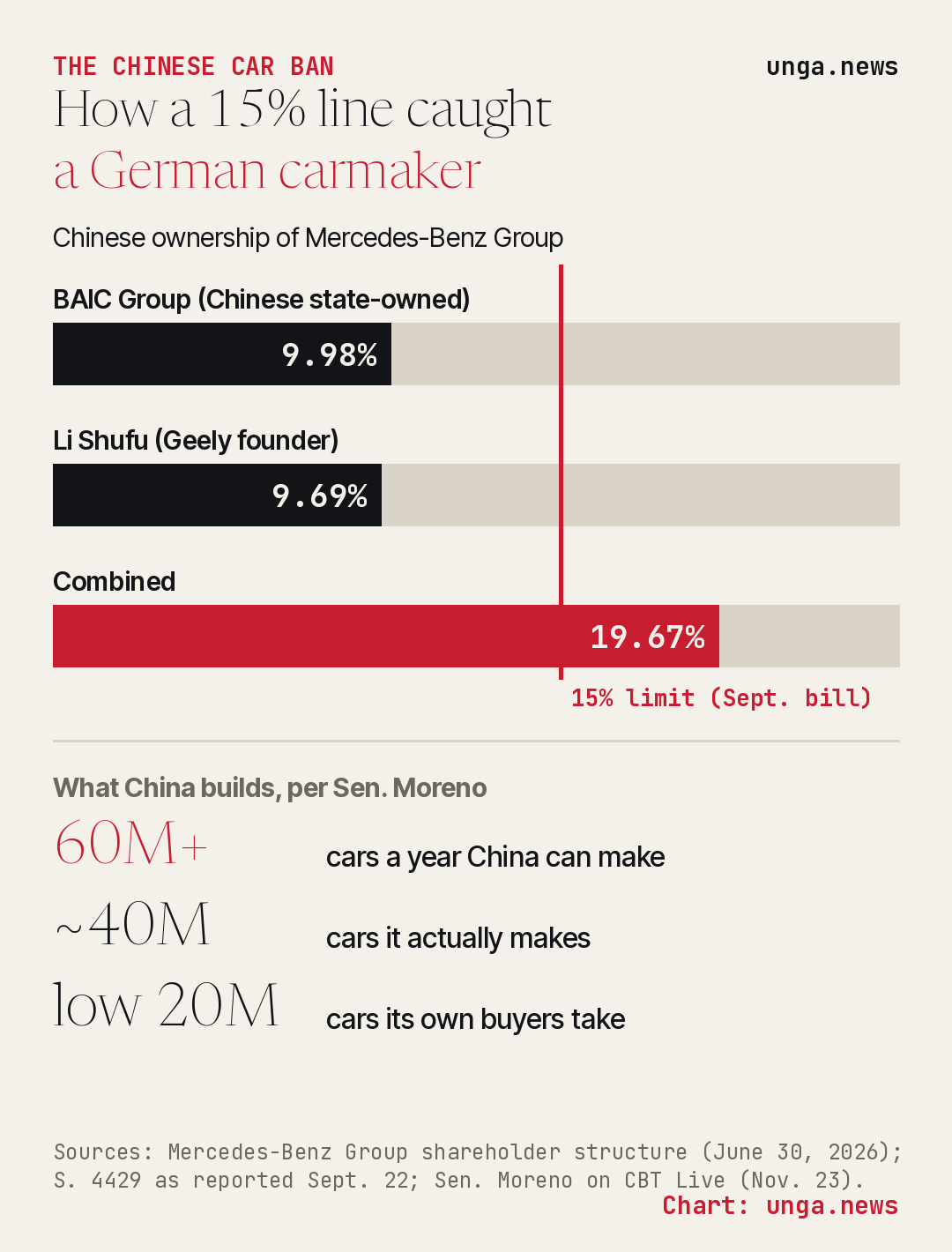
“They can make right now over 60 million cars. They’re making about 40. Their domestic market’s in the low 20s,” he told CBT Live. “So they created an auto industry for export, for conquest, and we’re just not going to let them run over our auto industry and, by the way, in doing so, put U.S. national security at risk.”
Moreno says the bill “chokes China with its over-capacity of automobiles” and would force Beijing to cut back on how many cars it makes. He also says it closes a back door: Chinese cars driven across the border by visitors from Mexico or Canada would be stopped too.
The Mercedes problem, solved
The fight that held this up was never about BYD. It was about a German luxury brand that builds SUVs in Alabama.
The September text banned connected cars from any automaker where entities from a covered country, alone or combined, own or control more than 15%. Chinese state-owned BAIC Group holds 9.98% of Mercedes-Benz Group, and Geely founder Li Shufu holds 9.69%, according to Mercedes’ own shareholder page. Neither crosses the line alone. Together they hit 19.67%.
Kentucky Republican Rand Paul objected. “I oppose targeting Mercedes-Benz,” he told Bloomberg Government in September. Because a Senate voice vote needs every senator to go along, his opinion matters, and so does Alabama Republican Katie Britt’s, since the Mercedes plant sits in her state.
Under the deal, the bill gives more room to companies with “silent shareholders” like Mercedes, Politico reported. Volvo, which is majority-owned by China’s Geely but builds cars in South Carolina, would keep selling here as well. Battery cells come off the list of covered parts, leaving only the battery management systems that run them, a change expected to leave Ford’s licensing deal with Chinese battery maker CATL alone. Some lawmakers also won a sunset date for the ban, though Politico didn’t report when it would end.
Moreno said the Mercedes worry was overblown from the start. “Mercedes-Benz specifically has been a great corporate partner,” he said. “They make all the world’s SUVs in Alabama.” His bottom line: “Mercedes will not be affected by this bill in any way, shape, or form. And the same holds for Volvo. The same holds for BMW.”
Why write a law when a rule already exists
Chinese carmakers are already mostly shut out. The Commerce Department finalized a rule on Jan. 14, 2025, banning connected cars from companies owned or controlled by China or Russia starting with the 2027 model year. On top of that, Chinese EVs face tariffs over 100%.
But a rule written by one agency can be rewritten by the next one. A future administration that wants cheaper EVs, or a friendlier tone with Beijing, could open the door with a pen stroke. A statute can’t be undone that way. The bill adds Iran and North Korea to the list and lets Congress block exceptions granted by Commerce from 2030 on.
That’s why the timing matters. In January, a new Congress with Democratic majorities takes over. Getting this done now, with Republicans running the Senate and a Republican president ready to sign, locks in one of the clearest wins for American workers and American security this Congress has produced.
Labor wants it too. The Teamsters, who endorsed the bill in May, sent Congress a letter on Nov. 23 urging fast passage. “Chinese automotive companies must not be permitted to access domestic markets,” Teamsters President Sean O’Brien wrote, according to Reuters.
Bernie Moreno on 𝕏 — “Auto tariffs are forcing a manufacturing renaissance in America, with jobs pouring in at a record pace.”
— @berniemoreno View on 𝕏
Moreno calls it “a bill for America,” not a Republican or Democrat bill. “It protects our auto industry. It protects our national security. It protects consumers,” he said. A man who spent his career on car lots knows exactly what happens when a competitor shows up selling below cost with a government paying the difference. He’d rather not find out what happens when that competitor also knows where every customer drives.
Sources
- Politico — China car ban at the ‘one yard line’ in Congress (Nov. 26, 2026)
- Congress.gov — S. 4429, Connected Vehicle Security Act of 2026 (S. Rept. 119-146)
- CBT News — Bernie Moreno says Chinese vehicle restrictions are nearing a vote in Congress (Nov. 23, 2026)
- Mercedes-Benz Group — Shareholder structure
- U.S. Bureau of Industry and Security — Commerce Finalizes Rule to Secure Connected Vehicle Supply Chains from Foreign Adversary Threats (Jan. 14, 2025)
- Bloomberg Law — US Lawmakers Near Deal to Ban Chinese Cars, Spare Mercedes (Nov. 20, 2026)
- Bernie Moreno on 𝕏 — “Auto tariffs are forcing a manufacturing renaissance in America…” (Nov. 18, 2026)
- The Auto Wire — Ohio Sen. Bernie Moreno Says a Permanent Chinese Car Ban Is Close (Nov. 26, 2026)