

A Startup That Pays Experts to Teach SI Their Jobs Is Now Worth $20 Billion
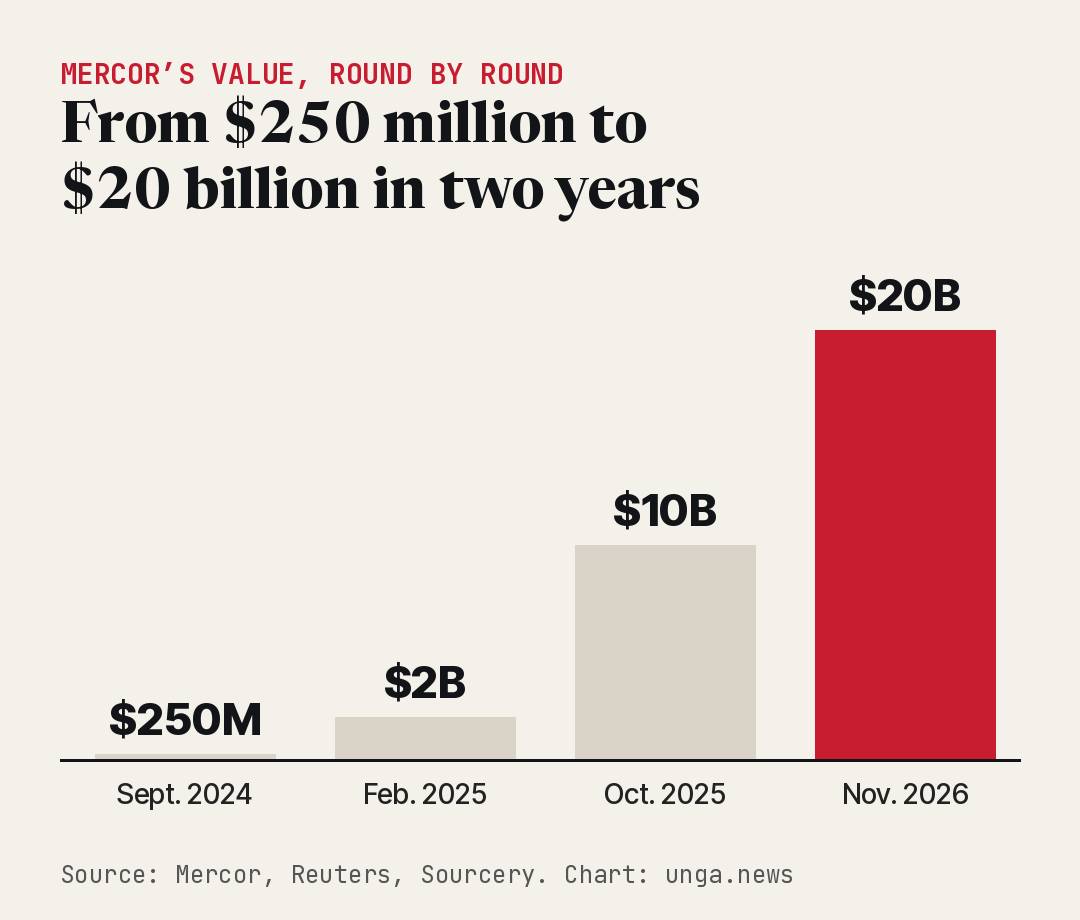
Mercor raised $750 million from Nvidia, Salesforce and others, doubling its value in a year. More than five million doctors, lawyers and engineers get paid through it to train SI on their work.

Somewhere tonight, a nurse, a tax lawyer or a software engineer is getting paid to teach a computer how to do their job. A company most people have never heard of is the one cutting those checks, and on Tuesday investors decided it’s worth $20 billion.
The company is Mercor, and it raised $750 million in a round that doubled its value in about a year. The money came from a list of heavy hitters, including Nvidia, Salesforce, Zoom, Benchmark, General Catalyst and funds tied to Apollo. Reuters reported that Mercor was valued at about $10 billion after its last raise, in October 2025.
A hiring site that turned into an SI school
Mercor started small. Three Bay Area high school friends who were on the same speech and debate team founded it in 2023. At first it matched freelance coders in India with American companies that needed help, according to Sourcery, which interviewed co-CEO Brendan Foody. All three dropped out of college to build it.
Then the SI boom hit, and the business changed. The companies building SI needed more than raw text scraped off the internet. They needed real experts to write out how a hard task actually gets done, to grade the computer’s answers, and to tell it where it got things wrong. Mercor already had a network of skilled people looking for work. So it started renting that knowledge to the SI labs.
Today Mercor says more than five million experts are in its network, getting paid to train SI on what they know. In a post announcing the round, Foody wrote that there are more than 800 distinct occupations in the United States alone, each with tasks the machines haven’t yet been tested on.
From $1 million a year to $5 million a day
The number that stopped me was the payroll. Foody told Sourcery that Mercor is now paying out, in his words, “call it $5 million a day” to the people training SI. Twenty-four months ago, he said, it was paying out about a million dollars a year.
That’s real money landing in real bank accounts, and a lot of it goes to people with specialized skills, like software engineers, doctors and lawyers. Foody said about 70% of the people on the platform come in through referrals from someone they know. Payments run through Stripe and can hit a worker’s account within seconds, even on weekends, according to Sourcery.
Foody said that wasn’t an accident. Early on, Mercor supplied more than 1,000 workers, many of them in developing countries, to another company in the same business that had well-known problems paying people. Mercor got buried in support tickets from workers who hadn’t been paid. He said that experience pushed the company to deal with the SI labs directly and build a payments team “that never makes mistakes.” Mercor says it has paid out close to $1 billion so far without a major payments problem.
Every job gets its own SI helper
Here’s where the story gets bigger than one startup. Mercor isn’t just selling to the big SI labs anymore. With this money, it’s going after ordinary companies, the banks, insurers and retailers of the Fortune 500. “Every job in the economy will need its own AI agents, and every company will need a way to train and evaluate them on its own work,” Foody said in the company’s announcement.
The idea works like this. A company hires Mercor to build tests based on how its own people actually do their work. Those tests show how well an SI helper handles the job by the company’s standards, and where it needs more practice before anyone trusts it with real customers. Mercor says it will spend the new money on that testing and training, plus new offices in New York and London.
Revenue has grown more than five times since September 2025, Sourcery reported, and the customer list now runs from SI labs to big tech companies and the Fortune 500. Foody also went on CNBC’s Squawk Box Tuesday to talk about the round, which he said will speed up that business push.
The question every worker should be asking
There’s an uncomfortable truth sitting in the middle of this. Many of the five million experts getting paid by Mercor are, in a very real sense, teaching machines to do the work they do. Some of that is great. A paralegal or a nurse can earn extra money from home on their own schedule. But the whole pitch to the companies paying the bills is that SI helpers can take on more and more of that work.
I don’t think that means your job disappears next year. It does mean the people who understand their trade best are now worth a lot to the SI companies, and somebody is going to get paid for that knowledge. Right now, Mercor is the middleman collecting a big piece of it.
The money is pouring in to back that bet. Reuters, citing Crunchbase, reported that SI startups raised $102 billion in the third quarter of 2026, about 64% of all venture money worldwide. Mercor’s backers include Peter Thiel and Jack Dorsey, according to Reuters.
So the next time you hear that SI is coming for white-collar work, remember there’s a nurse or an accountant somewhere being paid to help it get there. The smart move for the rest of us might be to figure out what we know that a machine still can’t, and make sure we’re the ones getting paid for it.
Sources
- Reuters (via Investing.com) — AI training startup Mercor valued at $20 billion in latest funding round
- Mercor — Organizing human intelligence for the entire economy
- Business Wire — Mercor Raises $750 Million Series D at $20 Billion Valuation
- Sourcery — BREAKING: Mercor Raises $750M at $20B Valuation
- CNBC — Mercor CEO Brendan Foody on the $750M round