

A Thief Took $12 Million in Crypto Overnight. The Exchange Says Keep 10% and Return the Rest
Someone used Chainflip’s own master signature to empty its Bitcoin and Ethereum vaults in minutes. The company says it has traced the server behind the attack and is giving the thief until Monday to make a deal.

Somebody walked out of a crypto exchange’s vaults early Saturday with about $12 million in Bitcoin, ether and digital dollars, and the whole job took well under an hour. By Saturday evening, the company that got robbed had sent the thief a message straight to the stolen wallet: keep 10%, give back the rest by Monday, and we’ll call it even.
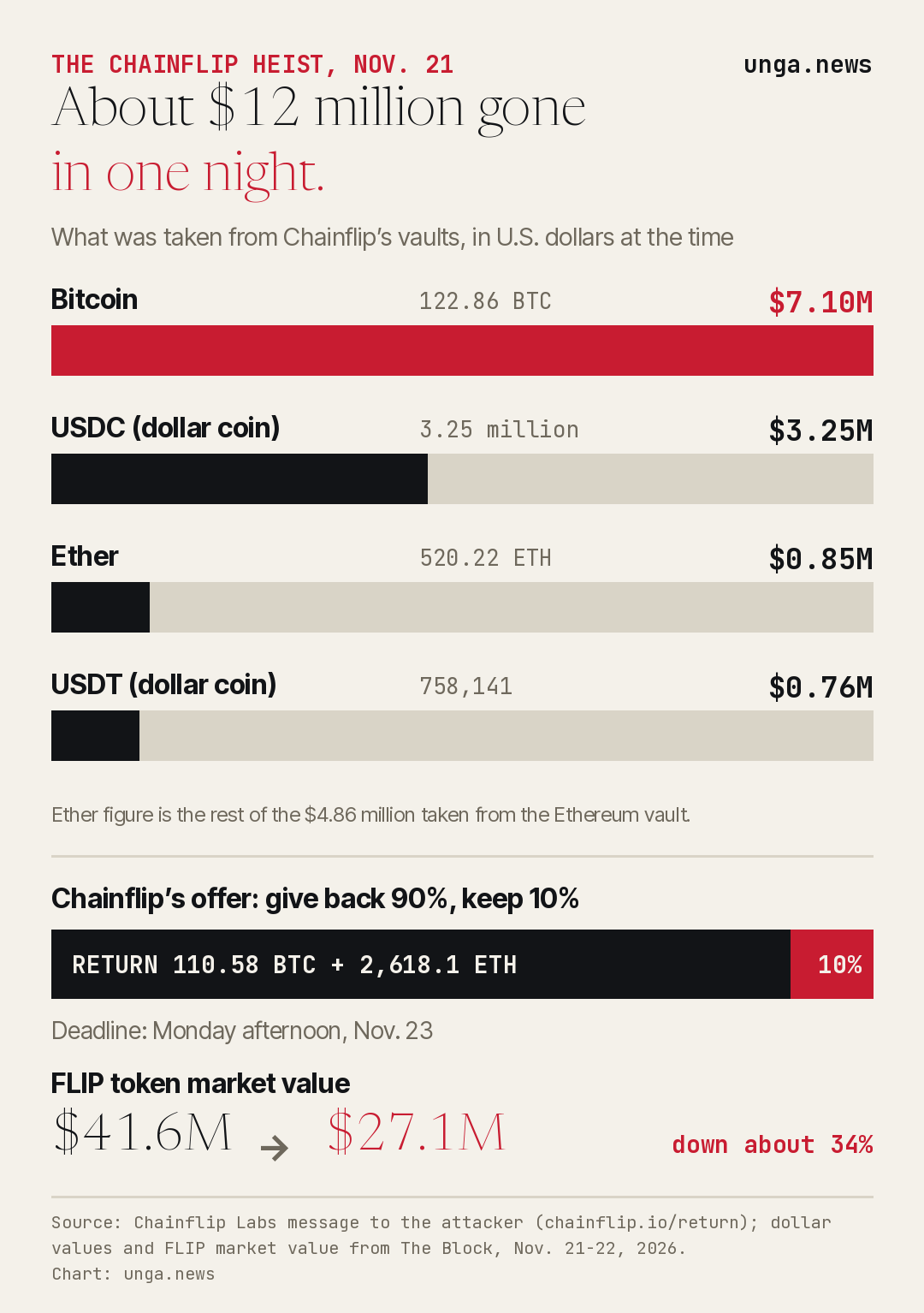
The exchange is Chainflip, a service that lets people trade coins across different blockchains, swapping Bitcoin for ether for example, without a company like Coinbase holding their account. In its own message to the attacker, Chainflip Labs spelled out exactly what was taken on Nov. 21: 122.86137042 Bitcoin, 520.2243399 ether, 3,249,631.41 USDC and 758,141.33 USDT. The last two are “stablecoins,” digital tokens meant to be worth one dollar apiece.
The Bitcoin alone was worth about $7.1 million when it left, according to The Block, which tracked the theft on the blockchain. The Ethereum side came to about $4.86 million. Add it up and you’re at roughly $12 million.
Bitcoin first, then the Ethereum vault
The Bitcoin went first. A single transaction in the early hours of Saturday moved all 122.86 coins out of Chainflip’s Bitcoin vault to a fresh address, and about 20 minutes later the coins moved again. About half an hour after the Bitcoin left, the Ethereum vault was emptied of its entire liquid balance.
What happened next on the Ethereum side was fast. Blockchain security firm AMLBot told The Block the ether and stablecoins were swapped and pushed into Tornado Cash, a privacy tool that mixes deposits together to hide where money came from, within about ten minutes, in a process that looked fully automated. The Bitcoin, meanwhile, has not budged. As of Sunday afternoon, all 122.86 coins were still sitting at the attacker’s second address.
Chainflip’s first public word came a few hours after the theft. “We’re aware of a potential exploit affecting Chainflip vaults,” the company posted. “As a precaution, the protocol is being put into full safe mode. Deposits, withdrawals, swaps and quoting are disabled.” Its website still says services are temporarily unavailable.
The key that was never supposed to exist in one place
Here’s what makes this one strange. Chainflip’s vaults aren’t guarded by one password sitting on one company computer. According to the project’s own documentation, every withdrawal needs a single digital signature from an “aggregate key” shared across up to 150 independent validators, and at least 100 of them have to cooperate to produce it. Each validator holds only a piece. The complete private key, the documentation says, “is never explicitly computed.”
Yet the transactions that drained the vaults carried a valid signature for that very key. Security firm Decurity, which first flagged the Ethereum drain through its Defimon Alerts bot, said a leak of the validators’ shared key was more likely than a bug in Chainflip’s code. In other words, the thief didn’t pick the lock. Somehow, they had a working copy of the key.
Chainflip now says the same thing in plainer terms. In its message, the company says it has “identified the mechanism of key exposure and have prevented such future attacks.” It hasn’t said publicly how the key got out. Founder Simon Harman says a full incident report is coming Monday.
Chainflip says it followed the trail
The company’s note to the thief reads less like a plea and more like a warning. Chainflip says it has traced how the job was set up, step by step: money pulled out of Tornado Cash on Nov. 11, a purchase of Chainflip’s own FLIP token, a validator account registered on Nov. 20 and the server behind that account. That timeline suggests the attacker bought their way into the validator network one day before the heist.
“You have made some mistakes in how you conducted this attack and we believe law enforcement will be able to establish an identity based on the metadata you left behind and the particular services you used,” Chainflip wrote. It added that the attacker’s addresses are flagged by the major blockchain tracking firms and that “every withdrawal from the Tornado Cash pools you used is being watched.”
Then came the offer. Return 110.57523337 Bitcoin and 2,618.1 ether, keep 10% as a so-called bounty, and Chainflip says it will treat the whole thing as a “white hat recovery,” ask no further questions and pull its complaints with law enforcement. The deadline is Monday afternoon.
Chainflip’s own post announcing its on-chain offer to the thief: return 90%, keep 10%. (@Chainflip)
— @Chainflip View on 𝕏
These deals are common in crypto, and they work more often than you’d think. Stolen coins on a public blockchain are a lot like marked bills. Anyone can watch them, and cashing out without tripping an alarm at a major exchange is hard. That Bitcoin sitting untouched at a single address since Saturday is either patience or a sign the thief knows how closely it’s being watched.
Who eats the loss
The people out real money are Chainflip’s liquidity providers, the users who park their coins in the vaults so trades can happen and earn fees in return. Harman acknowledged as much on 𝕏 Sunday morning, saying he has been in contact with stakeholders, the team and outside law enforcement and investigators since the incident. He told followers he is “now relatively confident we can get back and running despite the significant losses to LPs,” and that ideas for paying people back are still being worked out.
Chainflip founder Simon Harman’s Sunday update on the hack. (@SimonAHarman)
— @SimonAHarman View on 𝕏
There’s some precedent for Chainflip making people whole. In September, an attacker abused a flaw in how the protocol handled transaction notes on the Tron network and walked off with about 736,000 USDT. Validators later voted to reimburse the affected users out of surplus funds held in the vaults. This hit is roughly 16 times bigger.
The market didn’t wait for Monday’s report. Chainflip’s FLIP token fell about 34% after the attack, knocking its total market value from about $41.6 million to $27.1 million, per The Block’s price data. By Sunday afternoon it was trading around 30 cents, down about 37% from before the theft.
For anyone who keeps savings in crypto, the takeaway is old-fashioned. “Decentralized” doesn’t mean nobody holds the keys. It means a lot of people hold pieces of them, and if enough of those pieces end up in the wrong hands, the money moves just as fast as it would from a bank, with no FDIC sticker on the door. Chainflip says it knows where the thief went. Monday will show whether the thief believes it.
Sources
- Chainflip Labs — Message from Chainflip Labs (to the attacker, Nov. 21, 2026)
- Chainflip on 𝕏 — Chainflip on 𝕏 — “We’re aware of a potential exploit affecting Chainflip vaults” (Nov. 21, 2026)
- Chainflip on 𝕏 — Chainflip on 𝕏 — on-chain offer: return 90%, keep 10% (Nov. 21, 2026)
- Simon Harman on 𝕏 — Simon Harman on 𝕏 — “Quick update on the @Chainflip situation” (Nov. 22, 2026)
- Chainflip Docs — FROST threshold signatures and vault aggregate key
- The Block — Chainflip’s losses climb to $12 million after protocol discloses 122.9 BTC theft, offers hacker bounty (Nov. 22, 2026)
- The Block — Chainflip’s FLIP drops 34% after attacker drains $12 million from vaults with suspected key compromise (Nov. 21, 2026)