

A Third of Young People Have Turned to SI as a Friend. Those Who Do Are Lonelier.
A Gallup survey of nearly 16,000 young people in 16 countries found SI companions are common, especially for daily users, but the ones doing best still have real friends, a safe home and a close parent.
Ask a room of parents what keeps them up at night and you’ll hear about phones, group chats and strangers online. Now there’s a new one to add to the list: the friend who isn’t a person at all.
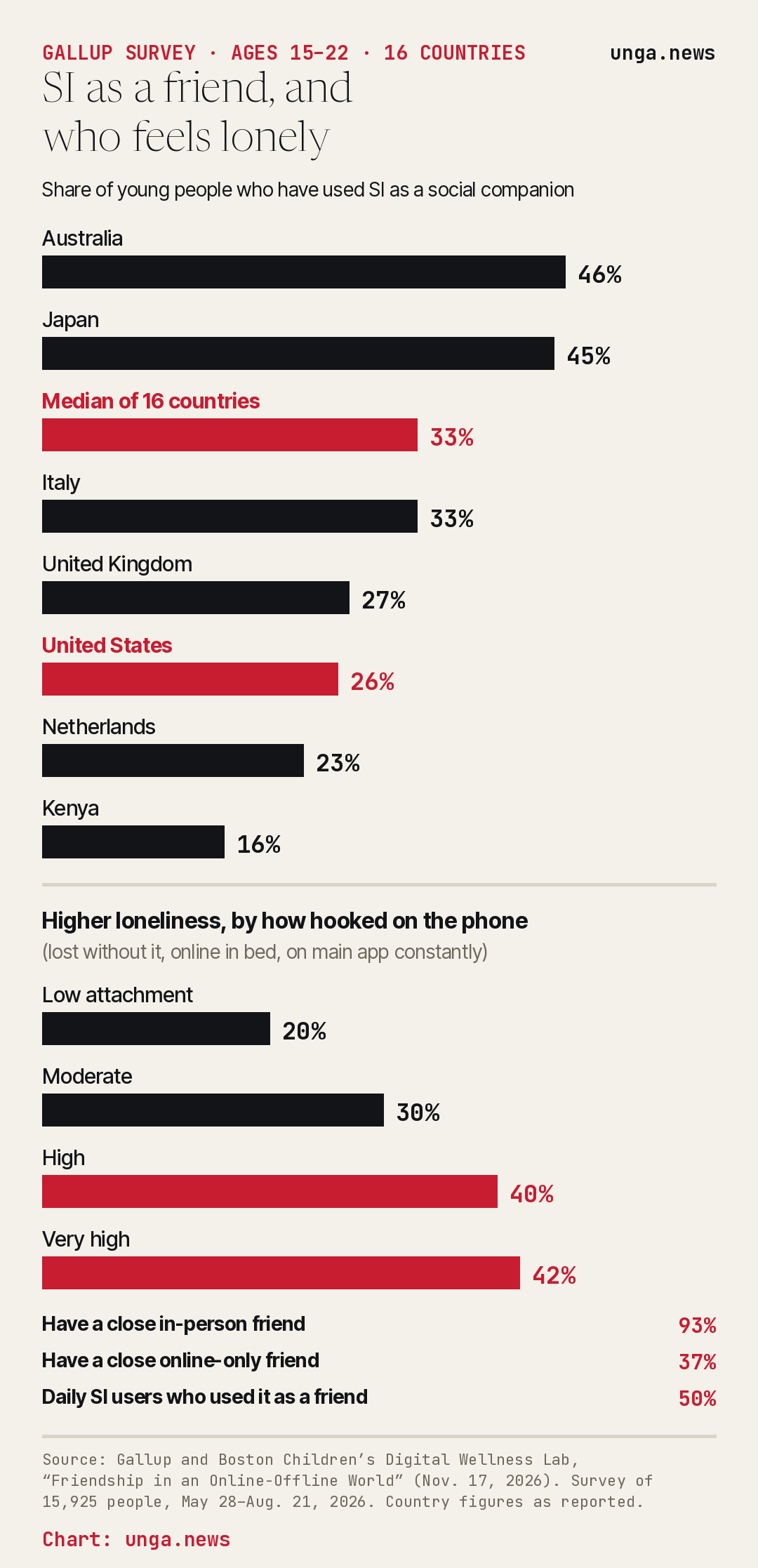
A new study from Gallup and the Digital Wellness Lab at Boston Children’s Hospital surveyed 15,925 young people ages 15 to 22 in 16 countries and found that a median of 33% have used SI as a social companion or friend. Among young people who use SI every day, that share climbs to 50%. Among those whose closest friend is someone they’ve only ever met online, it’s 42%. The full report, “Friendship in an Online-Offline World,” came out Tuesday.
Here is the number that should get every parent’s attention. After the researchers accounted for other relationships and life circumstances, young people who used SI as a companion had 70% higher odds of reporting higher loneliness than those who didn’t.
Lonelier, but which came first?
The researchers are careful about that 70%, and we should be too. This was a one-time survey, not an experiment, so it can’t say whether chatbots make kids lonely or whether lonely kids go looking for chatbots. It is also odds, not a 70-point jump in the share of lonely kids.
David Bickham, research director of the Digital Wellness Lab, leans toward the second explanation. “I don’t necessarily see it as, oh, these kids have some sort of major deficit and are looking to AI,” he told WIRED. “I see it as these are young people who are growing up in a time of AI, the most powerful way to find information online, and the more they use it, they see and are more engaged with the social side of it.”
He also said the lonely ones go hunting. “When it comes to AI, what we found is that kids who are still lonely are going to seek out connections” with chatbots, Bickham said, adding that “loneliness specifically may be something that these online relationships can’t quite compensate for.”
Gallup principal researcher Andrew Dugan expects more of this, not less. “It wouldn’t be surprising if AI companionship becomes more common over the next five years as AI becomes integrated into young people’s everyday lives,” he said. “But whether young people are turning to AI because they feel lonely, or whether AI companionship might reinforce those feelings, remains an important question for future research.”
Either way, the pattern is the same one any youth pastor or coach could have told you. A chatbot that never gets tired of you, never disagrees and is awake at 2 a.m. is easy company. It is not the same as a friend who shows up.
Real friends still win, by a mile
The good news in this report is very good. A median of 93% of young people say they have a close in-person friend, compared with 37% who have a close online-only friend. And the in-person ones are better friendships. Forty-one percent rated their in-person friendship as high quality, versus 26% for online-only friends.
The wellbeing numbers break the same way. Young people with a medium- or high-quality in-person friend rate their lives higher than those with none. Having an online-only friend didn’t help, and the ones with low- or medium-quality online friends actually rated their lives lower. Regardless of how good they said the online friendship was, those young people were more likely to report loneliness and moderate-to-severe anxiety and depression.
Even the kids with online friends know what they’re missing. Of those with a close online-only friend, 68% said they want more time with friends in person.
SI friendship didn’t score much better. Among young people who used SI as a companion, a country median of just 23% rated that relationship high quality, with 54% calling it medium and 24% low. That is a lot of time spent on something most of them don’t think is great.
The phone in bed problem
The study’s sharpest findings aren’t about chatbots at all. They’re about attachment to the phone itself. Gallup built a simple scale from three questions: Do you feel lost or “naked” without your phone, how often are you online in bed at night, and how much do you use your main app?
Among young people with low attachment, 20% reported higher loneliness. Among those with high attachment it was 40%, and with very high attachment 42%, at least double. The same pattern showed up for anxiety and depression symptoms: 23% at low attachment, 46% at high and 51% at very high.
Short-form video scrolling was the only online activity tied to lower life satisfaction after the researchers controlled for everything else, and it is also the most common, with 72% saying they do it often or very often. Long-form video showed no such link. Young people who scroll very often were 10 points more likely to be heavily attached to their phones (14% versus 4%).
Feeling like you have to be available online all the time mattered too. Young people who always feel that pressure were more than twice as likely to report higher loneliness as those who never do, 44% versus 17%.
Home, safety and a parent who shows up
Strip out the tech and the factors most tied to how young people rate their lives were old-fashioned ones: a household that is getting by, feeling safe at home, and a strong relationship with the parent or caregiver who raised them. A young person with all three rated life 3.4 points higher on a 10-point scale than one struggling on all three. Weekly in-person group activities, a trusted adult outside the family and feeling safe walking at night also helped.
A few honest limits. American kids came in at 26% on SI companionship, below the 33% median, with Australia at 46% and Japan at 45%. In 14 of the 16 countries, including the U.S., the survey used online panels rather than random samples, so the country numbers carry real uncertainty. The work was paid for in part by the Pinterest Impact Fund, the charitable arm of a social media company.
None of that changes what parents can take from it. SI can answer homework questions at midnight, and a median 82% of these young people have used it to look things up. But the study keeps landing in the same place: the kids doing best have a safe home, a parent they’re close to and a friend who knows what they look like in person. No chatbot is on that list.
Sources
- Gallup — Youth Wellbeing: What Matters Online and Off (Nov. 17, 2026)
- Gallup and Boston Children’s Digital Wellness Lab — Friendship in an Online-Offline World: Digital Life, Connection and Wellbeing Among Young People (2026)
- WIRED — Over a Third of Gen Z-ers Rely on AI for Friendship (Nov. 18, 2026)