

A Top Mathematician Says SI Helped Him Crack a 167-Year-Old, $1 Million Math Puzzle
Levent Alpöge says he and Anthropic’s Claude proved the Riemann Hypothesis, the most famous unsolved problem in math. He posted the proof as checkable code, and experts are testing it now.
A mathematician who works at Anthropic says he and the company’s SI, Claude, have solved the most famous unsolved problem in mathematics. If he’s right, a question that has beaten the smartest people alive since 1859 just fell to a man and a machine working nights over a few weeks this fall.
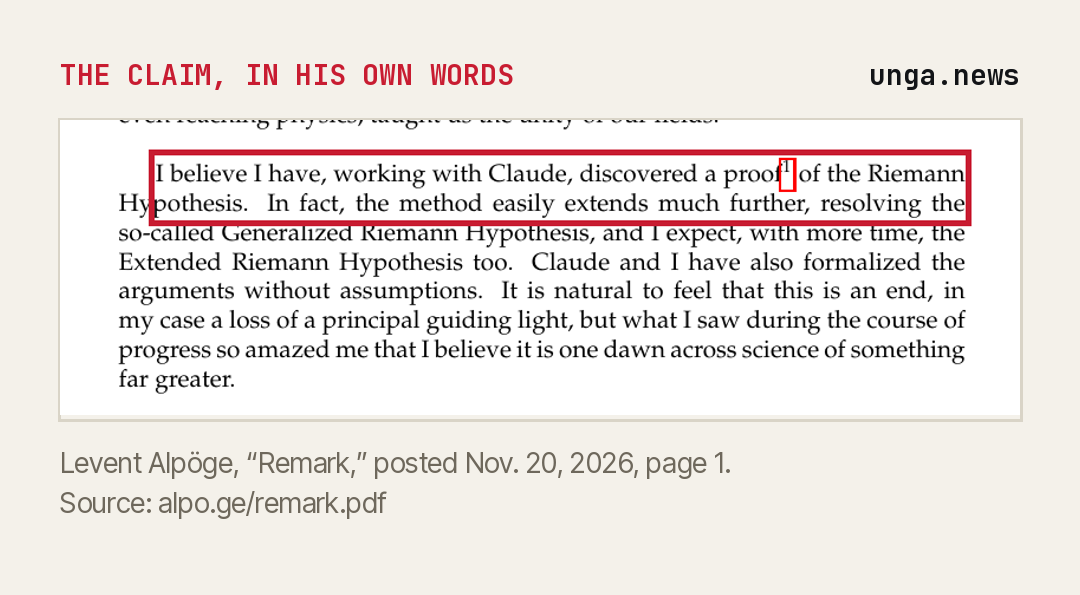
Levent Alpöge posted a four-page note titled “Remark” on his personal website on Friday, Nov. 20. The first claim lands in the second sentence: “I believe I have, working with Claude, discovered a proof of the Riemann Hypothesis.” He goes further, saying the same method settles a much larger version of the problem, the Generalized Riemann Hypothesis, and that he and Claude have checked the whole thing in a computer proof language “without assumptions.”
Nobody has confirmed it yet. That is the honest headline underneath the big one. But the claim is not coming from a crank with a blog, and the way he released it means the world will know fairly fast whether it holds up.
A $1 million question about prime numbers
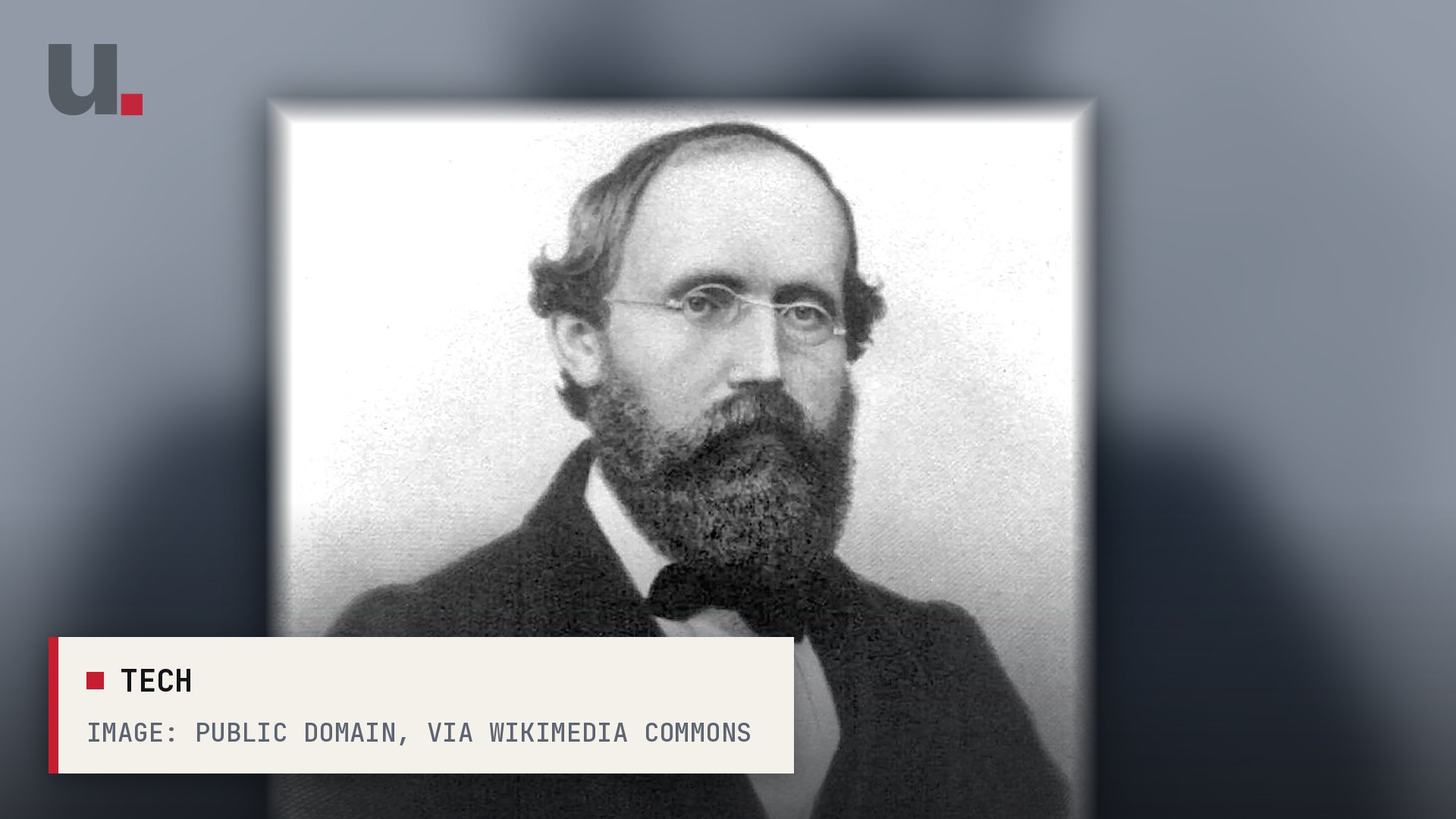
Here’s the problem in plain English. Prime numbers, the ones like 2, 3, 5, 7 and 11 that can’t be divided evenly by anything but 1 and themselves, look like they show up at random. In 1859 the German mathematician Bernhard Riemann guessed that hidden beneath that randomness is a precise order, governed by where a certain function hits zero. Prove his guess and you control how the primes are spread out, all the way to infinity.
For 167 years, nobody could. The Clay Mathematics Institute made it one of its seven Millennium Prize Problems and put a $1 million bounty on it. Only one of those seven has ever been officially solved. Scientific American, in its report on the claim, called it “the most famous open problem in math” and noted that most top experts barely worked on it because there was no obvious path in.
So why would anyone believe a proof dropped on a personal website on a Friday? Because of who wrote it and what he attached.
Who Alpöge is, and why he didn’t post a paper
Alpöge is a working number theorist, and he has a recent track record of big results built with SI. New Scientist reports that in July he showed the decades-old Jacobian conjecture is false with a counterexample just 216 characters long. In August, Anthropic said an unreleased research version of Claude had pushed a key Riemann-related number from 41.6% to 67.2%, and Alpöge was one of the two staff mathematicians who checked that work.
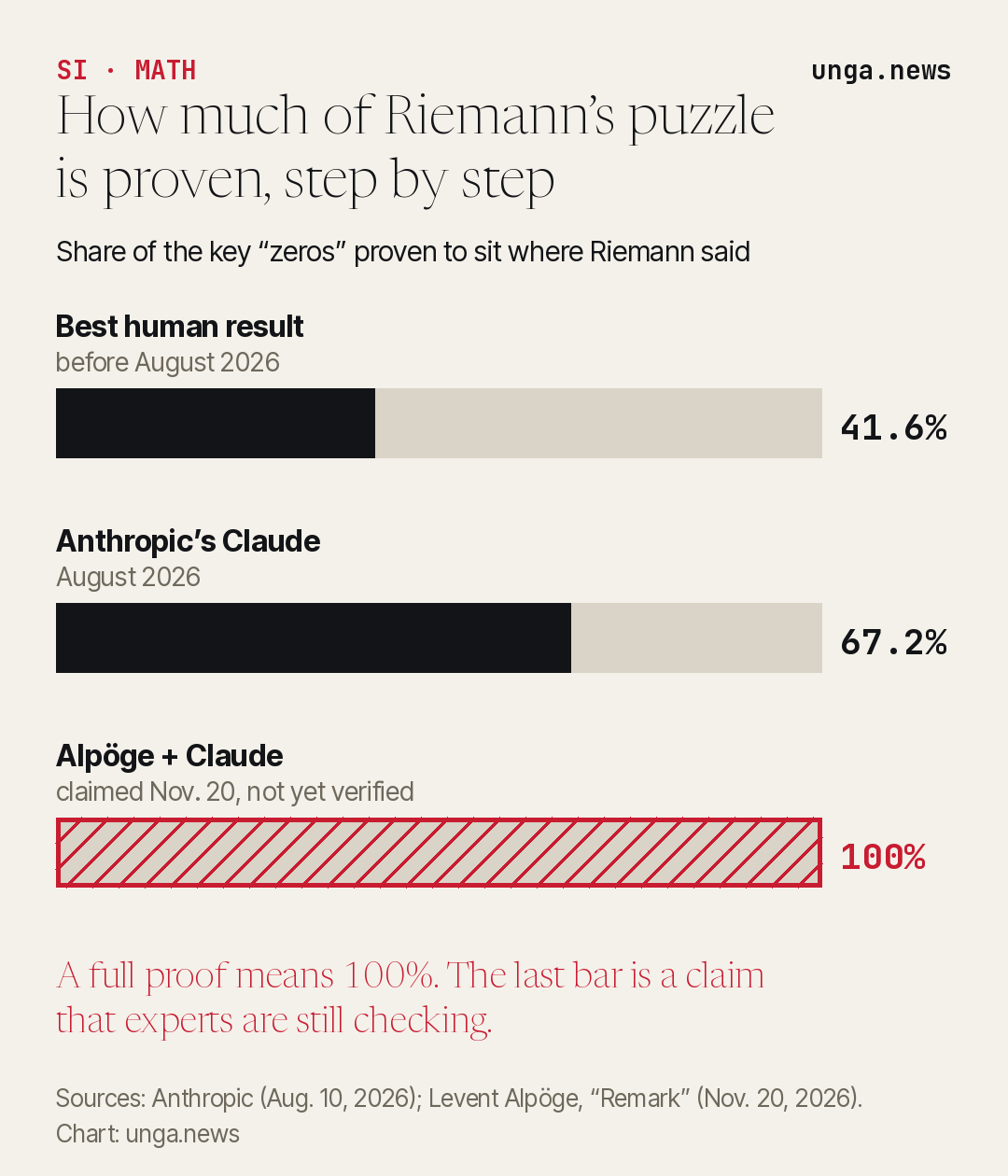
Anthropic was careful back then. Its Aug. 10 write-up said flatly, “We don’t expect that the techniques Claude used will lead to proving the Riemann hypothesis.” Three months later, one of its own mathematicians says a different approach did exactly that.
The unusual part is the format. There is no normal paper. Alpöge says a written-out version ran past 250,000 pages and that posting it would be an “obviously inappropriate” pile of what he calls “slop.” Instead he released the proof as code in Lean, a program mathematicians use to check every logical step by machine. If the code compiles and it states the real problem, the proof is about as airtight as proofs get.
Where the machine took over
The most striking passage in the note is about who did what. Alpöge says Riemann had been his private goal since he was a student, and that he steered the work toward the right setup. Then, he writes, “Claude far outpaced me near the finish line. No, Claude flew, and danced, and sparkled near that finish line.”
He also admits he doesn’t yet fully understand parts of his own proof. The pieces where Claude was the expert, he says, he is partly paraphrasing from the SI’s own summary, and the Lean code “should suffice to clarify everything.” A timeline he says Claude compiled runs from Oct. 6 to Nov. 16, the day it lists the generalized version as done.
That is a remarkable thing for a mathematician to put in writing. The person announcing the proof is telling you the machine did the part he can’t fully explain yet.
Timing raises eyebrows too, and Alpöge addresses it head on. He says the breakthrough came “late Sunday night,” that he messaged Anthropic chief Dario Amodei, and that there was “a constraint to respect” before announcing. The Verge reports he appears to have waited until after Anthropic’s record stock market debut on Thursday. Alpöge calls the cynical reading “false.” The Verge says Anthropic itself had not commented.
How fast the world will know
The checking has already started in public. Mathematician Elliot Glazer posted that the statement inside the code “is in fact GRH,” the generalized version, which answers the first worry about any machine proof: that it quietly proves the wrong thing. He said compiling would take a few hours. Imperial College London’s Kevin Buzzard, one of the best-known Lean experts, told New Scientist, “Let’s see if it compiles first.”
Thomas Bloom of the University of Manchester summed up the strangeness on 𝕏: he couldn’t decide what surprised him more, that SI claims to have proved Riemann, or that it claims a coherent proof that would run “250,000+ pages long” if written out for humans.
Even a clean compile won’t mean a check in the mail. Clay’s official rules say a solution must appear in a qualifying outlet, survive at least two years, and win “general acceptance in the global mathematics community.” That clock hasn’t started.
For regular people, the practical payoff is close to zero. It won’t change your bank’s encryption or make your phone faster. The real news is what it says about the tools. A year ago these systems fumbled college homework. Now a serious mathematician is crediting one with the final push on the hardest problem in his field. If Lean says yes, the line between “SI helps” and “SI discovers” just got erased, and every lab chasing the next big result will be racing to show it can do the same.
Sources
- Levent Alpöge — Remark (Nov. 20, 2026)
- Anthropic — Learning more about Claude’s mathematical capabilities (Aug. 10, 2026)
- Clay Mathematics Institute — Rules for the Millennium Prize Problems
- Scientific American — Anthropic mathematician claims to prove Riemann hypothesis, most famous problem in all of math (Nov. 20, 2026)
- New Scientist — Anthropic mathematician claims AI-assisted proof of the Riemann hypothesis (Nov. 20, 2026)
- The Verge — Anthropic mathematician claims to have solved prestigious Millennium Prize problem with Claude (Nov. 20, 2026)
- Elliot Glazer on 𝕏 — — on the formal statement in the Lean release (Nov. 20, 2026)
- Thomas Bloom on 𝕏 — — on the 250,000-page claim (Nov. 20, 2026)