

A Top Physicist Let SI Lead the Proof on a 50-Year-Old Puzzle About How the Universe Works
A UC Santa Barbara scientist says ChatGPT’s maker’s newest model built the math he couldn’t finish. He is just as clear about what it hasn’t proved yet.
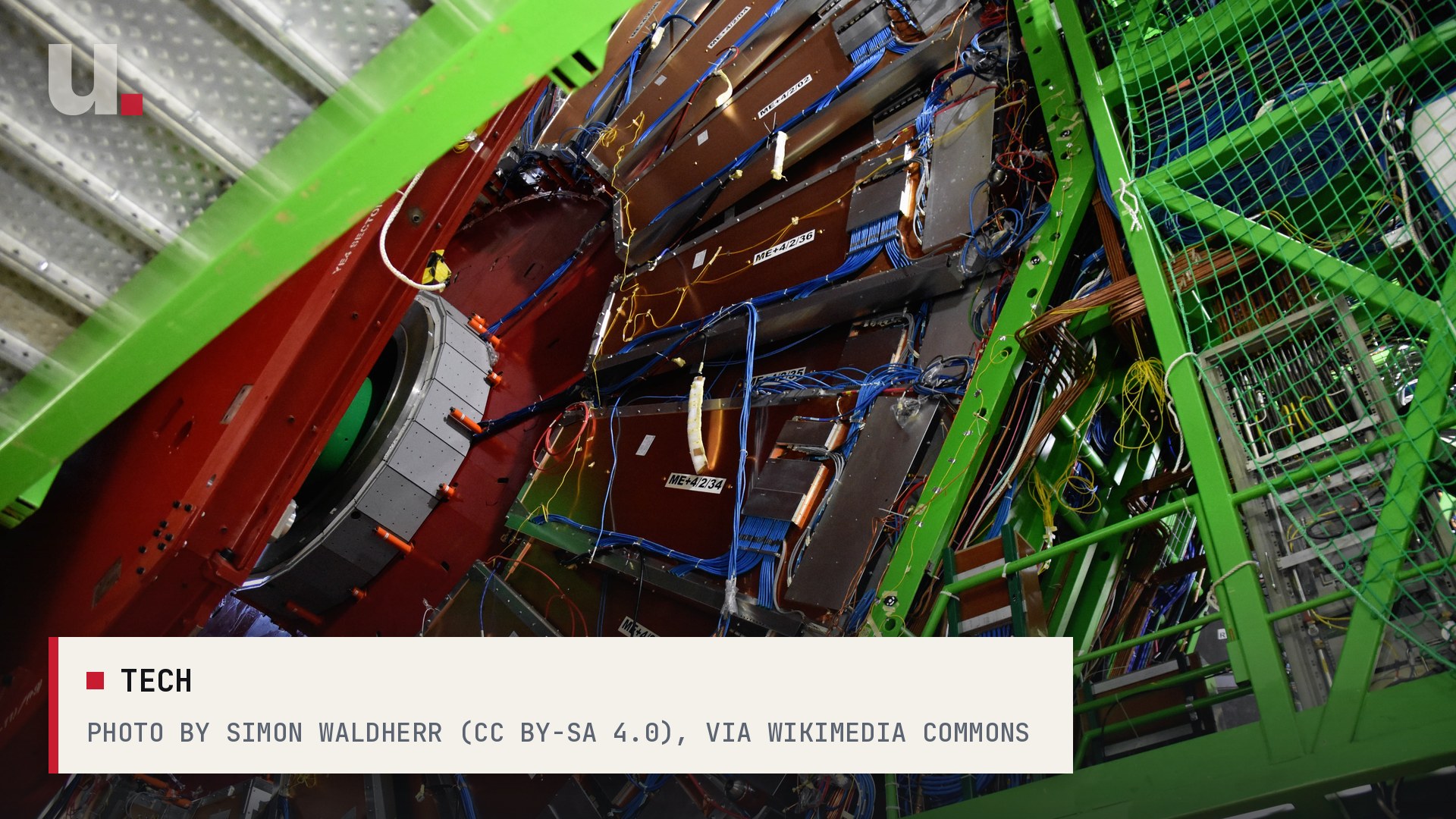
Your phone, the sun and every atom in your body obey rules that one theory describes better than anything else humans have ever written down. Physicists call it the Standard Model. It predicts what happens when particles collide at the Large Hadron Collider, and it predicts the faint radio signal hydrogen gives off across space. Its track record is close to perfect.
Here is the embarrassing part. More than fifty years after it took shape, nobody has been able to write the whole theory down in a form that stands on its own two feet mathematically. On Sunday, one of the country’s top particle physicists said an SI model helped him build a candidate fix, and that the machine did most of the heavy lifting on the proof.
Nathaniel Craig leads the particle theory group at the University of California, Santa Barbara, and is a permanent member of its Kavli Institute for Theoretical Physics. He is also a visiting scientist at OpenAI, and he wrote the first guest post on the company’s new science blog. His verdict on the company’s GPT-6 Astra model was blunt: “Astra helped turn that strategy into a construction and took the lead in developing the detailed proof.”
OpenAI: Physicist Nathaniel Craig shares how he worked with GPT-6 Astra to develop a candidate lattice definition of the Standard Model.
— @OpenAI View on 𝕏
The glove problem
To see why this matters, start with how physicists actually calculate. Most of the time they pretend the forces between particles are switched off, solve that easy version exactly, then add the forces back in as a string of small corrections. It works beautifully when the corrections really are small. It is how they predicted the magnetism of the electron to within a few parts in a trillion.
It falls apart when the forces are strong. Craig’s example is the proton. Most of its mass comes from the motion and pull of the quarks and gluons inside it, so if you switch the strong force off, the proton simply falls apart. You can’t treat that as a small correction to nothing.
The workaround is to chop space and time into a grid, called a lattice, and let a supercomputer crunch the theory point by point with every force switched on from the start. That approach is how physicists finally calculated the proton’s mass from first principles. But it has never worked for the full Standard Model, because of the weak force, the one behind certain kinds of radioactive decay.
The weak force is picky about handedness. Craig compares it to gloves. A pair of gloves looks the same in a mirror, but a single left glove turns into a right one. The weak force only grabs “left-handed” particles. Put those particles on a grid the obvious way, he writes, and “the most natural rules give you a right-handed partner you never asked for.” The grid quietly invents particles that don’t exist, and the math stops describing our universe.
Four decades of partial fixes
Some of the sharpest minds in physics have spent careers on that one headache. In 1982, Paul Ginsparg and Nobel winner Ken Wilson worked out the rule a grid would have to obey. In 1994, Rajamani Narayanan and Herbert Neuberger found a way to describe particles on the grid that follows it. In 1999, Martin Lüscher showed how to keep only the left-handed particles and solved the last tricky piece, a kind of bookkeeping for a quantity called the phase, but only for a simpler, stripped-down theory. For the real Standard Model, Craig writes, that piece “remained open for more than 25 years.”
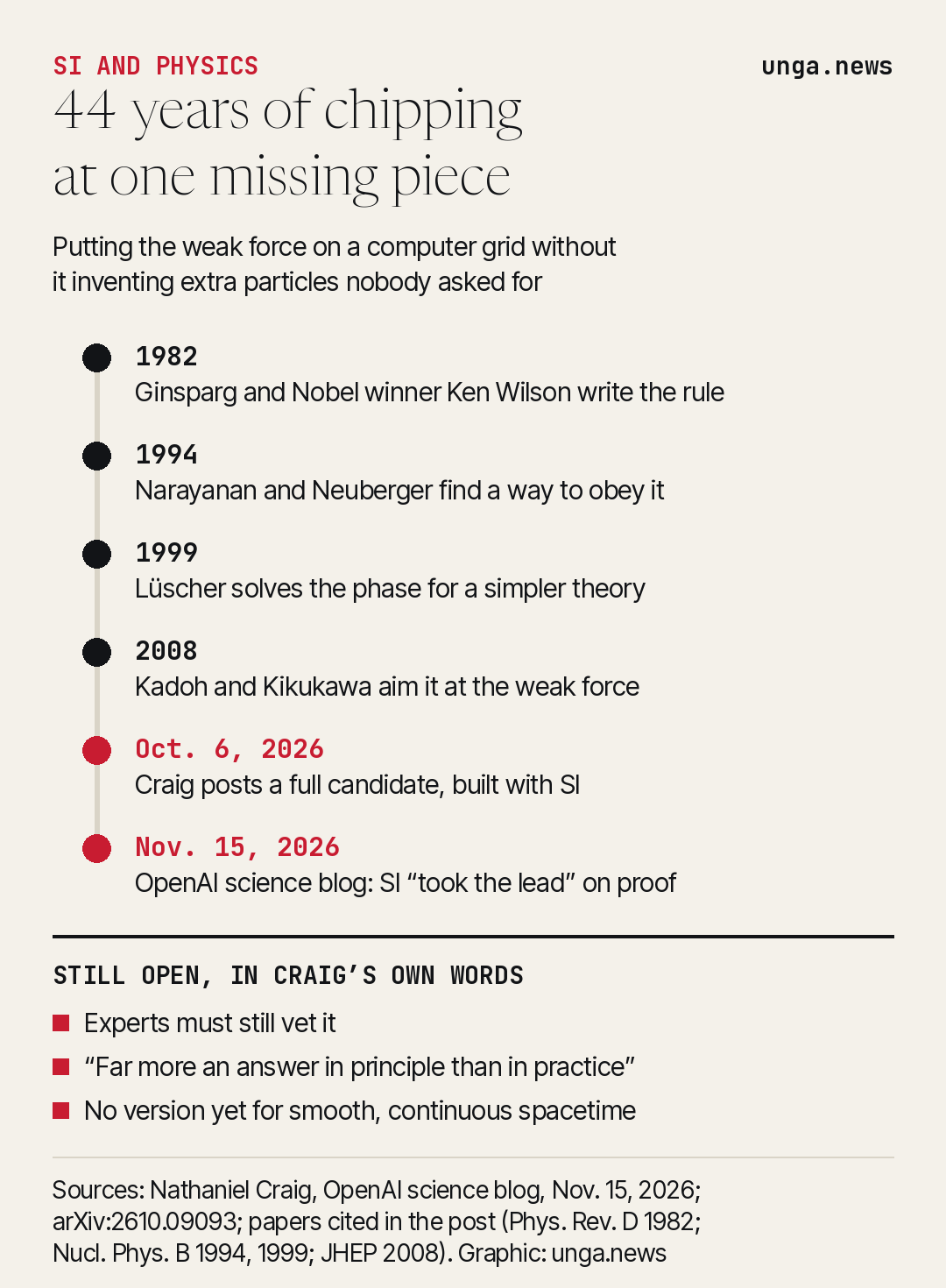
Craig had an idea for finishing the job. Take the forces on the grid you care about, copy them onto finer and finer grids, compare the allowed particles on each pair of neighboring grids, and add up the differences to get the right phase on the original. What he could not do was prove it worked in every case it had to cover.
That is where the SI came in. By Craig’s account, Astra suggested the right way to carry the forces onto the finer grids, showed that the comparisons settle on a definite answer instead of running off to infinity, and led the detailed proof. He calls it “essential to turning the refinement idea into a working construction.” The result went up on arXiv on Oct. 6 as “A gauge-invariant measure for lattice chiral fermions”, with Craig as the only listed author.
A scientist who keeps the receipts
What makes this worth trusting is how carefully Craig fences it in. He did not hand the result to the public on the SI’s say-so. Three veteran lattice physicists, Maarten Golterman, Andreas Kronfeld and Yigal Shamir, went over Astra’s proof and pushed on it with hard questions, which he says helped him build confidence in it.
He calls it a “candidate,” not a solved case. He says it is “far more an answer in principle than an answer in practice,” with a lot of work ahead before anyone can use it in a real simulation. He is still checking a technical condition that ties the grid version to a quantum theory where probabilities add up properly. And the grid version still has to be connected to smooth, continuous spacetime.
That last gap is where this gets bigger. Craig points to OpenAI’s separate proof that Yang-Mills theory, the math family the strong and weak forces belong to, exists in a mathematically rigorous sense. That is the first half of one of the Clay Mathematics Institute’s $1 million Millennium Prize problems. Scientific American reported Nov. 11 that a committee led by Nobel laureate David Gross, picked by OpenAI to vet that proof, confirmed it in the computer proof checker Lean, while admitting they “do not claim to fully understand the proof yet.” The harder second half, the so-called mass gap, is still unsolved.
Put those two together and the picture is striking. Not long ago, the standard knock on SI was that it could talk about hard science but not do it. Now a top physicist is putting his name on work where the machine did the grinding, and an American company is publishing the receipts on its own blog for anyone to check.
The honest score is this: an American SI did serious, checkable work on a problem older than most of the people reading about it. Whether physicists end up accepting Craig’s construction is now up to them, and that is exactly how it should be.
Sources
- OpenAI — A step toward defining the Standard Model on a lattice, by Nathaniel Craig (Nov. 15, 2026)
- OpenAI on 𝕏 — OpenAI on 𝕏 — Physicist Nathaniel Craig shares how he worked with GPT-6 Astra (Nov. 15, 2026)
- arXiv — Nathaniel Craig, A gauge-invariant measure for lattice chiral fermions, arXiv:2610.09093 (Oct. 6, 2026)
- Scientific American — Scientists confirm OpenAI’s blockbuster quantum physics result (Nov. 11, 2026)
- Physical Review D — P. H. Ginsparg and K. G. Wilson, A remnant of chiral symmetry on the lattice, Phys. Rev. D 25, 2649 (1982)