

A Walking Humanoid Robot Is Headed Into an American Chipmaker’s Factories to Try Out for Real Jobs
Boston Dynamics’ Atlas will start tests inside GlobalFoundries plants in early 2027, after two robot dogs logged 90,000 inspections at one fab. Hyundai now owns all of Boston Dynamics and wants 30,000 humanoids a year.
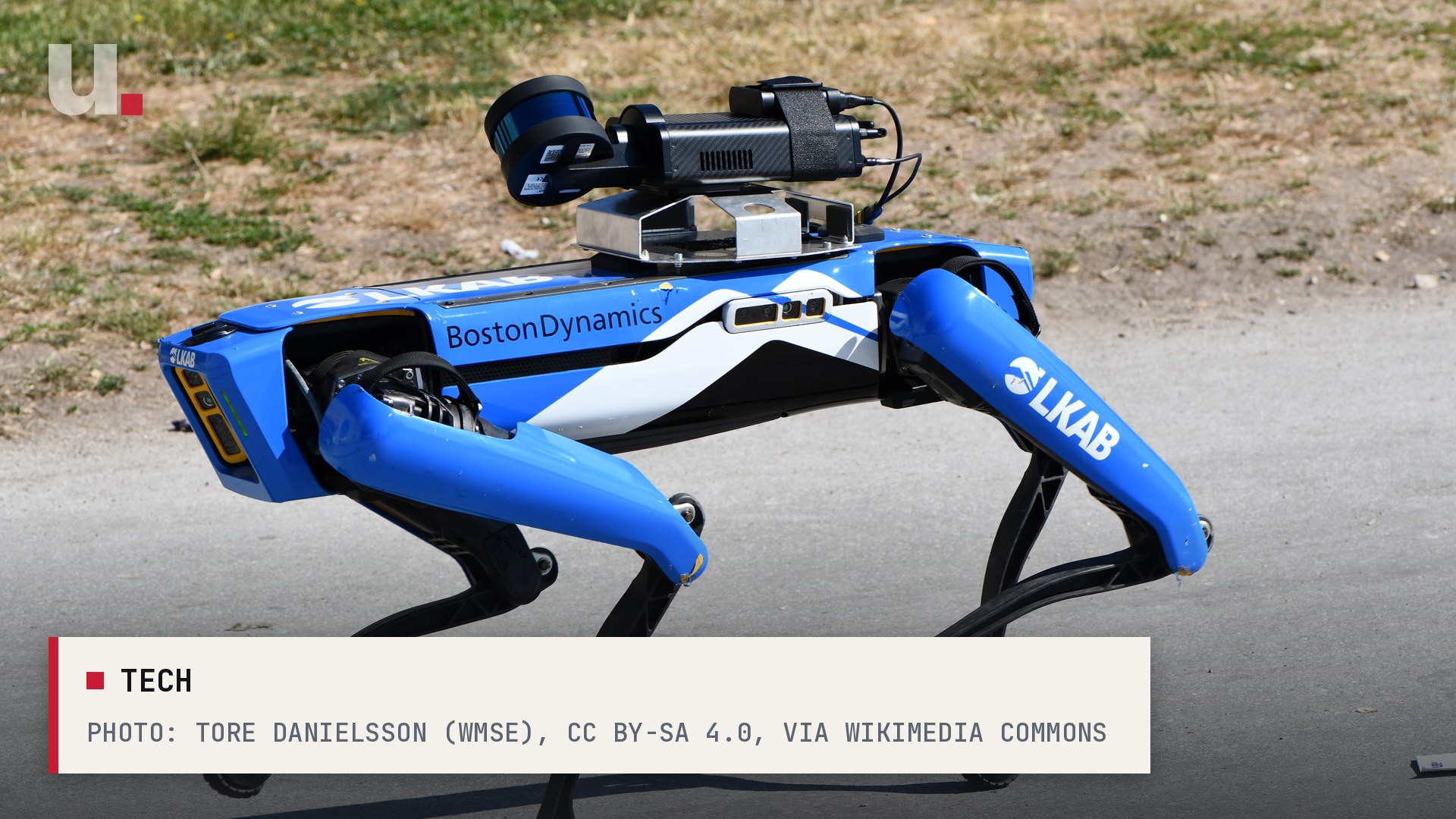
For four years a yellow robot dog has been walking the basement of a chip factory in Burlington, Vt., reading gauges and checking equipment so a human doesn’t have to. Now the company that built it wants to send in something much more ambitious: a robot shaped like a person.
Boston Dynamics and GlobalFoundries, the New York-based chipmaker that builds semiconductors for cars, phones, defense systems and data centers, announced Nov. 17 that the chipmaker will start testing Atlas, Boston Dynamics’ electric humanoid, inside its plants beginning in early 2027. GlobalFoundries is the first customer outside the car business to join the Atlas early adopter program, and the companies call it the first program of its kind for chip manufacturing.
The same day, a filing in Korea confirmed that Hyundai Motor Group now owns every share of Boston Dynamics. Put the two together and you get a clear picture of where walking robots are headed next: out of the lab, past the car plant, and into the factories America has been fighting to bring home.
The dog has already earned its keep
Atlas gets the headlines, but the reason GlobalFoundries is willing to try a humanoid is the four-legged robot that came first. Spot has worked at the Burlington plant for more than four years. In April the chipmaker sent two Spots to its plant in Singapore, where they work in the sub-fab, the cramped utility level below the clean room packed with pumps, pipes and power equipment.
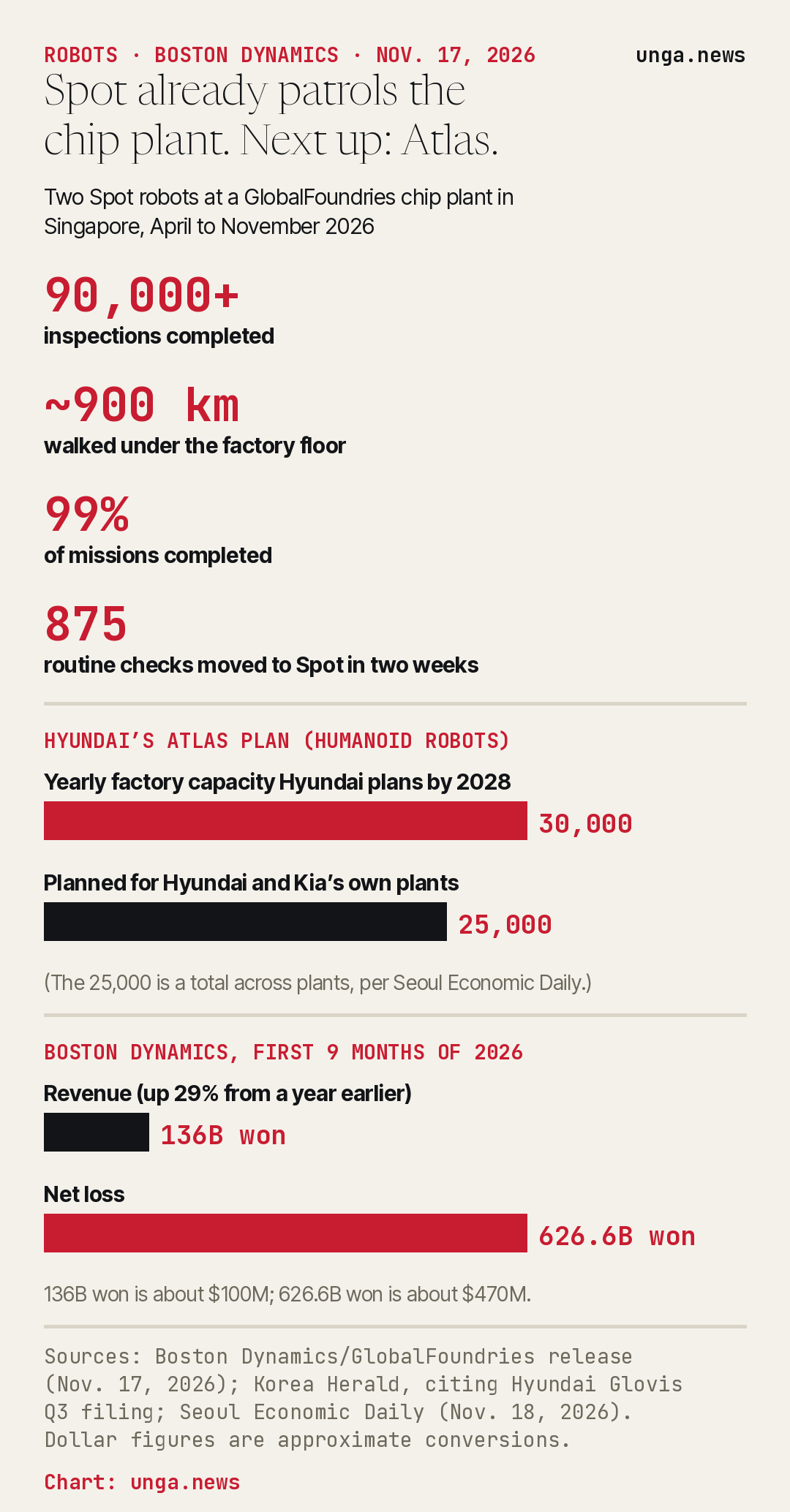
The numbers from that run are the most concrete part of the announcement. According to the companies, the two Singapore robots have walked nearly 900 kilometers, about 560 miles, and finished more than 90,000 inspections since April, with a 99% mission success rate. The chipmaker says it moved 875 routine inspections over to Spot in just two weeks using newer hardware and software, and it plans to more than double that number.
Now Spot is spreading across the company’s network: Malta, N.Y.; Burlington; Dresden, Germany; and Singapore. Malta is the one Americans should notice. It’s GlobalFoundries’ flagship fab in upstate New York.
“Spot has helped us shift from reactive to predictive maintenance, collecting data across thousands of inspection points to prevent downtime and keep our fabs running more efficiently,” said Pradip Singh, the chipmaker’s chief manufacturing officer. “Scaling Spot and testing Atlas are the next steps in our journey to AI-enabled manufacturing, putting physical AI to work across our operations worldwide.”
What a humanoid would actually do
Here the honest answer is that nobody knows yet, and the companies say so. The 2027 program is a tryout. The stated goals are to figure out which jobs a humanoid could handle, check whether the plants are ready for one, work out how it would plug into existing equipment, and begin early training on specific tasks.
Seoul Economic Daily, citing industry sources, reported that Atlas will learn to move wafers and other components. That is a tall order. Chipmaking happens at the scale of nanometers, where a tiny slip can ruin a batch, and modern fabs already move wafers with overhead robots on rails. A humanoid’s real value would be in the messy, in-between work those fixed machines can’t reach: carrying parts, loading tools, walking the same routes a technician walks today.
Zack Jackowski, Boston Dynamics’ chief product and technology officer, framed the deal around the data. Customers like GlobalFoundries, he said, are “realizing real operational value today while collecting the kind of data that will be extremely useful toward future manufacturing innovation in the next few years.”
For workers, the chipmaker is pitching this alongside its own program to train employees in SI. Nobody in the announcement talked about cutting jobs. The early pattern with Spot is telling: the robot took the boring, repetitive rounds in a hot, noisy basement, and people got the data.
Hyundai bets the farm on Atlas
The ownership change explains why Boston Dynamics is suddenly hunting for customers. According to the Korea Herald, a third-quarter filing by Hyundai Glovis showed that every remaining put and call option on Boston Dynamics stock had been exercised, closing out the purchase of SoftBank’s last 9.65% stake. Chairman Chung Euisun and Hyundai affiliates now own 100% of the company. Edaily reported that Hyundai also sold its stake in the separate research institute led by founder Marc Raibert to SoftBank, leaving Boston Dynamics focused on building and selling products.
The ambition is enormous. Hyundai is building capacity to make 30,000 Atlas robots a year by 2028. The first ones go to Hyundai Motor Group Metaplant America near Savannah, Ga., starting with lighter work like sorting and moving auto parts before moving to assembly once the technology proves itself. Seoul Economic Daily reported Hyundai plans to put about 25,000 Atlas units into Hyundai and Kia plants worldwide. To keep a 30,000-a-year factory busy, it will need outside buyers like GlobalFoundries.
The money hasn’t caught up yet. Boston Dynamics’ revenue for the first nine months of 2026 rose 29% to about 136 billion won, roughly $100 million, the Korea Herald reported. Its net loss widened to 626.6 billion won, or about $470 million, because of heavy research and production costs. Sources told the paper a stock market listing could come around 2029 or 2030, though no timeline has been set.
Why the chip plant matters
A humanoid in a car plant is a story about one company using its own robot. A humanoid in a chip plant run by somebody else is a market test. If Atlas can earn a spot in a fab, where precision is everything and downtime is ruinously expensive, it can probably earn one in warehouses, aerospace shops and battery plants too.
That matters for a country trying to rebuild its factory base with fewer young people lining up for factory work. The hard truth is that America isn’t going to win the chip race on cheap labor. It wins by building plants that run smarter, safer and around the clock. A robot dog that has walked 560 miles under a factory floor without complaining is a decent start. Next year we find out if its two-legged sibling can do the same.
Sources
- Boston Dynamics — Boston Dynamics & GlobalFoundries Expand Robotics Collaboration (Nov. 17, 2026)
- The Korea Herald — Hyundai Motor takes full ownership of Boston Dynamics
- Seoul Economic Daily — Hyundai’s Atlas Robot Moves Wafers at U.S. Chip Plant
- Edaily — Hyundai Motor Accelerates Beyond Robot Research to ‘Mass Production’; Atlas Heads to Semiconductor Factories
- Hankyung — Hyundai Motor Group robot Atlas heads into a chip plant for the first time (Korean)