

A Year After Its Betting Scandal, the NBA Teams Up With Kalshi and Polymarket
The league named the two prediction-market giants its preferred partners and signed an integrity pact with the federal CFTC, banning staff from trading and promising to flag suspicious bets.
The NBA said Monday it has picked Kalshi and Polymarket, the two biggest prediction-market exchanges, as its "preferred" partners, and signed a separate information-sharing pact with the federal regulator that polices those markets. On these sites, fans don't bet against a sportsbook. They buy and sell yes-or-no contracts with each other, like "Will the Lakers win tonight?", and the price moves with the crowd.
The timing is the story. It was almost exactly a year ago that Kash Patel's FBI and federal prosecutors in Brooklyn arrested Terry Rozier and Damon Jones in a sweeping insider-betting case that shook the league. Now the NBA is putting its logo on the fastest-growing way to trade on its games, and betting that tighter rules, not distance, will keep the game clean.
What the NBA signed
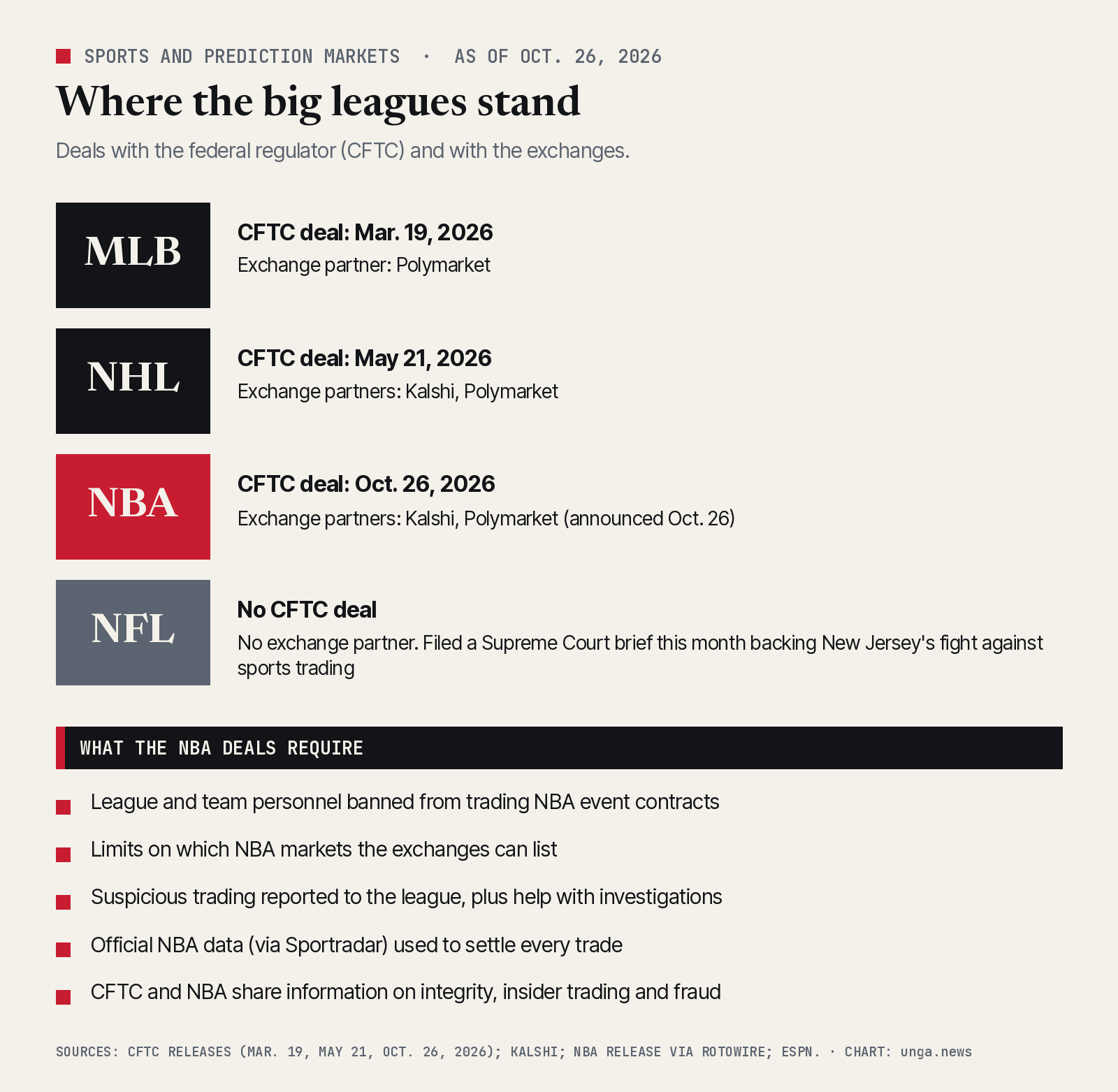
Both exchanges get the title "Preferred Prediction Market Exchange of the NBA," the right to use league and team logos, official NBA stats from the league's data partner Sportradar to settle every trade, and approved marketing. The NBA also expanded its existing deals with sportsbooks DraftKings and FanDuel to cover their prediction-market products.
In return, the league gets real control. Under the deals, the NBA limits which markets can be listed, league and team staff are banned from trading NBA contracts, and the exchanges must report suspicious trading and help with league investigations. "Protecting the integrity of the game is our top priority," said Scott Kaufman-Ross, the NBA executive who runs the league's partnerships, in the league's release.
The feds are in the room
The bigger piece may be the deal with Washington. The Commodity Futures Trading Commission, the agency that regulates these exchanges, announced its own agreement with the NBA on Monday, promising regular contact and shared information on integrity. CFTC Chairman Mike Selig said the NBA "joins the MLB and NHL in taking a responsible step toward protecting sports integrity and market participants from abuses in prediction markets like insider trading and fraud," and thanked Commissioner Adam Silver "for putting the integrity of professional basketball and America's financial markets first."
CFTC Chairman Mike Selig on the NBA agreement, Oct. 26, 2026
— @ChairmanSelig View on 𝕏
That's not just talk. In August, Selig's agency fined and banned a White House teleprompter operator who used early looks at the president's speeches to trade "mention" contracts on what words he would say. He made more than $107,000 between December 2025 and February 2026, and the CFTC made him hand it all back, pay a $65,000 penalty and stay off the markets for three years. The agency credited Kalshi with helping catch him. That's the pitch in one case: every trade on a federally regulated exchange leaves a trail.
Why the scandal still matters
The Brooklyn case is why the league can't shrug this off. According to the indictment prosecutors unsealed on Oct. 23, 2025, Rozier, then with the Charlotte Hornets, tipped a friend that he would leave a March 2023 game early with a "purported injury." The group put more than $200,000 on him to underperform. He left after nine minutes. Jones, a former player and coach, is accused of selling private injury news about Lakers stars. Prosecutors stressed the charges are allegations. Former Raptor Jontay Porter, who left two 2024 games early so others could cash bets on him, had already pleaded guilty.
Those bets went through regular sportsbooks, where it can take months to connect the dots. The NBA's new deals are built so that a suspicious trade on its games gets flagged straight to the league and, through the CFTC pact, to federal regulators.
The fight it walks into
There's a turf war over all of this. Many states say sports contracts on these exchanges are illegal sports betting dodging state gambling laws, and New York, where the NBA is based, is suing the exchanges. New Jersey has asked the Supreme Court to settle the question, and the NFL, the only major league without a prediction-market partner, filed a brief this month backing New Jersey. The exchanges say they're federally regulated financial markets, and only Washington gets the final word.
Silver has made his preference plain. "Frankly, from at least the NBA standpoint, we have roughly 40 different jurisdictions regulating us right now," he said, in remarks Kalshi quoted in its announcement. "So to have a consistent policy nationally, I think would be in our best interest." Kaufman-Ross told ESPN the league will stay out of the Supreme Court fight. "The jurisdictional issue is not our issue. Our issue is the way that our game is impacted," he said.
Kalshi announces its NBA partnership, Oct. 26, 2026
— @Kalshi View on 𝕏
What happens next
Kaufman-Ross told ESPN the contracts already plan for the day a court might shut sports markets down. The money is huge either way: RotoWire, citing Aldrin Research, counted more than $13.86 billion traded on NBA single-game markets from Jan. 1 through last season's Finals, and more than $1.58 billion since Oct. 1. The NBA's biggest name is already on board. LeBron James became a Polymarket spokesman in September.
The bottom line: one year after an FBI case showed how easy it was to cash in on locker-room secrets, the NBA decided it would rather have the traders inside a fence it helps build, with federal cops watching, than out on its own. Now the Supreme Court may decide whether that fence stands.
Sources
- CFTC — CFTC and National Basketball Association Sign MOU to Protect Integrity in Professional Basketball (Oct. 26, 2026)
- Kalshi — Kalshi and the NBA are partnering (Oct. 26, 2026)
- X (@ChairmanSelig) — CFTC Chairman Mike Selig on the NBA MOU (Oct. 26, 2026)
- X (@Kalshi) — Kalshi: The NBA has partnered with Kalshi as a Preferred Prediction Market Exchange (Oct. 26, 2026)
- CFTC — CFTC Orders Gabriel Perez to Pay $172,000 for Insider Trading of Mention Market Event Contracts (Aug. 28, 2026)
- U.S. Attorney's Office, E.D.N.Y. — Current and Former NBA Players and Four Other Individuals Charged in Widespread Sports Betting and Money Laundering Conspiracy (Oct. 23, 2025)
- ESPN — NBA partners with Kalshi and Polymarket amid regulation fight (David Purdum)
- RotoWire — NBA Completes Deal With Prediction Market Operators, Federal Regulators (Bill Speros)
- AP — NBA announces new agreements with prediction markets, eyeing integrity (Tim Reynolds)