

Agents Guarding Portland’s ICE Building Don’t Have to Wait to Get Hurt, Appeals Court Rules
Two Trump-appointed judges threw out a pair of Oregon orders that limited tear gas and pepper balls outside the building, and an order to redesign agents’ uniforms. “Courts cannot be the couture of the executive branch,” one wrote.
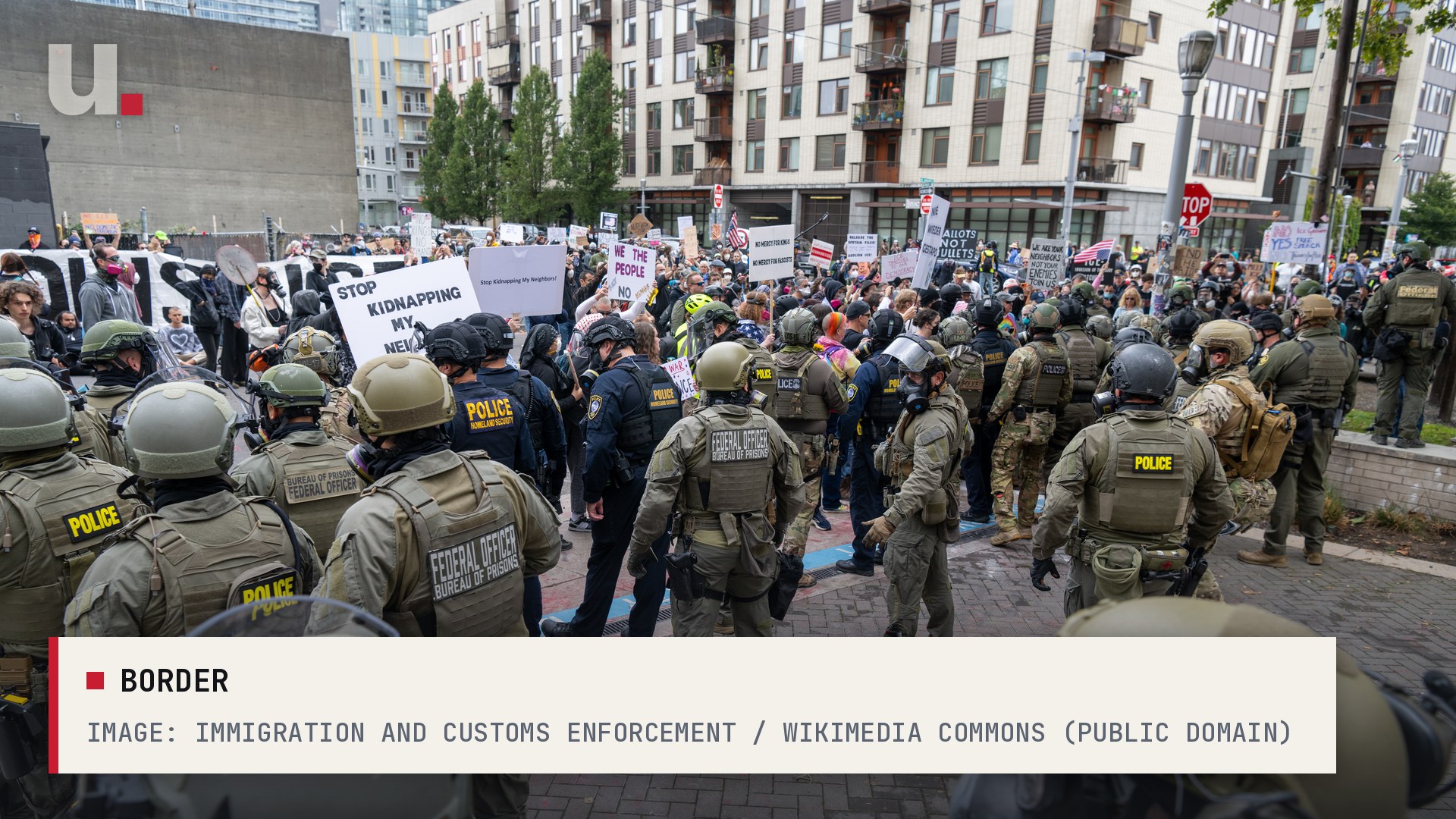
Federal officers guarding the immigration building in Portland, Oregon, no longer have a judge’s rulebook telling them they can’t clear a violent crowd until someone is about to get hurt. A federal appeals court threw out two Oregon orders on Tuesday that had boxed in how agents could use tear gas, pepper balls and other nonlethal tools outside the ICE office on the city’s South Waterfront.
The two rulings came from the same three-judge panel of the Ninth Circuit, the West Coast appeals court that conservatives have spent years complaining about. Both were 2-to-1. In the bigger case, Judge Kenneth K. Lee put the core point in one plain sentence: “Law enforcement agents may use nonlethal force to clear crowds and restore order—they need not wait until they face ‘an imminent threat of physical harm.’” That line is on page 7 of his opinion, and it is the whole ballgame.
A year at the front door
If you haven’t followed Portland, the court laid out the scene for you, and it isn’t a church picnic. Between June 2025 and February 2026, the opinion says, at least 150 protests were staged at that one building, with crowds as large as several thousand people.
Judge Lee was careful to say many of those people were peaceful. But he also listed what agents faced on the worst nights: people carrying bats and homemade weapons while wearing shields and ballistic vests, protesters hurling “rocks, glass, bricks, metal” at officers, fireworks flung toward the building, security cameras smashed, plywood torn off the guard shack, pallets stacked against the doors, and “high-powered strobe lights and lasers” aimed at officers’ eyes. One protester threw a smoke canister onto the roof and started a fire. One officer was dragged by a crowd.
Tear gas, the court noted, lets outnumbered officers break up a crowd without wading in with batons. Fewer people get hurt that way, not more.
The man in the chicken suit
The protester case was brought by five people: peaceful demonstrators and freelance journalists who got hit by gas or pepper balls. One of them, Jack Dickinson, is known locally as the Portland Chicken, because he shows up to protests in a yellow chicken suit. The opinion notes that Dickinson himself confirmed he and others would block the ICE driveway on purpose and refuse lawful orders to clear it. On Jan. 19 he and about 20 others trespassed on the driveway, and four of them, Dickinson included, were taken into custody.
That detail matters, because the plaintiffs’ theory was that federal agents were singling them out to punish their speech. The panel didn’t buy it. The record, Lee wrote, doesn’t show agents meant to retaliate, and it doesn’t show some unwritten DHS policy of going after protesters for their views. In his words, the plaintiffs “appear to be unfortunate collateral casualties of federal agents’ efforts to quell an unruly and sometimes violent crowd.”
Judges are not tailors
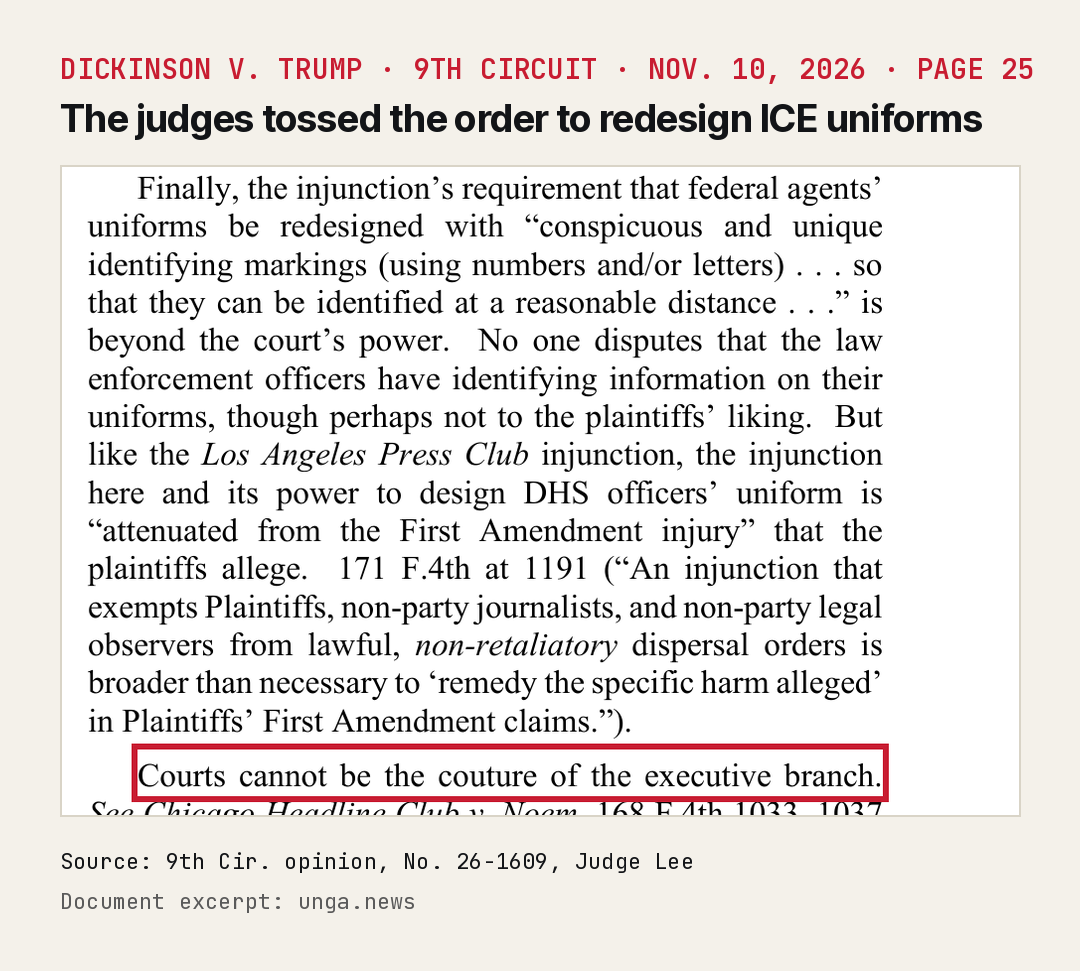
U.S. District Judge Michael H. Simon’s order, issued March 9, went well beyond tear gas. It barred officers from firing chemical or impact rounds unless the specific person they aimed at posed an imminent threat of physical harm. It limited pepper spray to people showing at least “active resistance.” It certified a class of everyone who has, wants to, or will “nonviolently protest against or report on DHS activities.” And it ordered ICE to change its agents’ uniforms to carry “conspicuous and unique identifying markings” readable at a distance.
That last part got the line of the day. “No one disputes that the law enforcement officers have identifying information on their uniforms, though perhaps not to the plaintiffs’ liking,” Lee wrote. “Courts cannot be the couture of the executive branch.”
I’ll admit that one made me laugh. It’s also exactly right. A district judge in Portland was about to become ICE’s fashion designer, and the appeals court reminded him that federal courts “must be reluctant to expand their authority by requiring intrusive and unremitting judicial management of the way the Executive Branch performs its duties.” The panel also tossed the giant class, saying a group that big and that varied doesn’t share the same legal claim.
No right to never smell tear gas
The second case came from the neighbors. Tenants of an apartment complex across the street, along with the nonprofit that runs it, said gas drifted over to their homes, and U.S. District Judge Amy M. Baggio agreed and banned the government from using it to disperse crowds there. Judge Eric C. Tung, writing for the majority in the second opinion, said there is no constitutional right “to be free from the government’s use of non-lethal crowd-control devices in response to disruptive demonstrations.”
Tung used the same test the Supreme Court used in the Dobbs abortion case: a right the Constitution doesn’t mention has to be deeply rooted in the nation’s history and tradition. The tenants, he wrote, didn’t point to “any historical prohibition—much less a ‘deeply rooted’ one” against police using these tools. Quite the opposite, he wrote: “such devices have long been a common tool of law enforcement to disperse crowds that have turned disruptive and violent.”
Judge de Alba’s line in the sand
The third judge on the panel, Ana de Alba, dissented in both cases. She agreed three parts of Simon’s order went too far, including the imminent-threat rule, the pepper-spray limit and the uniform redesign. But she would have kept the ban on firing munitions “at the head, neck, or torso of any person” unless deadly force would be justified, and she would have let the class stand. In the neighbors’ case, she said the tenants were likely to win.
Her dissent also spells out the protesters’ side in detail. Journalist Hugo Rios says an officer shoved him and damaged his camera until it stopped recording, and later he was hit by pepper balls about 20 times. Those claims are still in the record, and the lawsuits themselves are not over.
That is the part to keep straight. Tuesday’s rulings wipe out the temporary bans, not the cases. According to OPB, the same panel had already put both orders on hold over the summer, and federal officers haven’t used tear gas or similar chemicals at the facility in months. So nothing changes on the street tonight. What changes is the rule a judge has to follow next time.
Lee and Tung, the majority in both cases, were appointed by President Trump. The American Civil Liberties Union of Oregon represented the protesters and journalists. They can ask the full Ninth Circuit to rehear the cases. Until then, the law in the West says an officer facing a crowd throwing bricks doesn’t have to wait for one to land.
Sources
- U.S. Court of Appeals for the Ninth Circuit — Dickinson v. Trump, No. 26-1609, opinion filed Nov. 10, 2026
- U.S. Court of Appeals for the Ninth Circuit — REACH Community Development v. U.S. Department of Homeland Security, No. 26-1575, opinion filed Nov. 10, 2026
- OPB — Appeals court panel ends temporary ban on tear gas near Portland ICE building
- The Oregonian/OregonLive — Judges’ restrictions on force, tear gas at Portland ICE protests thrown out on appeal