

Alibaba Says Its New SI Turned Nearly Eight Hours of Factory Prep Into 24 Minutes
A week after opening its top model with no test scores, the Chinese tech giant is selling it to businesses. Nearly every number so far is its own.
A week ago, Alibaba switched on its most powerful SI for a two-week tryout and didn’t publish a single test score. On Tuesday it came back with numbers, a sales pitch and a bold claim: on one factory job, its new model cut nearly eight hours of hands-on work down to 24 minutes.
The Chinese tech giant’s cloud business announced Qwen4-Max for enterprise teams in a release datelined San Francisco, calling it “an always-on AI colleague that works, creates and explores alongside people.” It’s the same model Alibaba opened as a short preview on Nov. 11, when, as we reported, it offered no benchmarks, no model size and no price. Now most of those blanks are filled in. Almost every one of them is filled in by Alibaba itself.
Finally, a size and a score
Start with how big it is. Alibaba says Qwen4-Max has 2.4 trillion total parameters, the internal settings a model learns during training, with 71 billion of them active on any given word. It can read images directly and hold about a million tokens in its working memory at once, which is several thick novels’ worth of text or a large chunk of a company’s files.
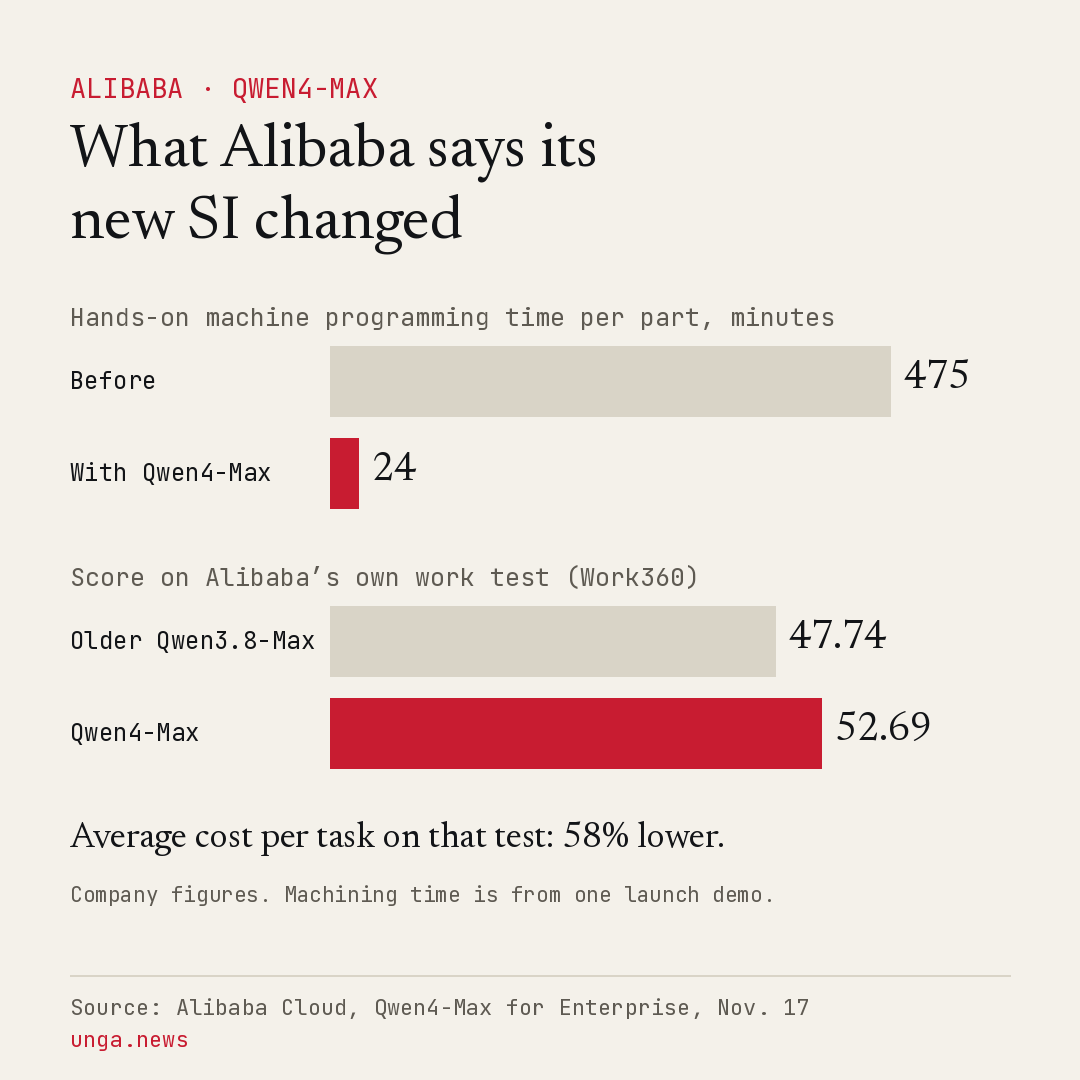
Then the scores. On Work360, a test Alibaba’s own Qwen team built to cover 26 broad fields and 721 narrow ones of professional work, Qwen4-Max scored 52.69, up from 47.74 for the older Qwen3.8-Max. Alibaba says it gets there using roughly a quarter to a third fewer tokens, the chunks of text a model reads and writes and that companies pay for, and that the average cost per task on that test dropped 58%.
There’s also a security number, which matters because businesses increasingly let SI write their software. On a secure-coding test, the share of functions that both worked and passed security checks rose from 22.0% for the older model to 31.8%. That’s a real jump. It also means more than two out of three still fell short of that bar.
The demos behind the eight-hour claim
The eye-catching results come from launch demonstrations, and Alibaba is upfront that they’re hand-picked. Its own FAQ says they come from specific demos “in the case shown” and that “results depend on the task, the tools and the data.”
In manufacturing, Alibaba says the model turned flat 2D factory layouts into 3D production lines, planned the paths cutting tools take through metal, ran simulations and caught spots where a tool would cut too deep or not deep enough before any metal was touched. In the case it showed, hands-on programming time per part fell from about 475 minutes to 24, a drop of about 95%.
In a lab test, Alibaba says Qwen4-Max ran on its own for 48 hours, hooked up to computers and a robotic lab, sorted through a pool of 2.7 million possible molecules, ran four rounds of designing, making and testing them, and came out with a new coolant for data centers that was made and checked as a real sample.
The legal demo will sound familiar to anyone who has ever dreaded a document dump. Handed 198 unorganized files for a company going public, the model sorted them into 14 folders, cross-checked public records and wrote an 86-page report covering 14 legal issues, with every conclusion tied to the file it came from. In finance, Alibaba says it used 90 connected tools to pull market data and build a spreadsheet and an editable slide deck where every figure traces back to a source.
Alibaba also says the model can deliver a long job in pieces, a feature it calls Live Delivery. Instead of making a team wait hours for one finished product, it ships a usable first draft early and keeps sending better versions, so people can check the work and steer it while it runs.
What a buyer still can’t check
None of these results come from an outside tester. Work360 is Alibaba’s own exam, and the release says plainly that the benchmark and cost figures are “as reported by the Qwen team.” Until independent groups run the model through their own tests, the 52.69 is a company number grading a company product.
Price is still a mystery, too. Alibaba isn’t posting a rate card. The release tells businesses to talk to its sales team to scope a pilot, and says “availability, features and pricing vary by region.” There’s no word on downloadable weights, the free-to-run versions that built much of Qwen’s following among American developers.
Alibaba says it trained the model to keep data for defensive cyber work, like finding and fixing security holes, while removing data meant for attacks. That’s a reasonable promise. It’s also one an American company handing its legal files or factory plans to a Chinese cloud provider will want spelled out in the contract, and Alibaba says its team will walk customers through data handling and storage terms before any pilot starts.
What changed this week is the pitch. A week ago Alibaba asked developers to “put it to the test on a real problem.” Now it’s asking businesses to put their real work on it, with a promise that one machinist’s day can shrink to a coffee break. The demos are impressive. The proof will come from the first customers willing to publish their own numbers.
Sources
- Alibaba Cloud — Alibaba Cloud Brings Qwen4-Max to the Enterprise
- unga.news — Alibaba Opened Its Next Flagship SI for Two Weeks Only
- Alibaba Cloud Model Studio — Qwen4-Max-Preview