

Amazon, Google and Meta Pushed Trump to Drop His Ban on Chinese Data Center Parts. He’s Moving Ahead Anyway.
China makes about two-thirds of the light-speed links that wire data centers together. Big Tech says it needs a decade to quit them. The White House isn’t waiting.
Every time you stream a game, ask a chatbot a question or back up your phone’s photos, the request lands in a data center somewhere and races between thousands of computers over fiber-optic cable. The little part that turns those electrical signals into pulses of light and back again is called an optical transceiver. Most of them are made in China. The Trump administration has decided that should change, and it is not backing off just because the biggest names in tech asked it to.
According to an exclusive Reuters report published Tuesday, the administration plans to press ahead with a Federal Communications Commission effort to block imports of new models of Chinese optical transceivers. It is doing so after Amazon, Google, Meta, CoreWeave and Cisco joined Microsoft in a meeting with White House officials earlier this year to argue against it. Three people familiar with the matter told Reuters the measure is moving forward, though they cautioned it could still be shelved if the mood inside the administration shifts.
A part nobody sees, made by a country we don’t trust
The worry is simple. A transceiver sits right in the path of the data. China hawks in Washington fear Beijing could use the devices to steal information, slip in malware or knock a data center offline at the worst possible moment. When those same data centers run banking apps, hospital records, government cloud contracts and the SI systems America is betting its future on, that is not a small risk.
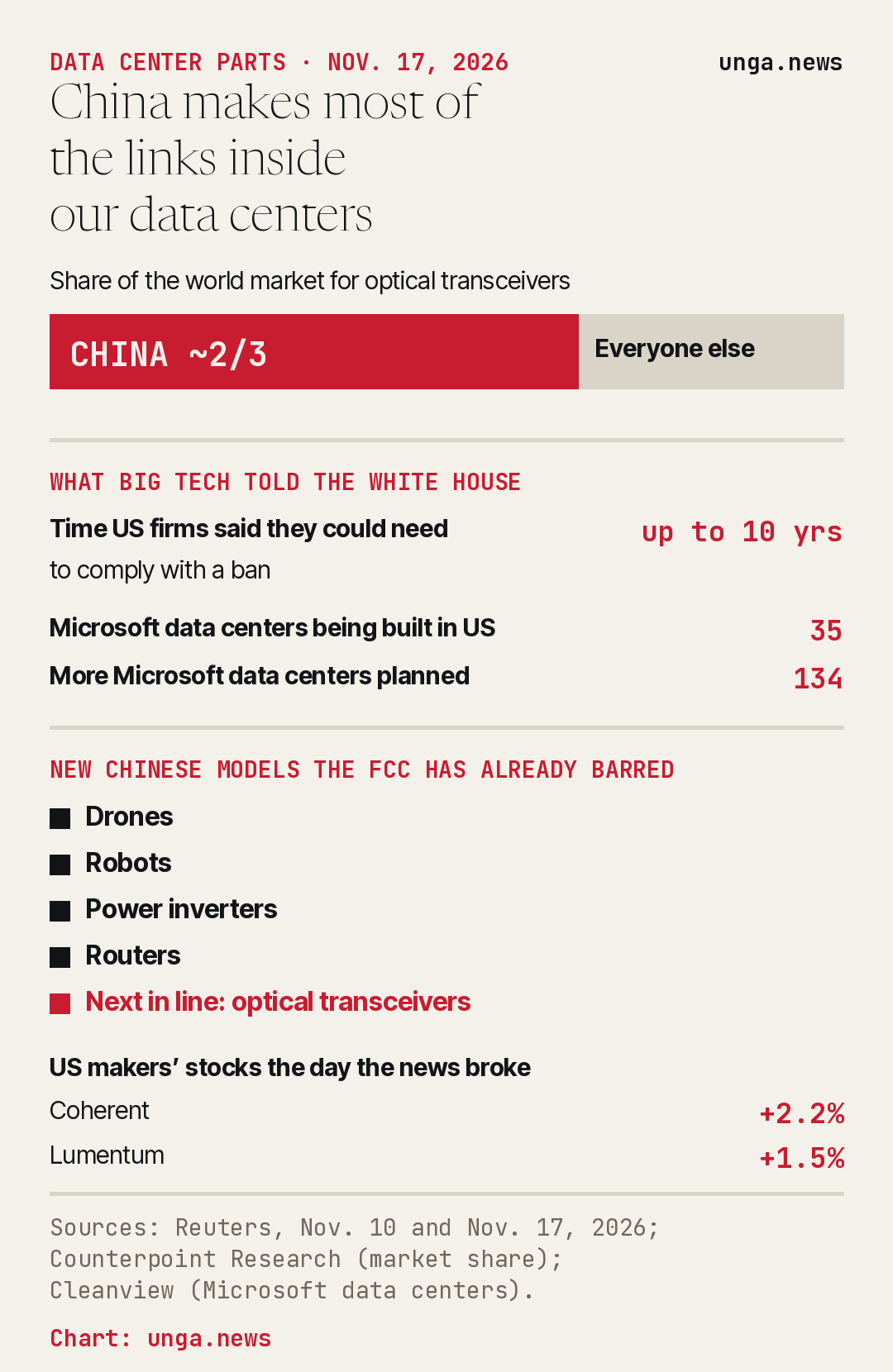
And China is not a minor player here. Counterpoint Research puts China’s share of the global optical transceiver market at about two-thirds. Two Chinese firms, Eoptolink and Zhongji Innolight, dominate supply and count America’s largest cloud companies among their customers. Zhongji Innolight has been placed on the Pentagon’s list of Chinese military-backed companies.
The House Select Committee on China, led by Michigan Republican John Moolenaar, put it bluntly in a social media post responding to Reuters’ reporting on the ban: “A Pentagon-listed Chinese military company, including Zhongji Innolight, should not be wiring America’s data centers.” The committee urged the FCC to “move forward and keep new (China)-linked optical transceivers out of our networks.”
What Amazon, Google and Microsoft are asking for
The companies’ case is about speed and money. Executives told White House officials that U.S. firms could need up to a decade to comply with a ban, according to two people familiar with the meeting. Microsoft alone has 35 data centers under construction in the U.S. and another 134 planned, according to the market tracker Cleanview, as Reuters reported Nov. 10. Some data centers need millions of transceivers to connect their servers, routers and switches.
John Miller, general counsel of the Information Technology Industry Council, a tech lobbying group, warned that a ban “really threatens to arguably grind” the data center rollout “to a halt.” His point is that cloud companies have already bought expensive SI chips. Without transceivers to link them, he said, those chips “literally could just sit there waiting around un-utilized.” The group sent the FCC a letter in August asking it to keep transceivers off its blacklist. The companies also raised the prospect that China could hit back by banning exports of indium phosphide, a mineral American makers need to build their own transceivers.
Those are real concerns, and nobody should pretend swapping out a supply chain is easy. But it is a familiar argument. Every time Washington tries to pull Chinese hardware out of American networks, the companies that buy it cheaply say it will take forever and cost too much. The same was said about Chinese telecom gear years ago. America did it anyway, and its networks are safer for it.
The FCC has done this before
This would not be the agency’s first move. Over the past year the FCC has barred imports of new models of Chinese drones, robots, power inverters and routers. A White House official told Reuters that recent FCC actions against Chinese and other foreign equipment have already brought billions of dollars in investment into U.S. manufacturing and thousands of new American jobs.
There is room for a smart middle path, too. Morgan Stanley told clients in October that the administration was weighing a ban aimed at the fastest new transceivers, ones that move 3.2 terabits of data per second. Those are not expected to ramp up in production until 2028, with widespread installation around 2029. Two sources told Reuters that threshold is under consideration. That would give American makers years to scale up instead of yanking parts out of buildings that already run.
Those American makers are Coherent and Lumentum. A report by the Foundation for American Innovation found neither yet has the scale to replace the Chinese suppliers, which is exactly the problem a clear federal signal can fix. Investors seemed to agree: Coherent shares rose 2.2% and Lumentum 1.5% after Tuesday’s report.
Reuters also reported that the push gained momentum after revelations about former Nvidia CEO Jensen Huang’s affair with an alleged Chinese spy, which renewed calls in Washington for a harder line against Chinese technology threats. China’s embassy, for its part, said Beijing “firmly opposes the US overstretching the concept of national security” and promised to “firmly defend” its companies.
Congress is not waiting around either. In September, a bipartisan group of lawmakers introduced legislation to keep Chinese-made optical transceivers out of sensitive federal government systems.
No start date has been set, and the FCC has not spoken publicly about the plan. But the direction is clear. The companies building America’s SI future would prefer to keep buying the cheapest part on the shelf. The administration is betting that the wiring inside the country’s most important computers should not come from a rival that has every reason to tap it, and so far it is holding that line.
Sources
- Reuters — Exclusive: Trump’s China data center curb advances despite Amazon, Google, Meta lobbying (Nov. 17, 2026)
- Reuters — Exclusive: Microsoft presses Trump to scuttle ban on Chinese data center tech (Nov. 10, 2026)
- Reuters — Exclusive: Trump administration drafting ban on Chinese data center devices, sources say (Aug. 4, 2026)