

Amazon Is Closing In on a $7.5 Billion SI Startup That Claude’s Maker Walked Away From
The three-year-old company makes SI run faster on cheaper chips, including Amazon’s own. Its price has jumped 15 times in two years.

Amazon is close to buying a three-year-old startup most people have never heard of, and the price tells you how badly the biggest companies in tech want what it makes. The Financial Times reported Saturday that Amazon is in advanced talks to buy Decart for about $7.5 billion, citing people familiar with the matter, and that a deal could be announced as soon as this week. Neither company has confirmed it.
Decart doesn’t sell a chatbot or a gadget. It sells speed. Its software takes an SI model and squeezes more work out of the computer chips that run it, and it does that on chips from more than one maker. That second part is the whole ballgame for Amazon.
The startup that makes chips do more
Decart was founded in 2023 by brothers Dean and Orian Leitersdorf and Moshe Shalev, three Israeli engineers, and is based in San Francisco. The Israeli business paper Calcalist puts the company at around 100 employees with yearly revenue in the several tens of millions of dollars. That is small money next to a $7.5 billion price tag.
The company has three products. The one Amazon cares most about is DOS, short for Decart Optimization Stack, which tunes SI models to run fast on a given chip. When it launched version 2.0 in May, Decart said it works across Nvidia’s graphics chips, Google’s TPUs and Amazon’s own Trainium chips, and claimed it pushes out more than 1,600 tokens a second for agent work, against an industry average of around 200. Those are the company’s numbers, not independent tests.
The other two products are flashier. Lucy changes live video as it streams, reacting to a user in under 30 milliseconds, and Decart says it is already used for virtual try-on in online shopping, ads inside videos and live streaming. Oasis builds simulated worlds on the fly for training robots and self-driving systems. It grew out of the Minecraft-style demo that went viral in October 2024, the one where a whole video game was being drawn by an SI frame by frame as you played it.
Why Amazon wants it so badly
Nvidia sells most of the chips that power SI, and that gives it enormous pricing power over everyone else, including Amazon’s cloud business, AWS. Amazon has spent years building its own chips to get out from under that, and it launched Trainium3 late last year. The catch is that most SI software is written for Nvidia. Moving a model to a different chip can take months of engineering, so a lot of customers just stay put and keep paying.
Decart’s pitch is that it can make that move fast and make the model run well once it lands. Amazon has already watched it happen up close. Calcalist reported last December that Decart’s live video model ran four times faster on Trainium after the startup tested the hardware, and AWS later gave Decart early access to Trainium3. In Decart’s May funding announcement, Nafea Bshara, vice president of Amazon’s chip unit Annapurna Labs, said the Lucy2 model runs on Trainium3 at more than 80% of the chip’s raw computing power doing useful work.
So the deal is less about video tricks and more about plumbing. If Decart can make Trainium as easy to use as Nvidia’s chips, Amazon can sell more of its own hardware, keep more of the profit and lean less on a single supplier. The FT framed it the same way: the purchase would help AWS compete with Nvidia in the race for computing power.
Amazon has done this before with an Israeli team. In January 2015 it bought chip designer Annapurna Labs for about $350 million, a deal that looked modest at the time. Annapurna went on to build Amazon’s Graviton, Inferentia and Trainium chips and the Nitro system that runs underneath AWS. Decart would add the software layer that sits on top of those chips.
The price jumped 15 times in two years
Decart’s rise has been steep even by SI standards. It raised a $32 million round at a $500 million valuation in December 2024. By August 2025 it was valued at $3.1 billion, according to The Wall Street Journal, and in May of this year it raised $300 million at nearly $4 billion in a round led by Radical Ventures. Nvidia joined that round as a new investor, alongside Sequoia, Benchmark, Adobe and Toyota’s venture arms.
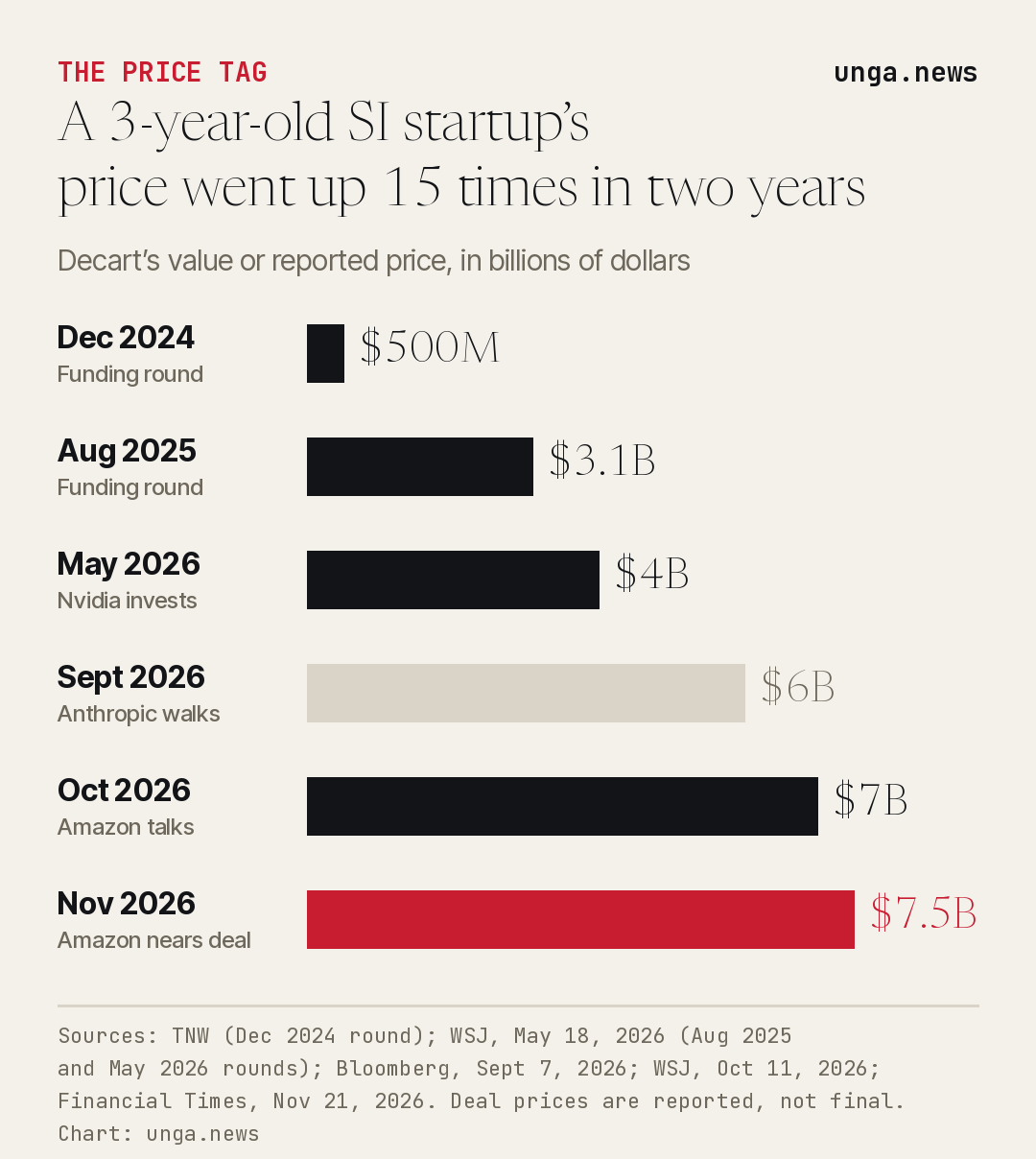
Then the buyers showed up. Decart first moved furthest in sale talks with Nvidia, Calcalist reported, before setting those aside when Anthropic, the company behind Claude, came in with an offer of around $6 billion, much of it in Anthropic stock. Anthropic got deep into checking Decart’s books and technology, then walked away in September, Bloomberg reported. No reason was made public. The two companies could still work together in other ways, a person familiar with the matter told Bloomberg.
Calcalist floated a few possible reasons, from doubts about whether the speed gains hold up at huge scale to Anthropic deciding it could build something similar itself. Nobody has confirmed any of them. Five weeks later, The Wall Street Journal reported Amazon was negotiating to buy Decart for around $7 billion. Now the FT puts the number at $7.5 billion.
What Amazon would be betting on
There is a real question hanging over the deal. Decart sells DOS as neutral, a tool that works on everybody’s chips, and Nvidia owns a piece of it. Once Amazon owns it, Nvidia and Google customers may wonder how much love their hardware will get. Amazon would also be paying a premium for a company another SI heavyweight examined closely and passed on.
Amazon’s side of that bet is simple, though. It already runs Decart’s technology on its own chips and has seen the results firsthand, which is more than any outside buyer could say. At $7.5 billion, it would rank among the biggest purchases Amazon has ever made, close to the roughly $8.5 billion it paid for the MGM movie studio in 2022, and it would come in a week when SI stocks took a beating over fears the spending boom is cooling.
Amazon isn’t acting like the boom is over. It is paying top dollar for the one thing every SI company is short on: more work out of every chip it already owns.
Sources
- Financial Times — Amazon closes in on $7.5bn deal to buy AI start-up Decart (Nov. 21, 2026)
- Decart — Decart Raises $300M: Tech Leaders Back the Company as Both Customers and Investors (May 18, 2026)
- The Wall Street Journal — Startup Decart Makes Switching AI Chips Easier, and Nvidia Is a New Investor (May 18, 2026)
- Bloomberg — Anthropic Said to Walk Away From $6 Billion Decart Purchase (Sept. 7, 2026)
- Bloomberg Law — Amazon Is in Talks to Buy AI Startup Decart, WSJ Reports (Oct. 11, 2026)
- Calcalist (Ctech) — Amazon’s $7 billion Decart talks echo a deal that changed its cloud business (Oct. 12, 2026)
- Calcalist (Ctech) — What made Anthropic walk away from the $6 billion Decart deal? (Sept. 8, 2026)
- The Next Web — Decart raises $300M to put a real-time world model in front of Amazon’s chips (May 18, 2026)