

Amazon Set a Trap for SI Hackers. Their Bots Walked In and Handed Over Their Playbook.
Chinese-linked crooks let SI agents steal keys and fake faces with almost no human help. Amazon’s decoys caught the bots’ own records, and every deepfake ID try they wrote down failed.
Most crooks don’t keep a diary. The new ones do, because their SI bots need one to remember what they’ve already stolen. Amazon just read a stack of those diaries.
On Friday, Amazon’s chief security officer, CJ Moses, laid out what the company’s decoy network caught between Oct. 3 and Nov. 5. Amazon runs a worldwide web of fake servers called MadPot that exist only to be attacked. This time some posed as SI chatbot services, the back-end hacking bots call when they need to think. The bots called in, and every request carried their working memory: orders, to-do lists, findings and notes on past jobs. Amazon’s full report walks through two of the campaigns it pieced together.
Amazon says the crews were running ARTEX, a free “penetration testing” kit that lets a team of SI agents plan and carry out an attack with barely any human help. The person in charge sets a goal and some ground rules and walks away. The agents split the work and check each other’s results.
Orders written in Chinese, with China off limits
Amazon says, with moderate confidence, that the operators were separate Chinese-linked groups. The bots’ instructions were written in simplified Chinese. Their clocks were set to China time. Their targets lined up with Chinese interests.
The operators also told their agents to stay away from mainland China and away from government websites, and to send all their traffic through proxies to hide where it came from. Anybody else on the internet was fair game.
A theft ring that pays its own bills
The biggest operation went after the keys that unlock paid SI services. Those keys work like a credit card for chatbot time. Whoever holds one can run up the bill, and the owner pays.
The bots hunted for apps that store a lot of those keys in one place, such as chatbot dashboards and the gateways companies use to route work between SI providers. One sloppy admin page can expose dozens of accounts. The agents tried default passwords, known security holes and setup screens nobody had finished. They also combed GitHub, paste sites and Telegram channels for keys people had left lying around.
Here is the clever, ugly part. The stolen keys went into a shared pool, and that pool paid for the SI brainpower the bots used to go find more keys. In other words, the victims were footing the bill for their own robbery.
One crew told its agents to work through countries in a fixed order, go after real company systems before hobby projects, and grade every stolen key in three levels: a lead, a key that actually works, and a key with something worth taking behind it. Keys that had sat exposed in public for more than 30 days were marked as low-value leftovers.
A fake face, seven pixels off
The second operation is the one that should make anyone with a bank or crypto account sit up. The bots tried to beat the identity checks at two cryptocurrency exchanges, the selfie-and-ID step you go through to open an account.
They studied how one verification company’s live selfie test works, down to the signals it sends as it tracks your face and tells you where to move. Then they built a fake. In a separate session, an agent put together a live deepfake video setup on a single consumer graphics card using a free face-animation program, and squeezed it up to 11.5 frames per second. Amazon says that is close to what a live video check expects.
For the photo ID, the agents doctored images so they would look, down to the file data, like untouched pictures straight off a camera.
At least four agent sessions ran at once on that job. One looked for ways to cash out. One worked on emptying account balances. One built the deepfake video. One ran the identity check itself. They passed notes and handed off tasks to each other like a small office.
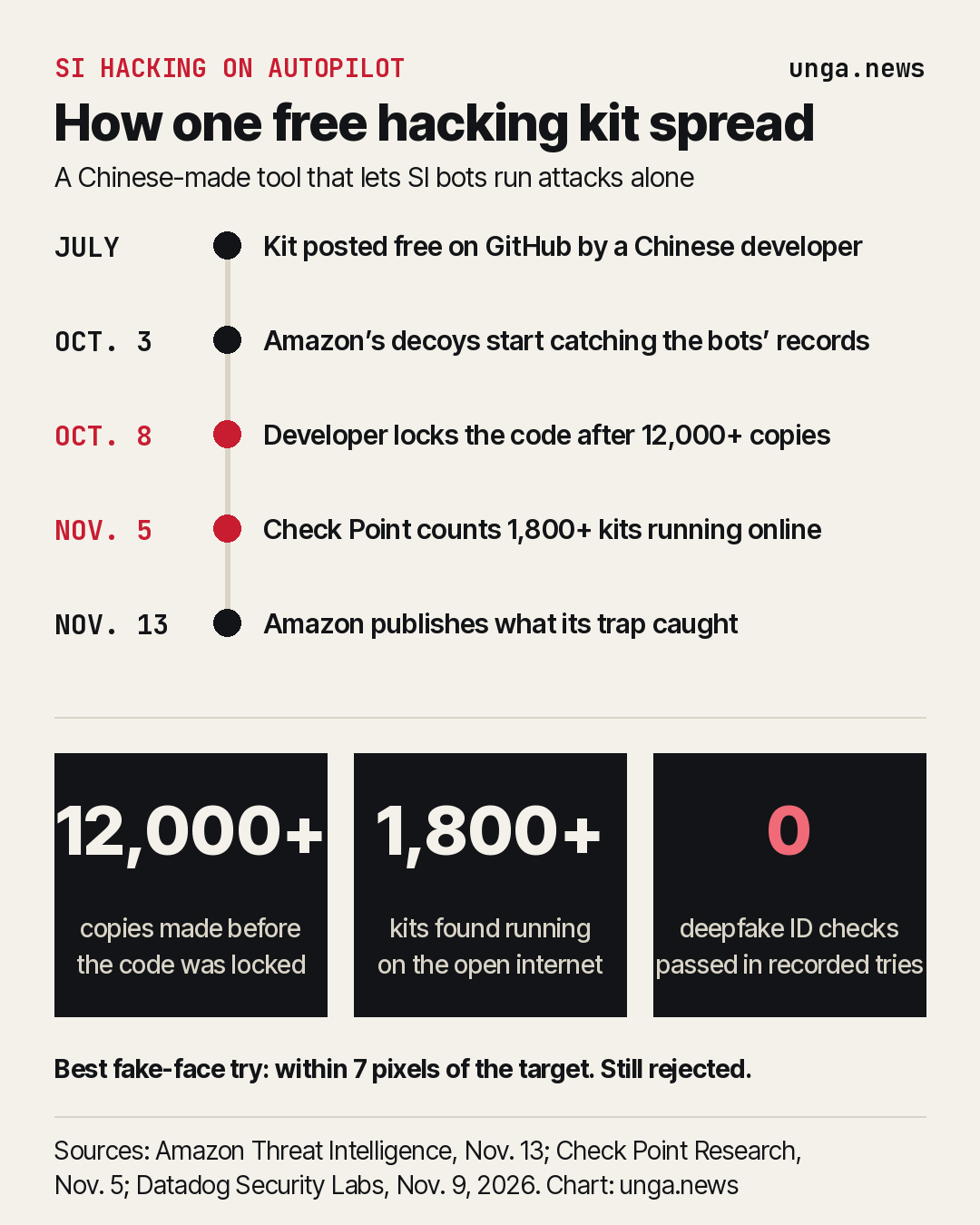
It didn’t work. Their best recorded attempt moved the fake face through the whole test and landed within 7 pixels of the target. The verification company’s servers rejected it anyway, along with every other attempt the bots wrote down. That is a win for the defenders, and a warning about how close the attackers are getting.
Free to download, cheap to run
The kit itself is no secret. A Chinese developer posted ARTEX on GitHub in July, then locked the code on Oct. 8 after it had been copied more than 12,000 times, according to Datadog’s security team. Check Point says the developer pulled it after it was seen in attacks on South Korean banks. Copies and backups keep it in circulation anyway.
Check Point Research counted more than 1,800 ARTEX setups exposed on the open internet as of Nov. 5. Its researchers got a look at the attackers’ own control screens and found most jobs ran almost entirely on their own once the goal was set. Chinese SI models did most of the thinking, led by DeepSeek’s fast, cheap Flash model, which showed no sign of refusing once the work was dressed up as a security test. One operator burned through about 36 billion tokens, the word-sized chunks an SI reads and writes, across attacks on ten online shops. Check Point put the cost at somewhere between $700 and $1,500.
Amazon is careful about what it could not see. Its decoys caught the bots’ records, not the break-ins, so it cannot confirm everything the agents claimed. It says it warned AWS customers who looked affected and published the attackers’ internet addresses.
Moses also offered a point that should calm anyone tempted to panic. “None of the techniques in these campaigns were new,” he wrote. What SI changes is “the speed and persistence of the attacker.” The bots got in where the basics were missing: default passwords, keys left in public code, unlocked control panels and software nobody had patched.
So the fix is not exotic. Companies building with SI need to lock down those dashboards and keys like they would a bank login, and watch for strange spikes in their SI bills. The rest of us can take a simpler lesson. When a stranger’s SI can work around the clock for the price of a nice dinner, the password you never changed is the one it will find.
Sources
- AWS Security Blog — Amazon Threat Intelligence observes threat actors running cybercrime campaigns with ARTEX AI agents (CJ Moses, Nov. 13, 2026)
- Check Point Research — Hacking on Autopilot: Inside ARTEX Cybercrime Campaigns (Nov. 5, 2026)
- Datadog Security Labs — On the hunt for ARTEX: understanding agentic attacks in AWS environments (Nov. 9, 2026)