

Amazon Tried to Block It. Trump’s FCC Just Let SpaceX Put a Million Computers in Space.
The FCC gave SpaceX the first license ever for data centers in orbit, up to 1 million solar-powered satellites, with hard deadlines starting in 2033. Amazon’s satellite unit had asked regulators to say no.
For years, the fight over computing power has been a fight over land, water and the power grid. On Wednesday, the federal government gave Elon Musk’s SpaceX permission to take a big piece of that fight off the planet.
The Federal Communications Commission granted SpaceX a license to launch and run up to 1 million satellites that work as data centers in orbit, a system the company calls Starmind. The agency called it the first authorization in U.S. history for a constellation of data centers in space. The satellites would crunch huge amounts of data up there and send the results back down here, built for the kind of heavy computing that SI models eat up.
FCC Chairman Brendan Carr put it in plain terms. “America is leading the world into the era of super intelligence,” he said. “Under President Trump’s leadership, the United States is moving decisively to ensure that this breakthrough technology creates opportunity, drives investment, and delivers lasting benefits for the American people.”
He called the license something that “opens a bold new frontier for the computing infrastructure needed to power America’s leadership and growth,” and gave credit to “SpaceX and the many competitors working on their own orbital data centers” for “meeting the moment.”
Why put a computer in orbit at all
Data centers on the ground are running into walls. They need enormous amounts of electricity, and towns are pushing back on new power plants, water use and higher bills. A satellite in the right orbit sits in sunlight nearly all the time.
SpaceX made exactly that case to the FCC. “By directly harnessing near-constant solar power with little operating or maintenance costs, these satellites will achieve transformative cost and energy efficiency while significantly reducing the environmental impact associated with terrestrial data centers,” the company told regulators, Reuters reported.
The FCC’s own announcement went further, saying the system “promises to bring the human race closer to a Kardashev II civilization,” the scientist’s term for a society that can harness the full power of its sun.
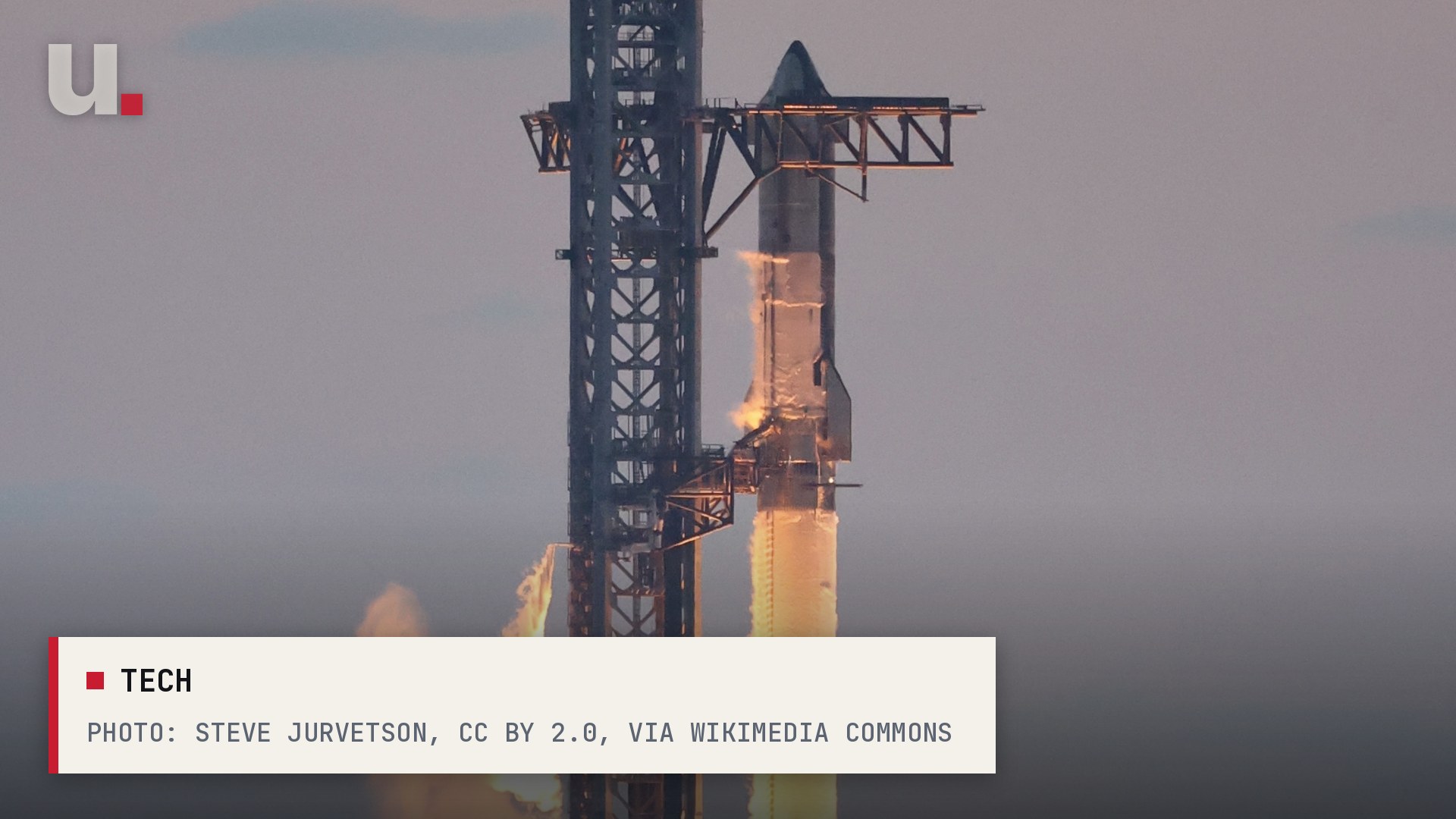
The plan leans on Starship, the giant reusable rocket SpaceX is still flight-testing. Launching a million of anything only pencils out if rockets get cheap enough to fly like airliners, and Starship is SpaceX’s bet that they will.
A million satellites, on a clock
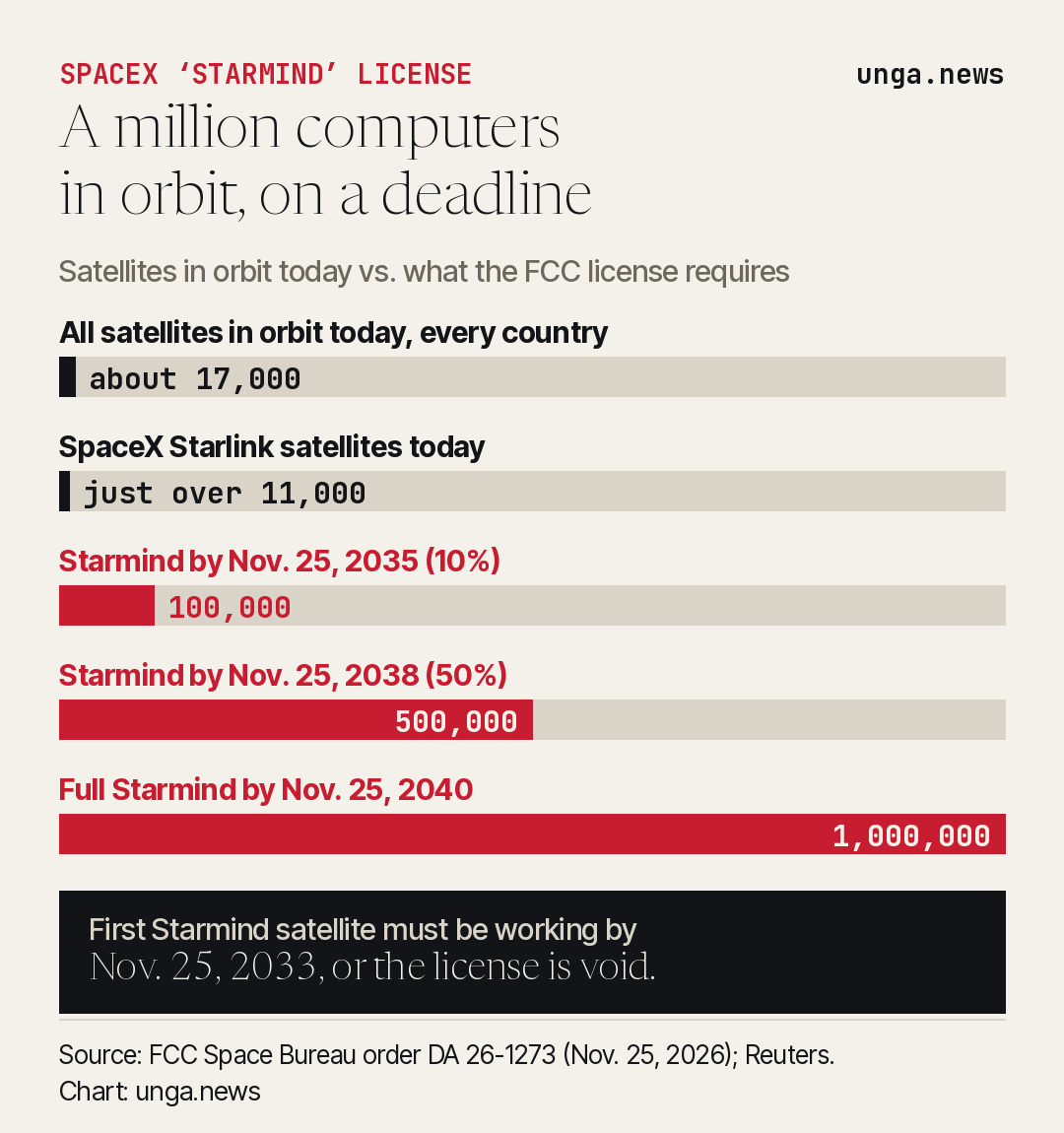
The number sounds wild because it is. There are only about 17,000 working satellites in orbit today from every country combined, and SpaceX’s Starlink internet network has just over 11,000 of them, according to Reuters.
But the license isn’t a blank check. The Space Bureau’s order spells out hard deadlines, and if SpaceX misses them, the authorization becomes “null and void.” SpaceX must have its first Starmind satellite working by Nov. 25, 2033. It must have 10% of the full number, or 100,000 satellites, flying by Nov. 25, 2035, half by Nov. 25, 2038, and the rest by Nov. 25, 2040. The license runs 15 years from the day SpaceX certifies its first satellite is up and working.
Satellite companies often ask for more than they plan to build, Reuters noted, to leave room for changes in design. SpaceX first sought approval for 42,000 Starlink satellites before it started launching, and it has since put up more satellites than the rest of the world combined.
The satellites will fly in bands between about 310 and 623 miles up. Most of their data will move over laser links between satellites, including links to SpaceX’s existing Starlink fleet. The FCC also approved radio channels as a backup for tracking and emergency control, on the condition that SpaceX doesn’t interfere with anyone else using them.
Amazon wanted it stopped
Not everyone cheered. Amazon’s satellite unit, Kuiper Systems, now called Amazon Leo, filed a petition asking the FCC to deny the application outright, according to the order. So did satellite company Viasat and the American Astronomical Society. Amazon and others argued SpaceX was unlikely to ever launch the whole system, Reuters reported, with some suggesting it could take centuries.
Carr had little patience for that back in March. “Amazon should focus on getting Amazon’s house in order with their own launches and their own satellite constellation, rather than worrying about other people that are actually out there launching satellites at the pace and cadence that SpaceX is,” he said.
Some critics questioned whether SpaceX could manage another giant fleet on top of Starlink. The bureau answered that those comments “do not provide any specific evidence” that SpaceX can’t meet the license conditions or follow the rules.
Astronomers worried about streaks across telescope images and about waste heat brightening the sky in infrared light. The FCC pointed to SpaceX’s commitment to coordinate with the National Science Foundation and said it had already run the application past NASA, NOAA and federal astronomy groups. It ruled the heat question falls outside its job, which is policing radio signals. Fears about satellites burning up in the atmosphere, the order said, “remain speculative and not supported in the record.”
The strings that came with it
The FCC didn’t hand over everything SpaceX asked for. SpaceX wanted flexibility to retire satellites flying above about 370 miles by parking them in disposal orbits or sending them into orbit around the sun, instead of bringing them down through the atmosphere. The bureau put that request on hold. Before SpaceX launches any satellite that won’t come back down to burn up, it has to file for a change and justify it.
For satellites below that line, the FCC found SpaceX’s debris plan meets the rules. SpaceX told regulators each satellite is designed to burn up completely on the way down, and that it will steer dead satellites to reenter over the ocean. It also has to file a report every January and July listing close calls with other spacecraft, satellites pulled from service, satellites that reentered, and how many are flying.
The bureau said it is still reviewing other companies’ orbital data center proposals and plans to decide each one quickly. That means Starmind is first in line, not the only one in line.
Whether a million computers in orbit turns out to be cheaper than building on the ground is a question only rockets and time will settle. What changed Wednesday is that SpaceX no longer has to wait on Washington to find out. Under Carr’s FCC, the company that already runs most of the satellites in orbit just got the first green light to put the next generation of computing up there with them.
Sources
- Federal Communications Commission — FCC Authorizes 1 Million Satellites for Data Centers in Space (Nov. 25, 2026)
- FCC Space Bureau — SpaceX Orbital Data Center System (Starmind) Memorandum Opinion and Order and Authorization, DA 26-1273 (Nov. 25, 2026)
- Federal Communications Commission — Space Headlines
- Reuters — US authorizes SpaceX to deploy 1 million satellites for data centers in space (Nov. 25, 2026)
- Ars Technica — The FCC has authorized SpaceX to deploy 1 million satellites