

Amazon’s Answer to Starlink Lost 40 Satellites When Its Rocket’s Engines Were Starved of Fuel
The rocket builder says Sunday’s failure came from fuel not reaching the engines, not the engines themselves. That clears Jeff Bezos’ engine company, but Amazon’s main ride to space is grounded and its internet network falls further behind.
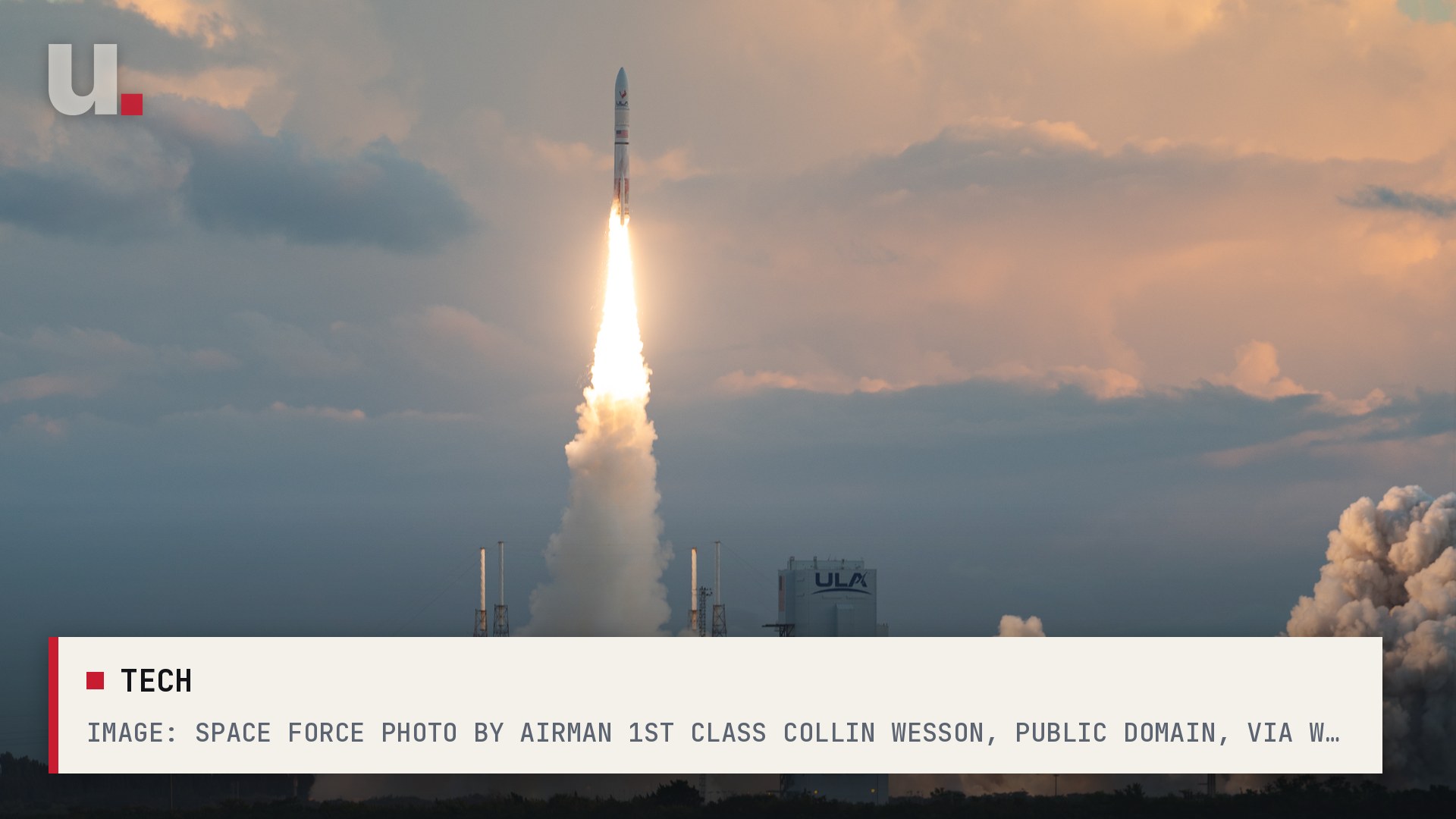
Amazon has spent years trying to build a home internet service that can go toe to toe with Elon Musk’s Starlink. On Sunday, 40 of its satellites fell back to Earth about ten minutes after liftoff. On Wednesday, the company that launched them finally said why.
It wasn’t the engines. It was the fuel getting to them. “While work remains to determine cause, preliminary indications are that the low booster thrust was the result of inadequate fuel supply from the vehicle to the BE-4 engines, not from the performance of the engines,” United Launch Alliance said in its latest mission update.
In plain English, the rocket’s two big main engines were working fine. They just weren’t being fed enough propellant by the plumbing inside the rocket itself. A starving engine can’t push, and a rocket that can’t push hard enough in its first few minutes never makes it to orbit.
Too low, too slow
The Vulcan rocket lifted off from Cape Canaveral Space Force Station in Florida at 12:40 p.m. Eastern on Sunday, after two days of delays and a countdown hold with 20 seconds left on the clock. It was the rocket’s first flight in nine months and only its fifth ever.
ULA said the first stage “experienced low booster performance” right after liftoff. That meant the stages split apart while the rocket was too low and below the speed it needed to reach orbit. The upper stage lit on time, and its two RL10 engines ran as planned, ULA said, but it “was unable to recover from the performance loss.” Contact and the mission were lost around the ten-minute mark.
The six solid rocket boosters strapped to the sides, which caused trouble on two earlier Vulcan flights, did their job this time. ULA said “all indications” point to normal performance from the boosters after nozzle fixes made for this launch.
GeekWire, citing Spaceflight Now, reported this was ULA’s first total mission failure since the Boeing and Lockheed Martin joint venture was formed in 2006. That’s a long, proud record to break on a mission this important.
A good day for the engine maker, a rough one for Amazon
The finding is a big relief to Blue Origin, Jeff Bezos’ rocket company, which builds the BE-4 engines. Its own New Glenn rocket uses seven of them on its first stage, and New Glenn has been sidelined since it exploded during a ground test on May 28. Blue Origin later traced that blast to a main oxygen valve and retrofitted the part, including on engines bound for Vulcan.
“Together, we identified that the low booster thrust was the result of inadequate fuel supply from the vehicle to the BE-4 engines, not from the performance of the engines,” Blue Origin said in a statement Wednesday. “ULA is a valued partner, and we look forward to Vulcan’s return to flight.” Blue Origin CEO Dave Limp also praised his engine team on 𝕏 for its “rapid response and support of ULA’s investigation.” Ars Technica reported New Glenn could fly again as soon as January.
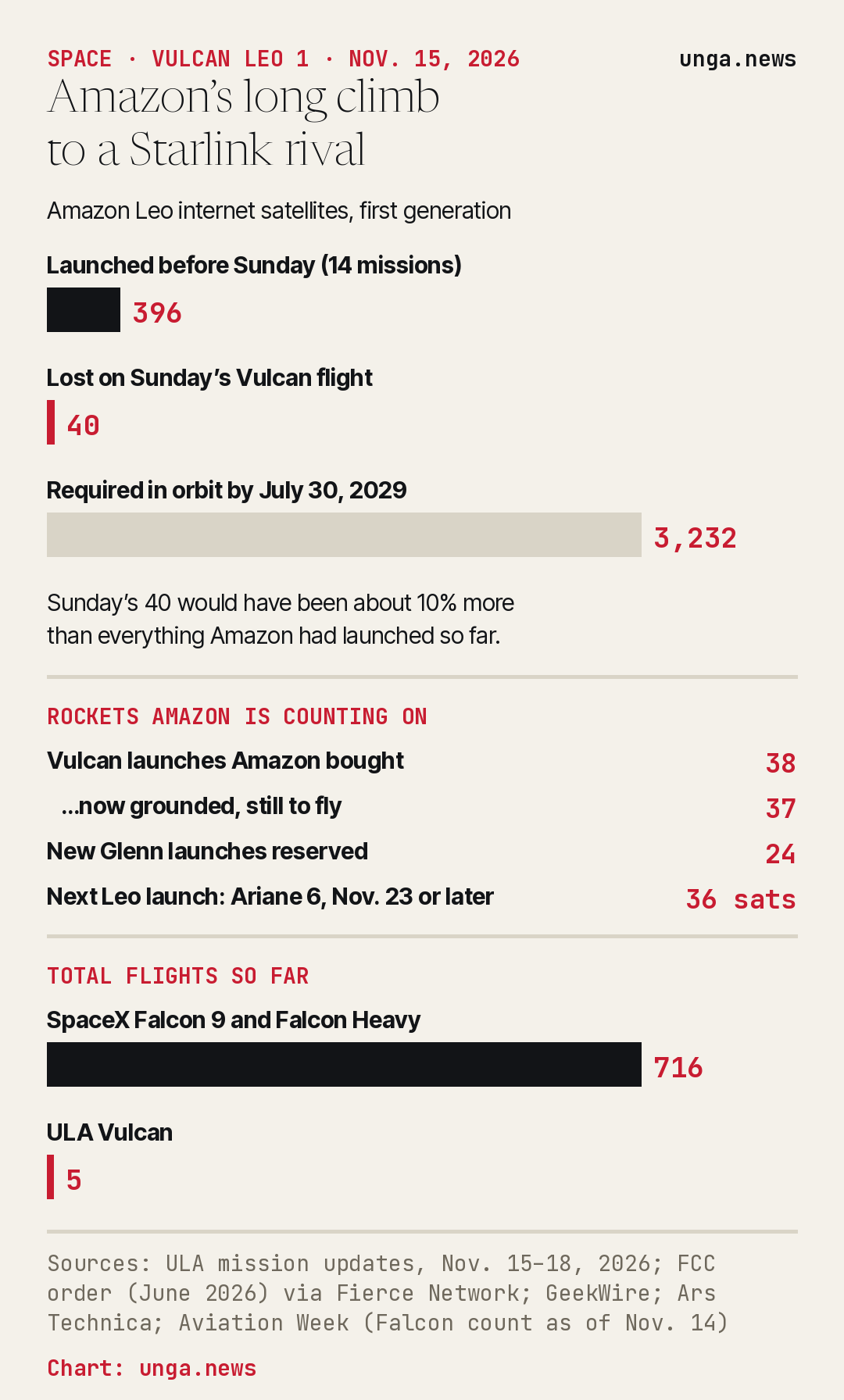
For Amazon, the news is mixed at best. Before Sunday it had launched 396 Leo satellites on 14 missions since April 2025. Its last successful launch was in July, on ULA’s older Atlas V rocket. Sunday was the first of 38 Vulcan launches Amazon bought, and Vulcan was slated to carry more than 1,500 of Amazon’s first-generation satellites, more than any other rocket in the program.
Those 37 remaining Vulcan rides are now stuck on the ground while the investigation runs. Ars Technica reported the rocket “will certainly be offline for several months” as ULA works through a new problem with the complicated plumbing that feeds liquid oxygen and methane to the engines. The Federal Aviation Administration is overseeing the ULA-led probe and must approve the final report.
The clock Amazon is racing
Amazon isn’t free to take its time. The Federal Communications Commission already waived Amazon’s July 2026 target of 1,616 satellites in service after the company admitted it couldn’t make it. The final deadline stands: all 3,232 first-generation satellites by July 30, 2029. If Amazon falls short, it keeps only the number that are working on that date.
Amazon told Fierce Network it still has enough satellites up to offer continuous coverage across certain latitudes and plans to start service in the coming weeks. Its next launch is a European Ariane 6 carrying 36 satellites, targeted for no earlier than Nov. 23 from French Guiana. Amazon also has 24 New Glenn launches reserved, which is why Wednesday’s finding about the engines matters so much to it.
The ripple goes past Amazon. Ars Technica noted Vulcan is under contract to carry roughly half of the military’s national security launches over the next few years. NASA had reason to breathe easier too: the upper stage that performed fine on Sunday, the Centaur V, is the one NASA recently picked for its Space Launch System moon rocket.
“The world is much, much worse off without Vulcan as a launch option,” John Gedmark, CEO of satellite maker Astranis, wrote on social media, as quoted by Communications Daily.
Meanwhile, in Texas
Now for the part that should make Americans proud. While ULA was combing through data this week, SpaceX was celebrating. On Nov. 14, its Starship upper stage came home from orbit and was caught by the launch tower’s giant arms for the first time ever, after dropping off 26 new Starlink satellites. SpaceX’s Falcon 9 and Falcon Heavy had flown 716 times as of that day, Aviation Week reported. Vulcan has flown five.
“It was almost magic,” NASA Administrator Jared Isaacman wrote on 𝕏 after the catch.
Space consultant Tim Farrar told Communications Daily the Vulcan failure likely won’t land Amazon in trouble with the FCC, but it does push back when Leo can offer full service and widens SpaceX’s lead.
Competition is good for customers, and rural families waiting on fast internet should want Amazon to get its network up. But Sunday was a reminder of what it actually takes. Building rockets that fly every few days, land and fly again is the hard part, and right now one American company is doing it at a pace nobody else can touch. ULA says it will share more as the investigation continues. Until Vulcan flies again, Amazon’s Starlink rival will be waiting on everyone else’s rockets.
Sources
- United Launch Alliance — Vulcan Leo 1 updates (Nov. 15–18, 2026)
- Ars Technica — Vulcan failure caused by inadequate fuel supply to engines, ULA says
- Ars Technica — Vulcan rocket fails during launch, dealing major blow to SpaceX competitors
- GeekWire — Latest findings point to fuel supply, not Blue Origin’s engines, in loss of Amazon Leo satellites
- GeekWire — Amazon loses 40 Leo satellites in ULA Vulcan launch failure
- Fierce Network — FCC waives Amazon Leo’s July 2026 satellite launch deadline
- Fierce Network — Amazon Leo on track for year-end service launch despite Vulcan explosion
- Communications Daily — Amazon Leo Facing Competition Woes in Wake of ULA Launch Calamity
- Aviation Week — Starship Flight 15 Ends With First Ship Tower Catch
- SpaceX — Starship Flight 15