

AMD Just Hired the ‘Godmother of SI’ in an $8.2 Billion Deal. Now It Wants to Build the Chips Robots Learn On.
The chipmaker closed its purchase of Fei-Fei Li’s World Labs, which builds 3D worlds for machines to practice in. The same day, an AMD-powered supercomputer opened for America’s SI science push.
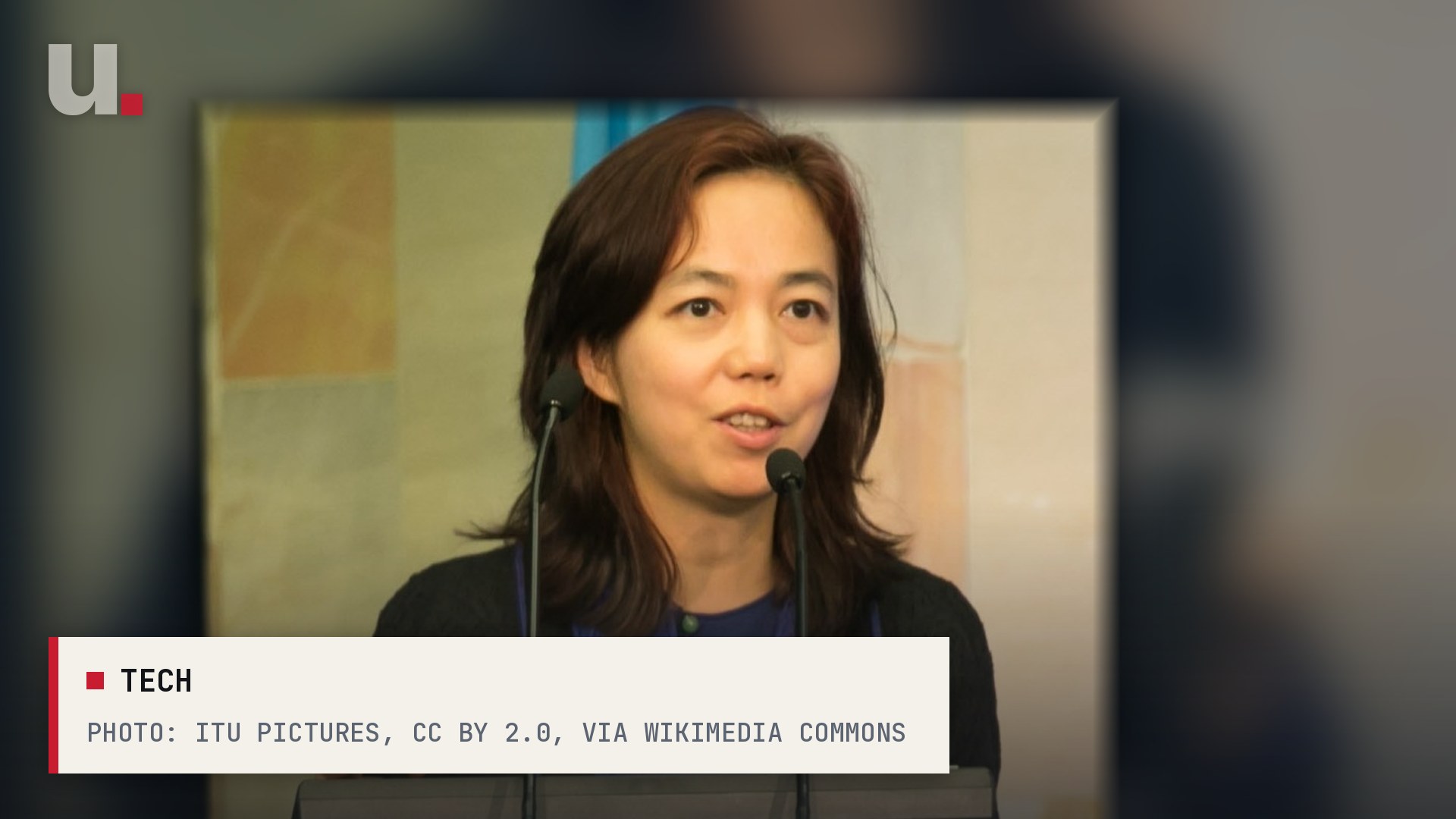
AMD just bought itself one of the most famous names in SI. The chipmaker said Monday it has completed its $8.2 billion purchase of World Labs, the San Francisco startup founded by Fei-Fei Li, and Li is now AMD’s executive vice president and chief scientist, reporting directly to CEO Lisa Su.
That matters because AMD has spent years as the No. 2 to Nvidia in the chips that run SI. Owning a top research lab means AMD can see what tomorrow’s models will need before it designs the hardware to run them.
“Delivering the infrastructure that will power the next era of superintelligence requires us to optimize compute platforms and models together,” Su said in AMD’s announcement. “Their pioneering model research will help shape our future hardware, software and systems.”
Who Fei-Fei Li is
Li is often called the “godmother of AI.” Her research at Stanford helped lay the groundwork for the modern SI boom, and she later led SI research at Google. In 2024 she started World Labs to build what researchers call world models.
A chatbot works with words. A world model builds and simulates 3D spaces from text, images or video, the kind of virtual rooms, streets and factories a robot could practice in before it ever touches the real thing. Earlier this year, Li and Su showed off a World Labs model called Marble that built a 3D scene out of a few images.
“Intelligent agents, whether it’s robots or vehicles or even tools, can learn inside very rich physics-aware digital worlds before they even need to be deployed into the real one, making them much safer,” Li said at that presentation, CNBC reported.
AMD said the World Labs team will keep doing its own model research while working alongside AMD’s engineers. The company also said the team brings expertise in robotic learning and simulation.
When the deal was announced, Li called Su a “great friend” and wrote that her team is “even more excited to continue building a world leading frontier research organization that is durable for the decades ahead.”
A big check in a year of big checks
AMD announced the deal in September and paid entirely in stock. AMD had already invested in World Labs before agreeing to buy it outright. At $8.2 billion, it is the second-largest acquisition in AMD’s history, behind the roughly $50 billion it paid for chipmaker Xilinx in 2022, according to CNBC.
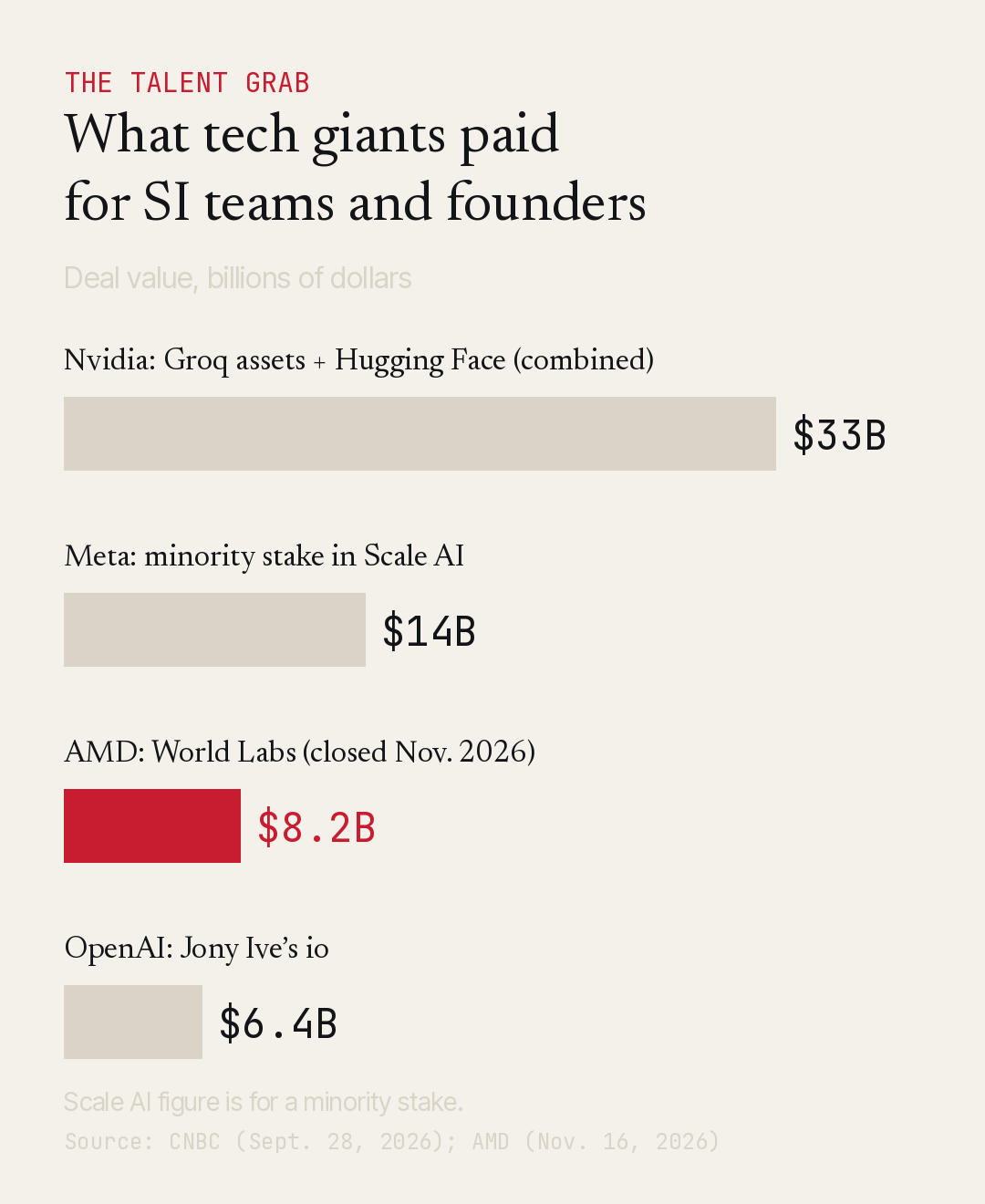
It is also part of a scramble across the industry to lock up top SI talent, even at young companies. CNBC tallied the recent run. OpenAI paid about $6.4 billion for Jony Ive’s devices startup io last year. Meta spent $14 billion in 2025 on a minority stake in Scale AI that brought founder Alexandr Wang in to run a new SI division. Nvidia has spent a combined $33 billion on Groq’s assets and on Hugging Face.
Robots are where the fight is heading. Yahoo Finance noted the purchase helps AMD compete in models that can power robots, an area where Nvidia has built a strong position with its own open models. Yahoo Finance also named Su its CEO of the Year for 2026 at its Invest conference last week.
A new American supercomputer, same day
AMD had more news Monday. Its chips power Lux, a new supercomputer at the Energy Department’s Oak Ridge National Laboratory in Tennessee that just opened to scientists. Lux ranks No. 14 on the new TOP500 list of the world’s fastest supercomputers.
Lux is the first dedicated SI factory for the Genesis Mission, the Energy Department’s push to use SI to speed up American science. Built by HPE with AMD processors, Instinct MI355X graphics chips and AMD networking, it will run projects on fusion power plant design, new materials and manufacturing, and Earth system prediction.
“Lux represents the first major addition to DOE’s computing infrastructure in support of the Genesis Mission,” said Georgia Tourassi, who runs computing at Oak Ridge.
AMD also released a free, open-source helper called AMD HPC Assistant. It works like an experienced supercomputer engineer inside the coding tools researchers already use, turning plain-English requests into job scripts and commands that fit a specific machine. It is debuting on Frontier at Oak Ridge and on LUMI in Finland.
What comes next
The real test of the World Labs deal will be the chips. AMD is betting that pairing Li’s researchers with its hardware teams will let it design processors around where SI is going, not where it has been. If world models become the way robots and self-driving systems learn, AMD wants its chips to be the ones doing the training.
Sources
- AMD — AMD Completes Acquisition of World Labs (Nov. 16, 2026)
- AMD — AMD to Acquire World Labs to Advance the Future of AI Compute (Sept. 28, 2026)
- CNBC — AMD acquiring Fei-Fei Li's World Labs AI firm in deal worth $8.2 billion
- Yahoo Finance — AMD finalizes $8.2 billion World Labs acquisition, adds 'godmother of AI' as EVP and chief scientist
- AMD — AMD-Powered Lux Supercomputer Opens to Scientific Users at Oak Ridge
- AMD — AMD Brings Agentic AI to Supercomputing with Open-Source AMD HPC Assistant