

America Just Signed Up Nine Allies to Guard the Chips and Cables That Run SI
Ten countries, from India and Japan to Israel and Britain, signed a pact Sunday to protect the minerals, chips, ports and power behind super intelligence. Germany and the Netherlands are next.
The phone in your pocket, the chatbot on your laptop and the data center humming outside some small town all depend on the same fragile chain: rare minerals, chip factories, undersea cables, ports and power plants. On Sunday in San Francisco, the United States got nine allies to sign a pledge to guard that chain together.
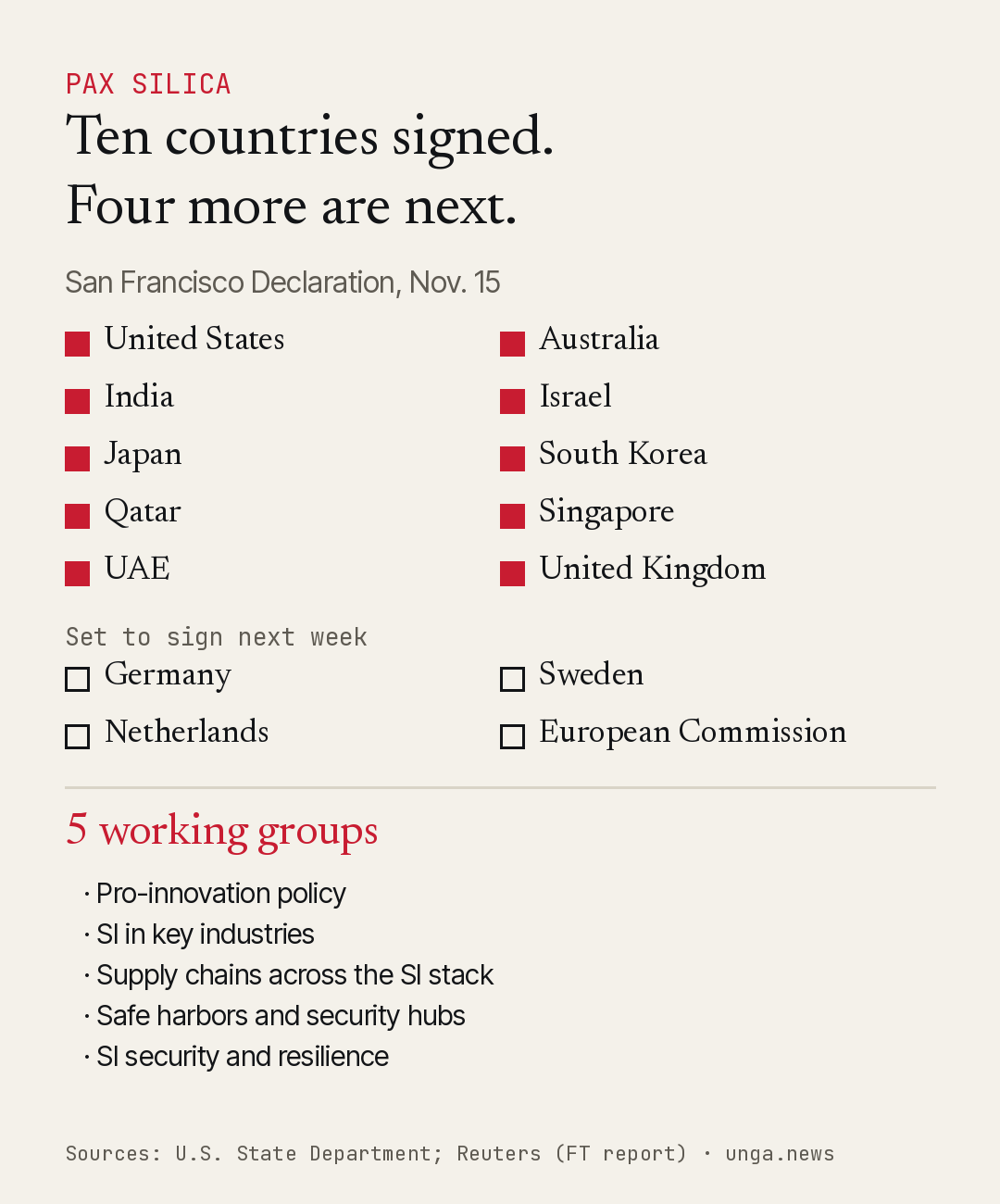
It is called the San Francisco Declaration, and it was signed at a retreat for founders of Pax Silica, the coalition the Trump administration launched last December to lock down the supply chains behind super intelligence. Under Secretary of State for Economic Affairs Jacob Helberg convened the meeting. The signers are the United States, Australia, India, Israel, Japan, South Korea, Qatar, Singapore, the United Arab Emirates and the United Kingdom.
“No nation can secure the foundations of the SI era alone, and the prosperity SI makes possible will only be as durable as the supply chains and infrastructure beneath it,” the State Department said.
What they actually agreed to protect
Most treaties drown in vague language. This one does something more useful. It writes down, in plain terms, what counts as worth protecting.
The first category is sensitive technologies. That covers goods, software, materials, know-how, components and even the machines used to make them, if stealing them or buying them up would give a hostile country “a meaningful military or intelligence advantage, or undue economic leverage” over the signers.
The second is critical infrastructure: the ports, terminals, shipping and logistics networks, communications lines and energy systems that SI supply chains run on, plus the digital platforms that coordinate them. If someone could disrupt them, seize control of them or quietly read the data flowing through them, they made the list.
That matters because the weak points of the SI race usually aren’t the flashy models. They are the boring things. A single port, a single mineral refinery or a single chip plant can become a choke point. Whoever controls the choke point has leverage over everybody downstream.
Five teams, one baseline
The declaration doesn’t stop at principles. It sets up five working groups to turn them into practice: pro-innovation policy, putting SI to work in key industries, supply chain cooperation “across the SI stack,” safe harbors and supply chain security hubs, and SI security and resilience.
Washington has been clear about where this is heading. Pax Silica is meant to push allies toward joint projects and shared export controls, and to cut their reliance on adversaries for critical minerals, SI models and the chips that run them, Reuters reported. The State Department described the coalition as “entering a new phase” less than a year after it launched, moving from shared principles to “a working partnership with a common baseline and a path to act on it.”
China isn’t named, but everyone knows who it’s about
The text never mentions China. It doesn’t have to. It talks about “economic coercion,” “non-market policies and practices” and keeping sensitive technology away from “hostile actors.” Reuters framed the pact squarely as part of America’s technology rivalry with Beijing, and the goal is plain: less dependence on an adversary for the minerals, models and chips the SI economy runs on.
In August, Reuters reported that the United States was preparing to tell dozens of countries they would have to pick a side in the SI race. Countries that also signed onto Beijing’s competing framework would be left out of the U.S.-led coalition. Sunday’s declaration is what picking a side looks like on paper.
The lineup itself sends a message. India and Japan, Asia’s two biggest democracies, are on board. So are Israel, South Korea and Singapore, which punch far above their size in chips and software, and the Gulf states Qatar and the UAE. That is a coalition spanning three continents, signed in an American city, under an American banner.
Europe is next
More are coming. Germany, Sweden, the Netherlands and the European Commission are set to sign next week, according to the Financial Times, which cited Helberg. That would pull Europe’s biggest economy and its central trade authority inside the tent, along with the Netherlands, a key player in the machines used to make advanced chips.
There is a small tell in the fine print about how far the administration has pushed the conversation. The declaration uses “super intelligence” throughout. A footnote adds that “for some participants, ‘super intelligence’ refers to ‘artificial intelligence.’” The U.S. government adopted the SI name after President Trump signed an executive order to rename it, The Hindu noted. Ten governments just signed a document in America’s vocabulary.
None of this is binding. There are no penalties, and the working groups still have to show they can do more than meet. But the hard part of any alliance is agreeing on what you are protecting and who you trust. On Sunday, the United States got ten countries to agree on both, with four more lining up behind them.
Sources
- U.S. Department of State — The San Francisco Declaration on the Secure Foundations of Enduring Prosperity
- Reuters (via Investing.com) — US, allies team up to protect AI tech and infrastructure amid China rivalry
- The Hindu (PTI) — India, U.S., eight other nations sign declaration to safeguard AI supply chains