

America Shuts the Back Door Chinese Companies Used to Rent Its Best SI Chips
A new Commerce rule says data centers anywhere in the world need a U.S. license before renting serious American computing power to Chinese firms. It takes effect Thursday.
For years Washington has banned shipping America’s best SI chips to China. And for years Chinese companies have had an easy way around it: don’t buy the chips, rent them. Set up an account at a data center in Malaysia or Singapore, log in from Beijing, and train your models on American hardware anyway.
The Commerce Department moved Monday to close that door.
The Bureau of Industry and Security released an interim final rule, written “by and at the direction of the Department of Treasury and the National Security Council,” that puts remote computing under the same controls as physical shipments. The point, in the bureau’s words, is to make sure “existing restrictions on access to sensitive American technology cannot be circumvented through remote computing arrangements involving data centers in third countries.” It was filed with the Federal Register at 4:15 p.m. Eastern on Monday and is scheduled to publish and take effect Thursday, Nov. 19.
“This new control is a logical extension of existing controls,” the rule reads, as quoted by TechCrunch. “These restrictions will undermine the ability of companies headquartered in countries of concern from using U.S. advanced Super Intelligence (SI) semiconductors to train advanced SI models.”
The rental loophole
Here is how the new rule works in plain English. If a company knows its advanced American chips or servers are headed to a data center anywhere in the world that will give companies from China, Macau or the rest of the government’s D:5 list of embargoed countries more than a set amount of computing power, it now needs a license first. That list also includes Russia, Iran and North Korea.
The line is 12 million in “total processing performance,” the yardstick export officials use for chips. TechCrunch puts that at roughly the top output of about 750 of Nvidia’s H100 or H200 chips. That’s a serious training cluster, not a startup’s test box. The rule counts capacity across “linked data centers,” including ones tied together digitally rather than under one roof, so a company can’t dodge it by splitting the job across buildings.
It also reaches the middlemen. According to an analysis by the law firm Nixon Peabody, the rule covers a data center that rents to an outside customer who in turn trains or serves SI models for a company from a country of concern. Exporters are expected to get the foreign data center’s own know-your-customer checks, including on who ultimately owns its customers. If a data center won’t hand that over, the government treats it as a red flag.
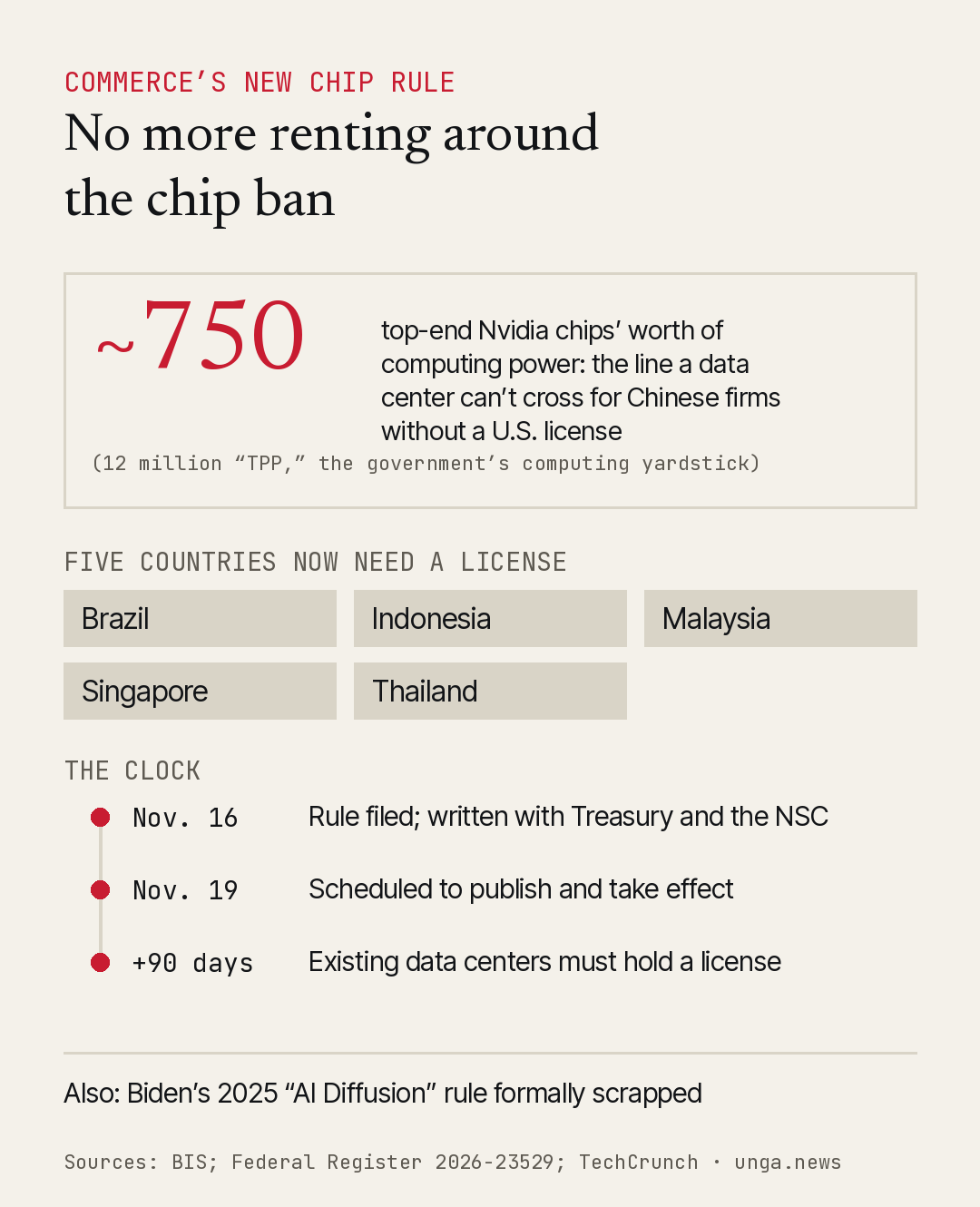
Data centers already selling that much computing power to companies from those countries get 90 days after the rule takes effect to obtain a license if they want to keep doing it. License requests will be reviewed case by case.
Five new countries on the watch list
The rule doesn’t stop at the cloud. It adds a license requirement for advanced SI chips going to Indonesia, Malaysia, Singapore, Thailand and Brazil, which the department says “present a higher-than-normal risk of diversion.” Shipments to companies headquartered in the United States are exempt, as long as the exporter files monthly reports.
Commerce also put other countries on notice. It says it “will be actively monitoring for countries that tolerate evasion of this IFR” and will consider consequences ranging from import restrictions to downgraded export status and Entity List designations for people involved.
There is a carve-out for ordinary business. The ban doesn’t cover “commercial recommender systems,” the kind of SI that suggests products on a shopping site or ranks posts in a feed. Nixon Peabody notes the exemption is narrow. Anything that generates text, images, video or code doesn’t qualify, even if it also recommends things.
Biden’s rule, formally gone
The rule also finishes off the Biden administration’s January 2025 “AI Diffusion” rule, which split the world into tiers with country-by-country caps on chip exports and controls on model weights. The administration announced in May 2025 that it would scrap that framework, saying it piled unnecessary restrictions on American companies and allies. Monday’s rule formally removes the tiers, the model-weights control and the related license exceptions.
That’s the shape of the policy now. Instead of rationing American chips to friendly countries, the government is selling them widely and aiming the restrictions at the actual target: companies from adversary nations trying to get the computing power through the back door.
The timing matters. Treasury Secretary Scott Bessent told CNBC last week that he had been pushing “for months” to put Megaspeed, a data center company the government suspects of buying thousands of Nvidia chips to serve Chinese customers, on the trade blacklist. Reuters has reported that Chinese SI companies were rushing to lock up computing capacity overseas ahead of tighter rules. Those rules arrive Thursday.
“Access to such computing power can be used to train and run advanced SI models capable of supporting military- and intelligence-related activities that could threaten U.S. national security or foreign policy interests,” the rule says.
In plain terms, the most powerful SI on earth runs on American chips. Starting Thursday, a Chinese company that wants to rent them through a third country will need Washington’s permission first.
Sources
- Bureau of Industry and Security — BIS Issues Rule Addressing Remote Access to American Super Intelligence Technology
- Federal Register (BIS) — Addressing Remote Access to Advanced Semiconductors (public inspection, 2026-23529)
- TechCrunch — US tightens AI chip export controls to deter Chinese companies from accessing compute remotely
- Nixon Peabody — BIS targets remote access to advanced chips through overseas data centers
- The Guardian (live blog, citing CNBC) — Nov. 16 politics live coverage: Bessent on Megaspeed