

Americans Have Filed a Record 5.2 Million Applications to Start Businesses This Year
It’s the most since the government started counting, and more of these new companies are expected to hire than ever before.

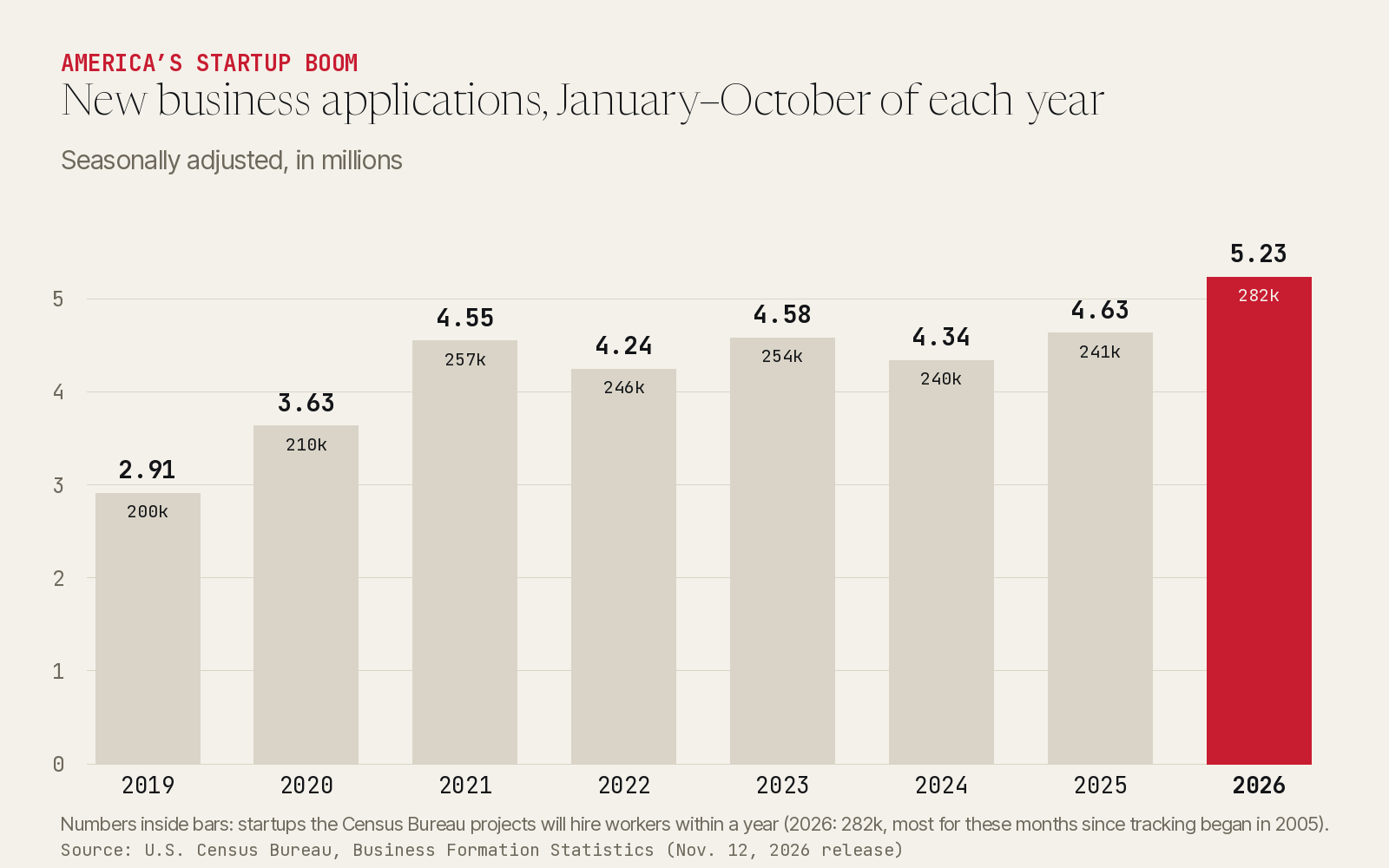
Americans are starting businesses at a pace this country has never seen. From January through October, people filed 5.23 million applications to open new businesses, the most for those 10 months since the Census Bureau began keeping count in 2005. It’s the kind of number that would lead every newscast if a Democrat were in the White House.
Treasury Secretary Scott Bessent pointed to the record on Small Business Saturday, the busiest day of the year for Main Street shops, as he urged people to buy local.
Scott Bessent on 𝕏 — Nov. 28, 2026
— @SecScottBessent View on 𝕏
“Their spirit of enterprise and courage to take risks remind us that there is no better place to build a business than the United States of America,” Bessent wrote, adding that small businesses make up 99.9% of U.S. firms.
His 5.2 million figure checks out. I pulled the Census Bureau’s own monthly data, the same numbers in its Nov. 12 Business Formation Statistics release, and added up the first 10 months of every year on record. This year comes to 5,232,255 applications after the bureau’s usual seasonal adjustment. That beats last year by 13% and 2024, the last year of the Biden administration, by nearly 21%. It also tops 2021, the pandemic-era burst that got covered for years as a once-in-a-generation boom.
Critics like to wave off application counts. Anyone can file for a tax ID, the argument goes, and a lot of those filings are side gigs or paper companies that never hire anybody. That’s a fair question, and the Census Bureau answers it with a second number.
Each month the bureau projects how many of that month’s applications will turn into real employer businesses, the kind that put people on a payroll within a year. For January through October, that projection comes to 282,324 new employer startups. That’s up almost 17% from the same stretch last year and is the highest for those months in the whole data set, which starts in 2005. It’s even ahead of 2007, before the financial crisis knocked the bottom out of new business creation for most of a decade.
So this isn’t just people filing paperwork. More of these new companies are expected to hire.
The growth also isn’t stuck in one corner of the economy. In the bureau’s unadjusted numbers, the biggest jump came in professional, scientific and technical services, the consultants, engineers, designers, accountants and software shops that make up the backbone of the white-collar economy. Applications there are up about 28% from a year ago. Construction, transportation and warehousing, health care, and administrative services are all up too.
It’s happening everywhere, not just in a couple of hot states. Every region of the country is up between 10% and 12%. Florida is up nearly 12% and California almost 14%. Utah is up about 25%, one of the biggest gains in the country.
There’s one soft spot, and I’d rather show it than hide it. October’s count, 501,609 applications, was 6% lower than September’s and about 1% below last October. One month doesn’t make a trend, and the 10-month total is still far ahead of any year on record. But it’s worth watching when the November numbers come out next month.
Why does any of this matter for the people who aren’t starting a company? Because new businesses are where a huge share of new jobs come from. Big corporations mostly shuffle workers around. It’s the startups that add net new jobs, and every one of those 282,000 projected employers is a future paycheck for somebody.
It’s also a vote of confidence. Nobody quits a steady job, drains their savings and signs a lease on a storefront unless they believe the economy and the rules will still be there for them in a year or two. Starting a business is a bet on the future, and right now Americans are making that bet in record numbers.
The Trump administration has worked to make that bet easier. The One Big Beautiful Bill that President Trump signed in July 2025 made the 20% deduction for owners of small, pass-through businesses permanent, so it no longer runs out at the end of 2025 like it was set to. The same law also made permanent the rule that lets businesses write off the full cost of new equipment in the year they buy it. Both had been sunsetting, and owners now have the certainty to plan around them.
You won’t hear much of this from the outlets that spent the week fixated on the President’s approval rating. A record like this one barely gets a mention.
The numbers come straight from the government’s own data. The startup surge didn’t slow down after the 2024 election. It sped up, and so far this year it’s running ahead of every year the Census Bureau has ever measured.
So if you head out this weekend to the new coffee shop, the family hardware store or the guy who just opened a barbershop down the street, you’re part of the story. Shop small. There are more small businesses to shop at than ever.
Sources
- U.S. Census Bureau — Business Formation Statistics, October 2026 (release CB26-184, Nov. 12, 2026)
- U.S. Census Bureau — Business Formation Statistics monthly time series (CSV)
- Scott Bessent on 𝕏 — Small Business Saturday post (Nov. 28, 2026)
- Congress.gov — H.R. 1 — One Big Beautiful Bill Act (Public Law 119-21)