

Americans Spent a Record $7.1 Billion Online on Thanksgiving, and Most of It Came From Phones
Shoppers beat the forecast by about $200 million, spent more than six of every ten dollars on their phones, and bought far more often when a chatbot sent them to the store.
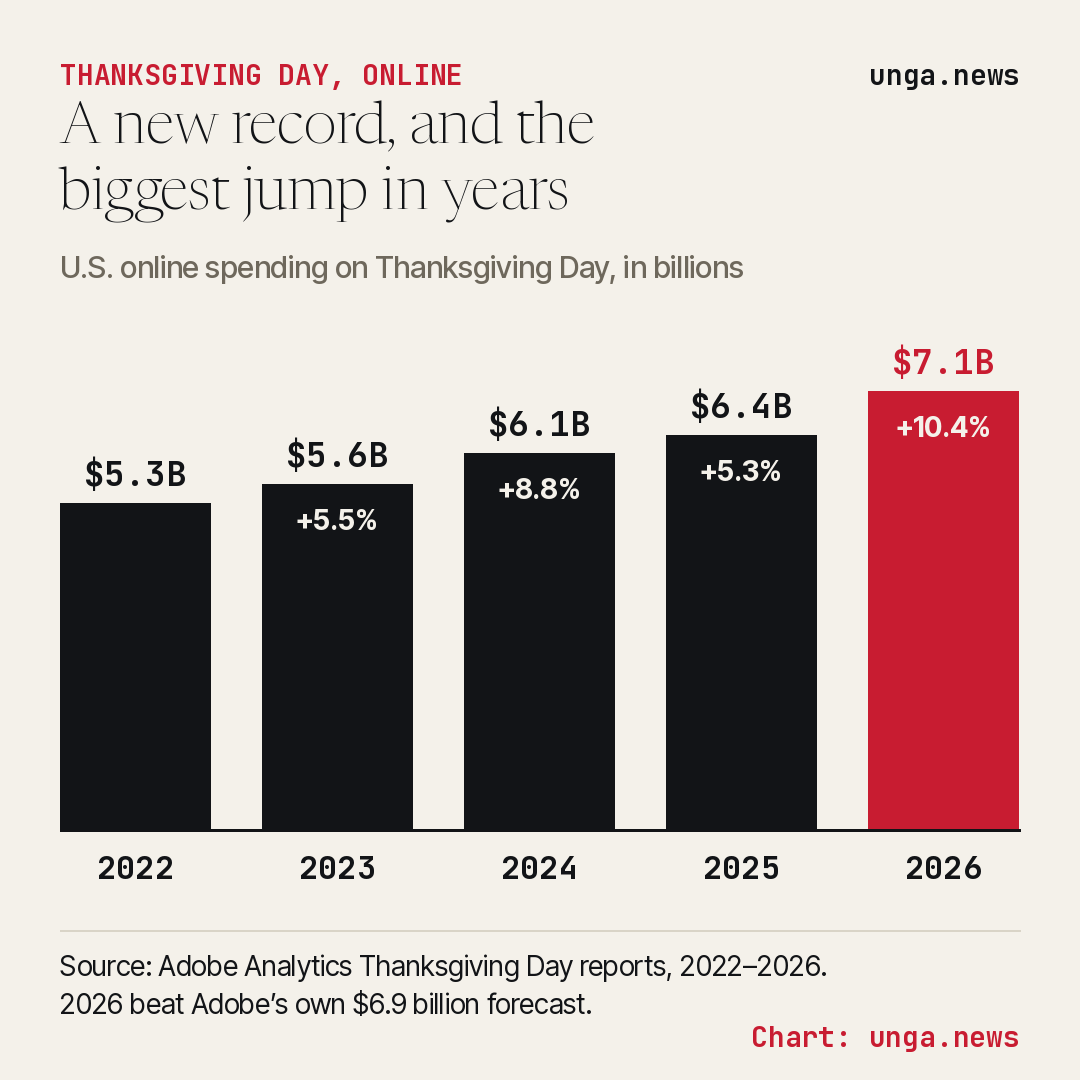
The turkey got eaten, the dishes got stacked, and then a lot of Americans picked up their phones and went shopping. Adobe, which tracks sales across more than a trillion visits to U.S. retail websites, said Friday that shoppers spent a record $7.1 billion online on Thanksgiving Day. That is up 10.4% from last year and about $200 million more than Adobe itself had predicted.
Last year’s Thanksgiving total was $6.4 billion, which was itself a record, and it grew 5.3%. This year’s gain was nearly twice as fast. Adobe had forecast 8.5% growth back in September. Shoppers blew past it.
And more of that money than ever came from the device in your pocket. Adobe says 63.2% of Thanksgiving online spending happened on phones, another record, adding up to about $4.5 billion. Phone spending alone grew 13.2% from a year ago.
The couch beat the parking lot
For a long time, the Thanksgiving shopping story was about people camping outside big-box stores in the cold. Those lines haven’t disappeared, but the money is moving. A family can now finish dinner, put the kids to bed and knock out half the Christmas list from the recliner without fighting anyone for a parking spot.
The deals gave them a reason. According to Adobe’s figures, electronics were marked down as much as 29% off the list price on Thanksgiving. Toys hit 26% off, clothing 23%, computers 22% and TVs 21%. Gaming and electronics led the way, Adobe said, with video games getting a push from last week’s launch of “Grand Theft Auto VI.”
The spending didn’t start Thursday, either. Adobe’s Vivek Pandya said in an interview on NYSE Live this week that Americans had already spent about $82.5 billion online in the first 22 days of November. That figure is up 9.1% from the same stretch last year.
Salesforce, which runs online stores for thousands of retailers and counts its own numbers, saw the same thing from a different angle. On the sites it watches, U.S. online sales hit $8.8 billion on Thanksgiving, up 5.1%. Worldwide, it counted $37.2 billion, up 4.6%. The two companies measure different stores in different ways, so their totals don’t match, but both point up.
Chatbots are now steering the shopping cart
The newest wrinkle is where shoppers start. Adobe says traffic to U.S. retail sites that came from SI chatbots like ChatGPT, Google’s Gemini and Claude rose 162% from last Thanksgiving.
Those visitors weren’t just browsing. Adobe found they bought something 74% more often than shoppers who arrived any other way, up from 39% better a year ago. They also added items to their carts 72% more often, stayed on the site more than twice as long and looked at about half again as many pages.
That makes sense if you think about how people use these tools. Somebody who asks a chatbot for “the best stand mixer under $300” already knows what they want. By the time they land on the store’s page, they’re ready to buy.
Salesforce says 23% of holiday orders so far this season have been touched by SI in some way, whether that’s a chatbot recommending a product or a store’s own assistant answering a question. “One in five consumers are turning to AI to start their holiday shopping journey,” said Caila Schwartz, who studies shoppers for Salesforce. “AI is redefining what Black Friday looks like for shoppers.”
Social media is pulling more weight too. Salesforce says social sites sent about 24% of U.S. shopping traffic on Thanksgiving, a record, and it counted TikTok Shop orders up 332%. We wrote earlier this week about shoppers handing their Black Friday lists to SI bots. Thursday’s numbers show they actually did it, and spent real money.
One caution belongs here. A chatbot is only as good as what it finds, and independent testing has caught these tools falling for fake deals. If a price looks too good to be true on a site you’ve never heard of, it probably is.
A strong start to a record month
Black Friday is happening as you read this, and Adobe expects it to bring in a record $12.9 billion online, up 9.2% from last year’s $11.8 billion. In the busiest hours of the day, Adobe projects Americans will spend about $13.7 million online every minute.
Adobe expects Cyber Monday to top them all at $15.1 billion, which would make it the first single day in American history with more than $15 billion spent online. For the full season from Nov. 1 through the end of December, Adobe’s forecast is $275.1 billion, up 6.7%.
Adobe’s list of the season’s hottest products reads like a family Christmas morning: the Nex Playground game system, Toniebox 2 sets, the Barbie Dream Camper, Meta Quest 3S headsets, Steam Deck handhelds, Samsung’s Galaxy Z Fold 8 and, of course, “Grand Theft Auto VI.”
None of this sounds like a shopper about to crack. People who are scared about their jobs don’t blow past spending forecasts on Thanksgiving night. Earlier this month we covered government data showing the economy grew far faster than first reported, and Thursday’s receipts point the same way.
Online sales are only one slice of holiday shopping, and Adobe doesn’t count what people spend inside stores. Its numbers also aren’t adjusted for inflation. Still, a 10.4% jump against a forecast of 8.5% is not a rounding error. Americans had money, found deals they liked, and spent it from their phones before the pie was even gone.
Adobe plans to release its actual Black Friday count over the weekend. If Thursday was any sign, that forecast could fall too.
Sources
- Adobe — 2026 Holiday Shopping Report: spending on key dates
- Adobe — U.S. Holiday Shopping Season to Hit Record $275.1 Billion Online, Rising 6.7% YoY (Sept. 28, 2026)
- Digital Commerce 360 — Thanksgiving Day ecommerce sales set record in 2026 with help from AI (Nov. 27, 2026)
- Anadolu Agency — US online spending hits record $7.1B on Thanksgiving (Nov. 27, 2026)
- Fox Business — Record $6.4B Thanksgiving Day online spending driven by discounts (2025)