

An Ohio Republican Wants Lawmakers to Beat a Governor’s Veto With a Simple Majority
Rep. Ron Ferguson’s H.J.R. 11 would drop Ohio’s veto-override bar from three-fifths to a majority and let voters decide in May. He says the people who write the laws should get the last word. The Speaker isn’t sold yet.
Here’s a question most people never think about until it matters. When the governor vetoes a bill, how many lawmakers should it take to say, “No, we’re passing it anyway”?
In Ohio the answer has been three-fifths of each chamber since 1851. One Republican in the Ohio House wants to change that to a plain majority, and he wants voters to settle it at the ballot box next spring.
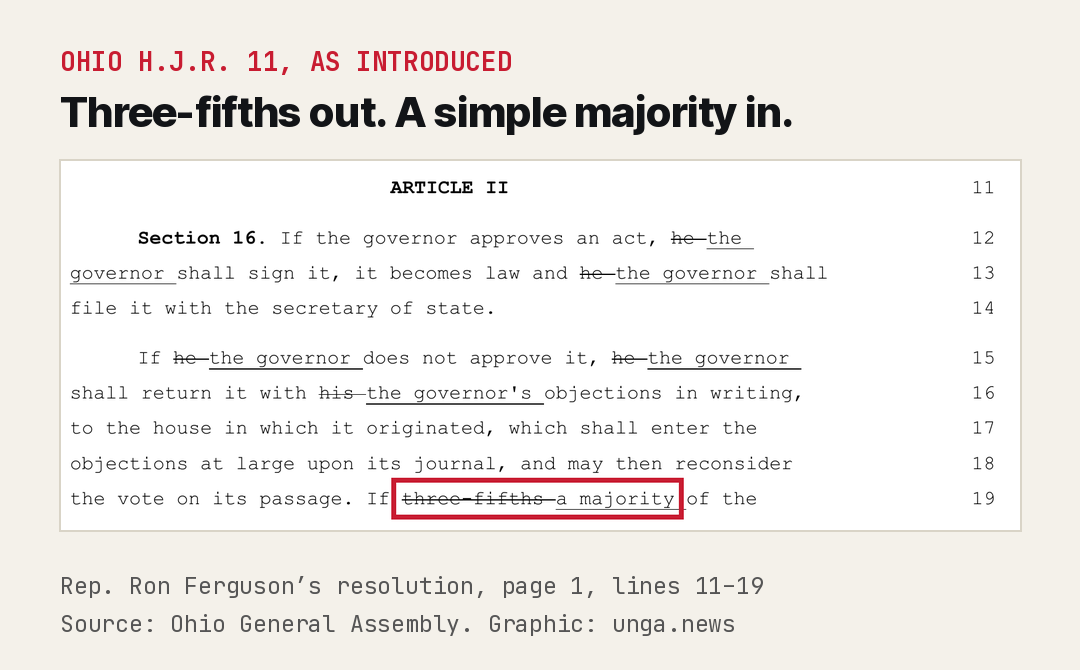
Rep. Ron Ferguson introduced House Joint Resolution 11 on Nov. 9. It’s short. The heart of it is one edit to Section 16 of Article II of the Ohio Constitution, the section that spells out how vetoes work. Where the text now says a bill can be passed over the governor’s objections by “three-fifths” of the members elected to each house, Ferguson’s version strikes that and writes in “a majority.” You can see the change right on page one of the resolution.
In real numbers, the Ohio House has 99 members and the Senate has 33. Three-fifths means 60 votes in the House and 20 in the Senate. A majority would be 50 and 17. That’s a difference of 10 House votes and three Senate votes, which is a lot of room in a chamber where big bills often pass by a few votes either way.
Ferguson’s case: the people who write the laws get the last word
Ferguson’s pitch isn’t about one governor. He told Signal Ohio’s Andrew Tobias the change is right no matter who holds the office. “This is the right thing to do whether it’s Gov. DeWine, Amy Acton, or the next Democrat or Republican 20 years from now,” he said. “Lawmakers are the ones that are supposed to write the laws, and so we’re the ones who should be able to override a veto and demand that.”
That’s an old argument, and it has real weight. The legislature is the branch closest to voters. Every House member faces the public every two years. A governor gets one signature that can stop months of work, and right now it takes a supermajority to undo it. Ferguson is betting a lot of Ohioans think the people they send to Columbus should be able to finish the job with the same kind of majority it took to pass the bill.
And he’s not alone in thinking the governor’s office has gotten too strong. Greg Lawson of the Buckeye Institute, a conservative think tank in Columbus, told the Dayton Daily News the idea fits a wider push to put “guardrails around the executive under governors of both parties.”
The federal Constitution uses two-thirds for Congress. States pick their own rules, and Ohio’s three-fifths bar was set more than 170 years ago.
Why the timing is the whole story
Amending the Ohio Constitution isn’t something the legislature can do alone. A joint resolution has to pass both chambers with three-fifths of the members, and then the voters decide. Ferguson’s resolution would put the question on the special election ballot of May 4, 2027. Because it’s a constitutional amendment and not a regular bill, the governor can’t veto it.
That last part matters. Gov. Mike DeWine leaves office in January, and Democrat Amy Acton takes over as governor. Republicans hold three-fifths of both chambers through the end of this year. Starting with the new General Assembly, the Nov. 3 results mean they won’t have that margin in both. So if the resolution is going to the ballot, the window to send it there is the lame-duck session right now.
Supporters see that as a chance to lock in a rule that would outlast any one governor. Critics see it as changing the rules on the way out the door. Democrats called it a last-minute move aimed at Acton before she takes office.
The Speaker isn’t on board, at least not yet
The biggest hurdle may be inside Ferguson’s own caucus. House Speaker Matt Huffman, a Lima Republican, said Tuesday that running a statewide campaign by May would be “almost impossible” and that his caucus hasn’t talked about it. “It wasn’t something that was raised by the representative or anybody else,” Huffman said.
The House majority’s press secretary, Olivia Wile, went further on the bigger chatter around Columbus about curbing the incoming governor. “These are rumors and strictly that,” she told the Herald-Star.
DeWine wasn’t a fan of the idea either. “I don’t think any governor would approve anything,” he said, “that would dramatically change the powers of the governor.” That’s about as honest an answer as you’ll get from a sitting governor. No one in that chair wants a smaller veto.
So the resolution sits in committee. LegiScan’s record shows it was referred to the House General Government Committee on Nov. 10. A hearing hasn’t been set, and the clock runs out when this General Assembly ends.
What a majority override would mean in practice
Strip away the politics and here’s how this would work day to day. Today, a governor who keeps just over two-fifths of either chamber on his side can make a veto stick. Under H.J.R. 11, he would need about half of a chamber to hold. That pulls power back toward the legislature and makes vetoes more of a speed bump than a wall.
It cuts both ways over time. A Republican legislature could override a Democratic governor more easily. A Democratic legislature years from now could do the same to a Republican governor. Ferguson is openly saying he’s fine with that trade, because he thinks the branch that answers to voters most often should win the tie.
There’s also a practical upside conservatives like. When lawmakers pass something with a solid majority today, a veto can send them back out hunting for a few extra votes. A majority override would end most of that horse-trading. Bills would pass or fail on their merits once, not twice.
What happens next
For this to reach voters in May, it has to clear the House committee, win 60 votes on the House floor, and then win 20 in the Senate, all before the session ends. With the Speaker publicly cool on it, that’s a steep climb in a few weeks.
Even if it stalls, Ferguson has put the question on the table, and it won’t go away. The same idea can come back in the next General Assembly, or reach the ballot by citizen petition, which skips the legislature entirely. Either way, Ohio voters may eventually get asked a simple question: should the people who write the laws need 60%% of the room to get the final word, or just more than half?
Sources
- Ohio General Assembly — House Joint Resolution 11, as introduced
- Ohio House of Representatives — House Journal, Nov. 9, 2026
- LegiScan — OH HJR11 bill status
- Dayton Daily News — Ohio House speaker dismisses a Republican proposal to weaken governor’s veto power
- Herald-Star — Ohio House Republicans try to shut down rumors of attempt to limit Acton’s governorship