

Court Lets California Count 20,000 Ballots Flagged as Possible Noncitizen Votes. Dissenting Judge: Federal Law Says Hold Them
A 2-1 Ninth Circuit panel said DOJ came too early and sent the case back to a Los Angeles judge for Tuesday. Trump appointee Patrick Bumatay wrote that holding those ballots is "the bare minimum."
A federal appeals court on Monday refused to make California set aside the mail ballots of more than 20,000 people the federal government flagged as likely noncitizens. Not throw them out. Just hold them in a separate pile until someone checks whether the voters are citizens.
The vote was 2-1. And the two judges in the majority never said California was right. They said the Justice Department came to them too early, before the trial judge in Los Angeles had ruled. So the fight goes back to that judge, David Carter, who holds a hearing on Tuesday. Election Day is Nov. 3.
What the court actually decided
This was a ruling about which court goes first, not about whether noncitizens are voting. The panel's unsigned order says the government "failed to allow the district court adequate opportunity to consider its application," so "we lack jurisdiction over this appeal." It granted Los Angeles County's motion to dismiss and called DOJ's emergency request moot.
The majority went further, calling the government's emergency "at least in part" a "self-constructed one." Its timeline: DOJ asked Carter twice for a ruling by Nov. 3, then, at 8:57 p.m. on Oct. 21, asked for one by noon the next day. Fifteen hours later, with no ruling, it appealed.
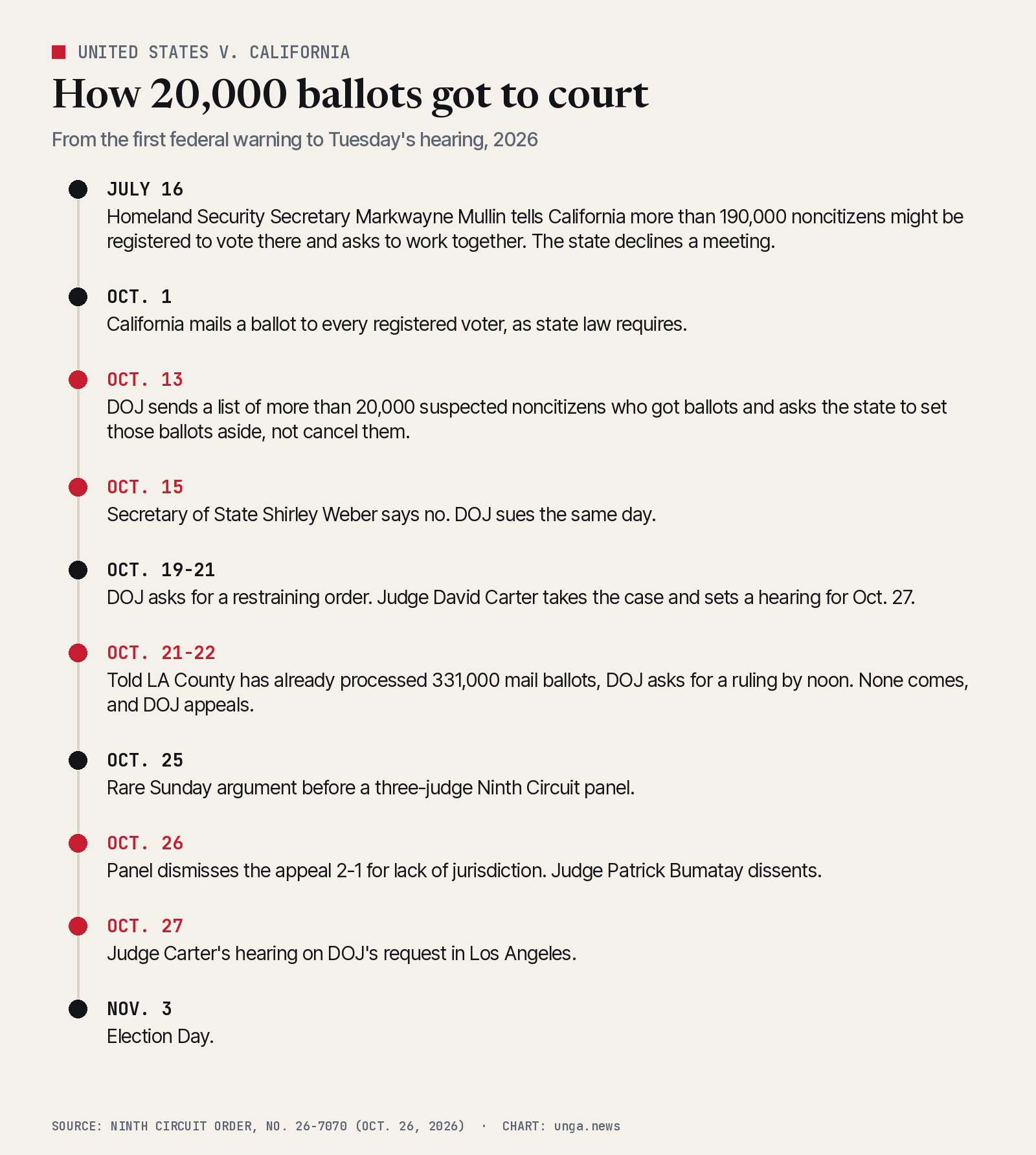
Here's the hole in that story. DOJ says it changed course for a reason. In a court filing on Oct. 20, the state side admitted LA County had already processed more than 331,000 mail ballots since Oct. 5. Every one of those envelopes, once opened and counted, is mixed in for good. Think of it like dropping a handful of suspected counterfeit bills into a bank's vault. Once they're in the pile, you can't pull them back out.
The dissent: 'We should've stopped it'
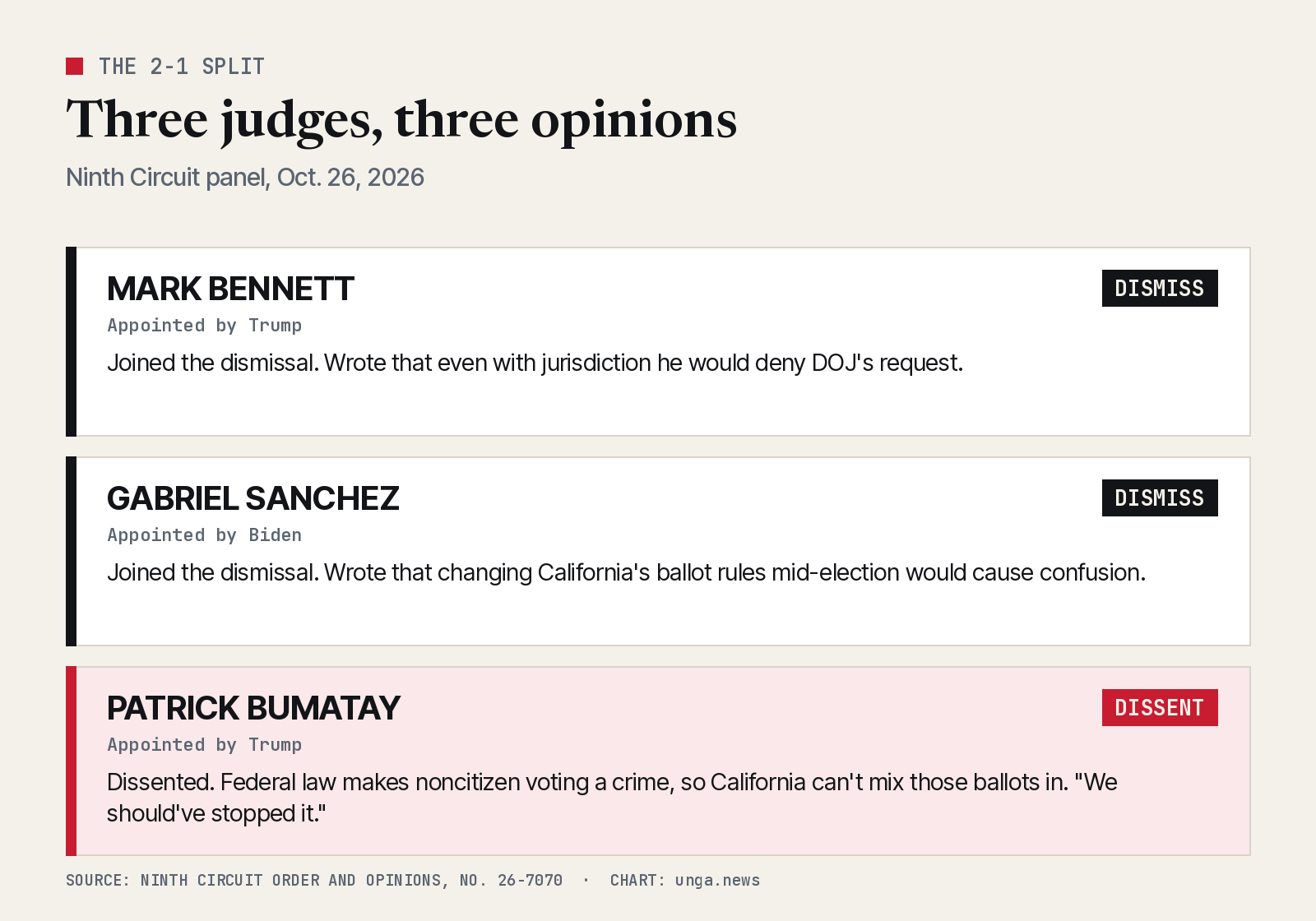
Judge Patrick Bumatay, a Trump appointee, wrote the dissent, and it reads like the case DOJ wanted to make. "The question—does the federal government have the power to stop this potential attack on the integrity of our elections? Under both federal law and the Constitution, the answer must be 'yes,'" he wrote.
His argument is simple. Congress made it a crime for a noncitizen to vote in a federal election, under 18 U.S.C. 611. The Constitution's Supremacy Clause says federal law wins when a state gets in its way. California's choice to keep mixing flagged ballots in with everyone else's, he wrote, "frustrates the federal prohibition on noncitizens voting." His bottom line: setting aside ballots from people the government identified as likely noncitizens "is the bare minimum."
He made the same point from the bench Sunday, telling California's lawyer that without a court order, "you will never know."
Why 'election rules' don't settle it
Judge Gabriel Sanchez, a Biden appointee, wrote that even with jurisdiction he'd block DOJ under the Purcell principle, the Supreme Court's warning against courts changing election rules close to an election. Judge Mark Bennett, also a Trump appointee, joined the dismissal and wrote that he would deny DOJ's request on the merits too.
Bumatay's answer is the best line in the 91 pages: "In California, no one is changing the terms. Citizens can vote. Non-citizens can't. That's always been true. An injunction here isn't changing the rules but applying them." He also noted that holding a ballot aside doesn't cancel it. If a voter checks out as a citizen, the ballot counts.
What California hasn't answered
The state's main defense is that DOJ's list isn't reliable. Secretary of State Shirley Weber questioned its accuracy in her Oct. 15 letter, and Sanchez wrote that the state and county have "serious doubts" about the government's data. But the dissent lays out what happened before the list ever reached court. When DHS first wrote in July that more than 190,000 noncitizens might be on the rolls and asked to "work collaboratively," Weber wrote back without offering to check, and declined a meeting.
That leaves the question California still hasn't answered: if the federal list is wrong, why not check it? The state could clear every real citizen on the list and count their ballots. Instead, it argues state and federal law won't let it hold those ballots back. LA County told the court it has a software "Freeze Policy" barring major system changes from Oct. 14 through Nov. 6, covering a system that tracks close to 5.9 million voters.
What happens next
Tuesday is the next stop. Carter has said he will "rule promptly after hearing from the Parties." Whichever side loses can go back to the Ninth Circuit, and from there to the Supreme Court. The Justice Department had not posted a public response to Monday's ruling when this report published.
Meanwhile, the ballots keep coming in, and every day more of them go into the count. The court said DOJ moved too fast. Bumatay's warning is that if nobody moves, "you will never know."
Sources
- U.S. Court of Appeals for the Ninth Circuit — United States v. California, No. 26-7070, Order dismissing appeal, with concurrences by Judges Bennett and Sanchez and dissent by Judge Bumatay (Oct. 26, 2026)
- U.S. Court of Appeals for the Ninth Circuit — Oral argument video, United States v. California, No. 26-7070 (Oct. 25, 2026)
- U.S. Court of Appeals for the Ninth Circuit — Opinions list: USA v. State of California, et al., No. 26-7070 (filed Oct. 26, 2026)
- Los Angeles County Registrar Dean Logan (Ninth Circuit filin — Emergency Motion to Dismiss Appeal (Oct. 24, 2026)
- U.S. Department of Justice (Ninth Circuit filing) — Emergency Motion for Injunction Pending Appeal (Oct. 23, 2026)
- State of California (Ninth Circuit filing) — State Defendants' Opposition to Emergency Motion for Injunction Pending Appeal (Oct. 24, 2026)
- U.S. Department of Justice (district court filing) — United States' Notice of Appeal, No. 2:26-cv-12025 (C.D. Cal., Oct. 22, 2026)
- Cornell Law School, Legal Information Institute — 18 U.S.C. 611, Voting by aliens
- U.S. Supreme Court (U.S. Reports, Library of Congress) — Purcell v. Gonzalez, 549 U.S. 1 (2006)