

Apple Accused ChatGPT’s Maker of Stealing Its Secrets. Now It Says Apple Read a Worker’s Private Texts.
OpenAI fired back in federal court on Black Friday, saying Apple took its gadget designs through a returning engineer, leaned on shared factories to shut it out and dug through an ex-employee’s personal iMessages.
In July, Apple went to court and accused ChatGPT’s maker of raiding its engineers to get a head start on gadgets. On Friday, while most of the country was out chasing Black Friday deals, OpenAI turned the case around. It now says Apple is the one that took secrets, and that Apple’s people went digging through a former engineer’s private text messages after he quit.
OpenAI and its hardware company, io Products, filed counterclaims in federal court in San Jose on Nov. 27, joined by two former Apple employees Apple had sued, Chang Liu and Tang Yew Tan. The filing denies that anyone stole from Apple and lays out 12 claims of its own, from trade-secret theft to invasion of privacy. OpenAI wants damages, court orders to stop the conduct, and a jury trial. Reuters reported that the filing calls Apple’s employment practices a way to “trap” workers so they can’t build anything for a competitor.
Apple and OpenAI didn’t answer Reuters on Friday. Everything below is OpenAI’s side of the story, and none of it has been tested in court yet.
The engineer who went back to Apple
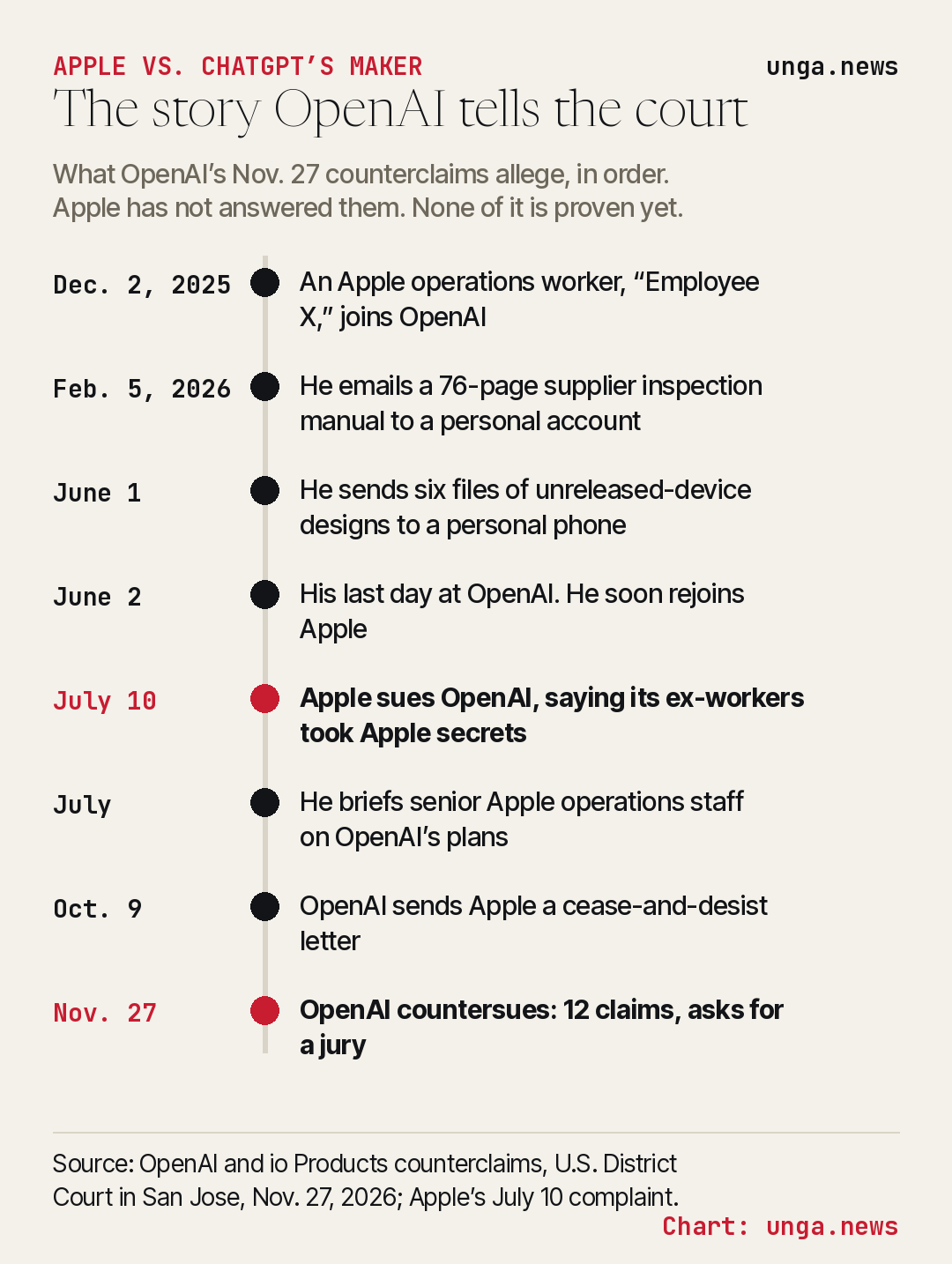
The heart of the new filing is a man OpenAI calls only “Employee X.” According to the counterclaims, he came over from Apple on Dec. 2, 2025, starting out on camera and optics quality and then taking on enclosures, metal finishing, inspection and manufacturing quality for OpenAI’s unreleased devices.
OpenAI says he spent his six months there quietly copying its work. On Feb. 5 he allegedly sent himself a 76-page supplier measurement and inspection manual. On June 1, a day before he left, OpenAI says he sent six archives of files to a personal phone number in Singapore, holding the shape of an unreleased device, enclosure measurements and factory test records. Then, the filing says, he went back to Apple.
That July, OpenAI claims, Apple asked him to brief senior members of its Asia-Pacific operations team on OpenAI’s hardware work and its plans for products nobody has seen yet. OpenAI first raised the problem in a cease-and-desist letter on Oct. 9 and in an Oct. 14 court filing that said he had moved more than 100 confidential files to personal accounts. Apple told the court that same day that its first search had turned up no OpenAI secrets and that it wanted more details.
Leaning on the factories
The part of the filing that should bother anyone who believes in open competition is about suppliers. Gadgets aren’t made in one building. They pass through a chain of specialty shops that polish metal, coat glass and test parts, and many of those shops also work for Apple, by far the biggest customer in the business.
OpenAI says Apple’s supply managers pushed those shared vendors to reveal which projects they were doing for OpenAI, and even the names, locations and jobs of workers who used to be at Apple. Suppliers feared losing their Apple orders if they helped the newcomer. For many specialized steps, OpenAI says, there are only one or two qualified shops anywhere.
Two examples stand out. One finishing shop allegedly moved OpenAI’s metal-coating work to a separate overnight shift after Apple objected to the two companies’ parts going through the same area at the same time, which raised costs for everyone. A second manufacturer allegedly told OpenAI it couldn’t do the planned work at all because of threats from Apple, which forced OpenAI to rework its manufacturing plans, according to Bloomberg Law.
If that’s true, it’s the old playbook of a giant using its size to choke off a rival before the rival ever ships a product. Conservatives have spent years warning that Big Tech uses its muscle to pick winners, and this time the accusation comes from inside the industry.
Private texts on a returned laptop
The most personal charge involves Chang Liu. He left Apple on Jan. 22, 2026. The filing says he left his personal iCloud account signed in on an Apple device he turned in for one reason: so his old manager could pull Apple work files off it. OpenAI says that permission never covered his private life.
Instead, the counterclaims say, Apple and its outside forensic firm, Charles River Associates, went through Liu’s personal iMessages, including conversations he had after leaving with people who had nothing to do with Apple. Liu now accuses Apple of invading his privacy and breaking federal and California computer-access laws.
OpenAI also claims Apple encouraged staff to mix work and personal accounts on iCloud and iMessage, then used the work files found on those personal accounts to go after people who left for competitors. Most iPhone owners trust Apple’s privacy pitch. A company that sells privacy reading an ex-employee’s private texts would be a hard look, if a court finds it happened.
Apple’s side and the 400 who left
Apple’s original suit, filed July 10, tells a mirror-image story: former Apple workers took confidential hardware and manufacturing information with them, and OpenAI used it to speed up its push into consumer devices. Engadget reported that Apple accused them of downloading dozens of confidential files on unreleased products, engineering presentations and technical specs. OpenAI denies that.
The fight is really about talent. OpenAI says about 400 Apple employees have left to join it. Tang Tan is the biggest name among them. He spent about 24 years at Apple and now runs consumer hardware at OpenAI. He and Liu are asking the court to rule that Apple’s contracts can’t stop them from using their general skills, public information or ordinary recruiting, and they are attacking a one-year ban on hiring away Apple staff. California law has long protected a worker’s right to change jobs, and that’s the ground they’re standing on.
There’s plenty of reason for skepticism on both sides. Apple is the most valuable gadget maker on earth, protective of every secret and used to winning. OpenAI is spending heavily to become a hardware company almost overnight and is happy to hire Apple’s people to do it. Both have reasons to make the other look like the thief.
For regular people, the outcome decides how fast real competition shows up in the devices in their pockets. A market where one giant can quietly tell the factories who they’re allowed to serve isn’t much of a free market. A jury in San Jose may end up deciding which company played dirty, and the fight is going to drag Apple’s supplier relationships into open court either way.
Sources
- Reuters — OpenAI countersues Apple for stealing trade secrets (Nov. 27, 2026)
- Bloomberg Law — OpenAI Says Apple Pressured Suppliers to Shun Its Devices (Nov. 27, 2026)
- Anadolu Agency — OpenAI countersues Apple over alleged trade secret theft, supplier pressure (Nov. 27, 2026)
- Engadget — OpenAI Countersues Apple And Accuses It Of Stealing Trade Secrets (Nov. 27, 2026)