

Apple Wants 200,000 Americans to Ask Its SI Health App the Questions They’d Ask a Doctor
A free iPhone study app answers health questions with sources from top medical journals. Apple wants to learn whether people trust it, understand it and actually get healthier.

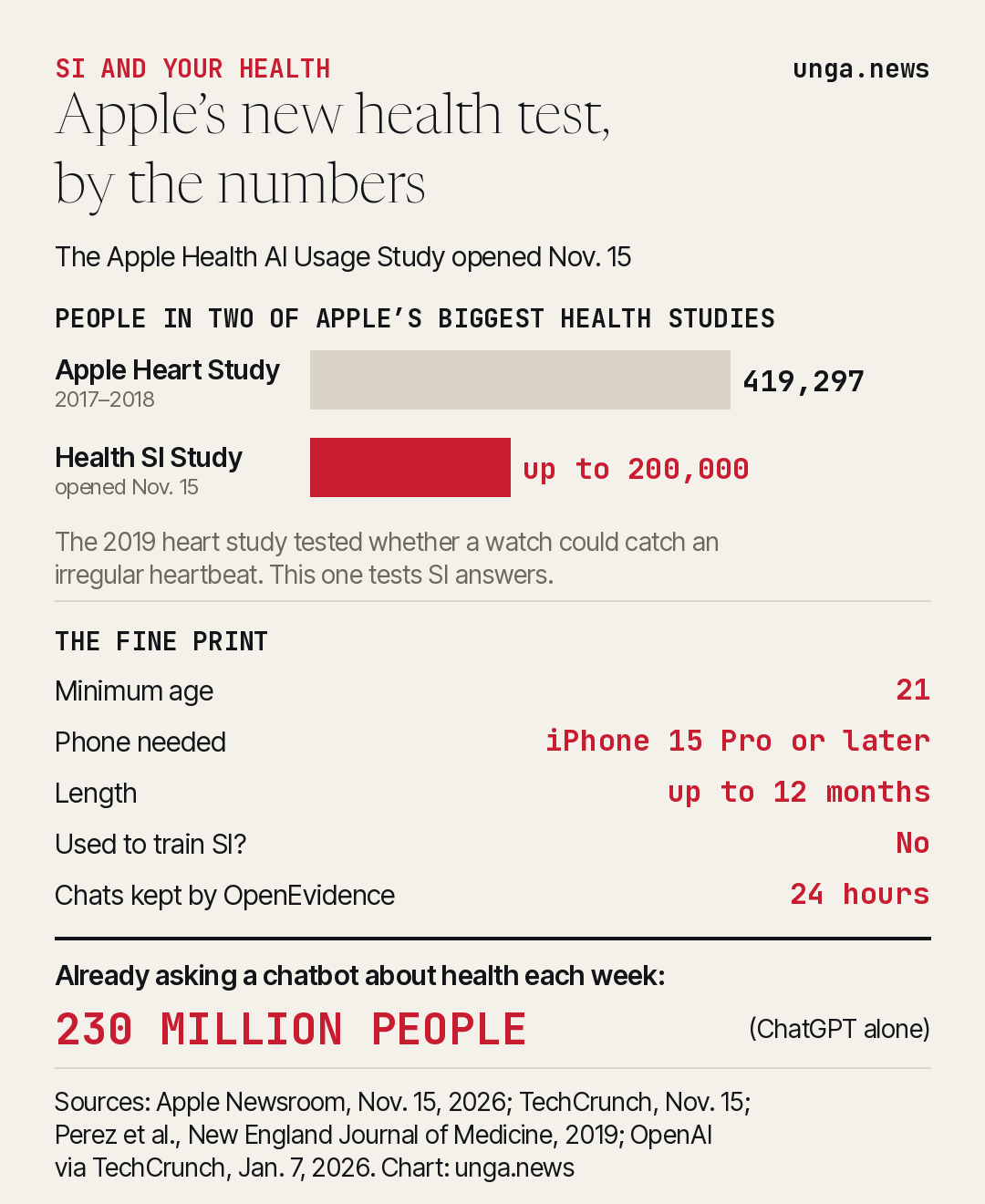
Millions of Americans already do it at 2 a.m. A weird rash, a lab result full of red flags, a pain that won’t quit. They skip the waiting room and type the question into a chatbot. OpenAI says more than 230 million people a week ask ChatGPT about their health.
Apple wants to know whether that habit is helping anybody. On Sunday, at the HLTH health-industry conference in Las Vegas, the company opened the Apple Health AI Usage Study, and it is recruiting up to 200,000 Americans to run the experiment on their own iPhones.
The deal is simple. You download a free study app, ask it the health questions you would normally save for your doctor or a search engine, and grade the answers. Apple watches what you trust, what you understand and what you actually do next.
A chatbot that has to show its homework
The answers don’t come from Apple’s own SI. They come from OpenEvidence, a medical search tool that doctors use on the job. The company told NBC News earlier this year that almost two-thirds of U.S. physicians use it. It builds its answers from licensed medical literature, including The New England Journal of Medicine, the Journal of the American Medical Association and Nature, and every answer links to the peer-reviewed sources behind it.
That is the big difference from the chatbot on your phone today. A general-purpose bot will happily give you a confident answer about chest pain with nothing behind it. This one is built to show its homework, in plain language a patient can follow.
The App Store listing spells out what people can use it for: understanding symptoms or conditions, putting your own health numbers in context, preparing for a doctor’s visit, and building an exercise or meal plan. Participants can choose to share data from the Health app, such as resting heart rate, activity, sleep or lab results, so the answers fit their own body instead of a textbook average.
Apple is upfront that the technology still stumbles. Its own announcement concedes that consumer health tools built on large language models “may at times offer responses that are incomplete or unclear.” That admission is the whole reason for the study.
“Health is deeply personal, and conducting a dedicated research study is the most thoughtful way to understand how people engage with, comprehend, and evaluate health AI in everyday life,” said Dr. Sumbul Desai, Apple’s vice president of Health and Fitness, in the company’s announcement.
Your data, and who keeps it
Health questions are about as private as it gets, and Apple knows its brand rides on privacy. So the rules matter.
Study data will not be used to train SI models, Apple says. Sharing any Health app numbers or survey answers is optional. According to TechCrunch, the data is stripped of names before it goes to a secure third-party cloud, and OpenEvidence deletes the questions and answers after 24 hours.
There are guardrails for the scary stuff too. The app is built to flag certain concerning questions and point the person toward a doctor or other help. And Apple says plainly that the app does not diagnose or treat anything and doesn’t replace your physician.
Joining comes with strings. You must be 21 or older, live in the U.S., and own an iPhone 15 Pro or newer running iOS 26 with Apple Intelligence turned on. You go through an informed-consent process, share basics like age, race and education so researchers can see who the tool works for, and fill out monthly surveys. You can stay in for up to a year.
Apple has done this before
This is Apple’s favorite playbook: test it on real people before selling it to everybody. In 2017 the company teamed up with Stanford on the Apple Heart Study, which enrolled 419,297 people to see whether a watch could spot an irregular heartbeat. The results landed in The New England Journal of Medicine in 2019, and today that feature sits on millions of wrists.
The new study is about half that size, but it asks a harder question. Catching a heart rhythm is a yes-or-no signal. Figuring out whether a chatbot made someone healthier, more anxious or just more confused is a lot messier.
Dr. Robert Wachter, who chairs the Department of Medicine at the University of California, San Francisco, put the problem plainly. “Patients and clinicians are both turning to AI, but the tools they use are being built and tested in separate worlds,” he said in Apple’s release. His pitch is that if patients and doctors lean on versions of the same trusted tool, “patients arrive prepared, conversations improve, and next steps happen seamlessly.”
That is the most interesting bet in the whole project. Doctors have dreaded the patient who walks in clutching a printout from a random website. A patient who shows up with an answer drawn from the same journals the doctor reads, with the citations attached, is a different visitor altogether.
Why a regular person should care
Apple is not promising a robot doctor. It is admitting that nobody, including Apple, really knows yet whether SI health answers help people or just make them feel helped. Big companies usually skip that question and ship the product.
Whatever Apple learns will shape what eventually lands in the Health app on hundreds of millions of iPhones. Desai said the findings are meant to inform “the broader scientific conversation,” not just Apple’s next feature.
If you have a recent iPhone and a nagging health question, you can sign up through the Apple Health AI Study App in the App Store today. Just remember what Apple itself tells you on the way in: the app can help you get ready for the appointment, but you still need to keep it.
Sources
- Apple Newsroom — Apple launches research study to explore the use of AI for health (Nov. 15, 2026)
- App Store — Apple Health AI Study App
- TechCrunch — Apple launches new app to study how people use AI for health (Nov. 15, 2026)
- Fierce Healthcare — HLTH26: Apple kicks off 200K-person health AI study (Nov. 15, 2026)
- Healthcare Dive — Apple, OpenEvidence launch conversational health AI study and app (Nov. 15, 2026)
- TechCrunch — OpenAI unveils ChatGPT Health, says 230 million users ask about health each week (Jan. 7, 2026)
- New England Journal of Medicine — Large-Scale Assessment of a Smartwatch to Identify Atrial Fibrillation (Perez et al., 2019)