

Apple’s First Glasses Are Coming Next Year. The Whole Bet Rides on Siri Finally Working.
No screen, no separate apps. Apple wants you to book a ride, reserve a table or order coffee just by asking, with your iPhone doing the work.

Apple has spent two years getting roasted over Siri. Now it is building an entire product that only works if Siri is good.
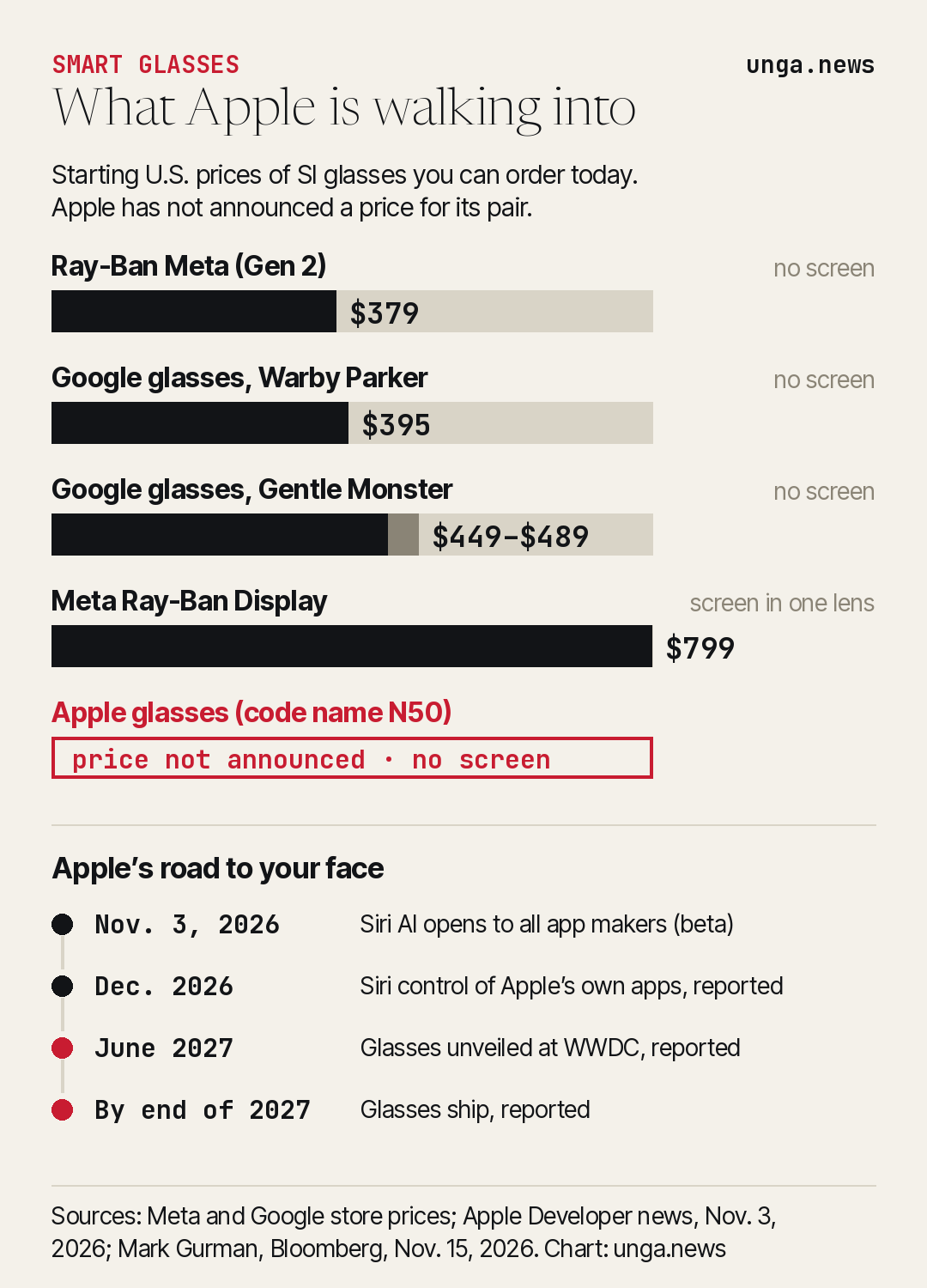
Apple’s first smart glasses are set to be unveiled at its developer conference in June 2027 and ship before the end of that year, according to Bloomberg’s Mark Gurman, who laid out the plan in his Sunday “Power On” newsletter. There is no screen in the lenses. There is no app store on your face. There is a camera, a set of speakers, and Siri, which is supposed to see what you see and get things done for you.
The pitch is simple enough for anyone to picture. You say you need a ride, and a car gets booked. You ask for a table at 7, and it gets reserved. You order your usual coffee without pulling out your phone. Movie tickets, shopping, directions, a sign in a language you can’t read: all of it handled by voice, with the work done quietly on the iPhone in your pocket.
A thinner pair than Meta’s, with a charger the size of a Tic Tac
Inside Apple the glasses go by the code name N50. Gurman reports that current prototypes are slightly thinner than Meta’s second-generation Ray-Bans. Some test units tuck oval camera openings right into the frame instead of a bump sticking out. A light on the front shows when the glasses are in use or charging, and Apple is testing more privacy features on top of that.
Apple is working on several styles and colors, with a heavy focus on materials and sound. Employees have called the audio “industry-leading,” according to the report, and the glasses handle music, phone calls and FaceTime audio.
The charging setup is classic Apple. Testers snap on a flat, three-pin magnetic connector near the end of the left arm, a plug Gurman describes as “roughly the size of a Tic Tac,” and they can keep wearing the glasses while they charge. Whether that design survives to the shipping product is still an open question.
Under the hood, prototypes run a stripped-down version of the software that powers Apple’s Vision Pro headset, on a chip derived from older Apple Watch processors. That’s not a lot of horsepower, and it isn’t meant to be. The glasses lean on a recent iPhone for the heavy lifting, which also means one thing up front: no Android. They have Wi-Fi, so some features, like audio, can keep going when you walk away from your phone, but they are not built to stand on their own.
The real product is Siri
Strip away the frames and the bet is plain. Apple doesn’t want developers building a separate glasses app. It wants every iPhone app to let Siri press its buttons.
That groundwork is already rolling out. On Nov. 3, Apple told developers that a new preview in the iOS 27.3 beta lets any app plug its content and actions into Siri AI. “People can just ask for help in their own words, and Siri AI carries out any custom action you’ve built, from checking a delivery to booking a reservation to placing an order,” the company wrote. For bigger jobs, Apple added what it calls skills, which let Siri chain several actions together into one request.
Gurman reports that Apple plans to ship that kind of Siri control for its own apps in December, with support from outside apps following in 2027. The idea was first shown off back in 2024 and has since been rebuilt on newer SI models. Apple wants app makers wired in well before the glasses go on sale, so the first buyers can actually order the coffee on day one.
Siri also gets eyes. With the cameras, Apple wants it to name a building you’re looking at, suggest a dinner from what’s sitting in your fridge, give you directions, and translate signs and conversations. Calls, texts, notifications, calendars, reminders, music and smart-home controls round out the list. Apple is even planning visual reminders, the kind tied to something you’re looking at.
Last to the party, with every iPhone app in tow
Apple is not early here. Meta sells its Ray-Ban glasses starting at $379, and its Ray-Ban Display model, which puts a small screen in one lens, goes for $799. Google and Samsung opened preorders on Nov. 12 for Gemini-powered glasses starting at $395 through Warby Parker. Apple hasn’t said a word about price.
What Apple has that the others don’t is the iPhone and the apps already living on it. Gurman reports the company sees that app library as its biggest selling point against rival glasses. If your bank, your rideshare, your coffee shop and your movie theater all let Siri act for them, a pair of frames suddenly does a lot more than take photos and play podcasts.
The glasses will overlap with another Apple gadget in the works: AirPods with cameras, still slated for late 2027, which would also feed Siri a view of your surroundings. The glasses get the edge on battery and room for sensors, and Apple sees them as something people could wear all day.
The hardware is ready. The software is late.
Work on the glasses began in the early 2020s, and Gurman reports Apple has largely locked in the hardware. The holdup is the part customers will actually notice. The software and SI work is running behind, he reports, and it could push the 2027 launch.
That is the honest catch. Apple has the design chops, the supply chain and the customers. Everything else rides on Siri understanding a mumbled request on a noisy street and booking the right car to the right address. Get that right, and Apple turns the phone in your pocket into an assistant you never have to look at. Get it wrong, and it’s a very handsome pair of headphones.
For now, nothing is official. Apple hasn’t confirmed the glasses exist, and the dates come from Gurman’s reporting, not from Cupertino. But the Siri plumbing is shipping in a beta right now, and that part isn’t a rumor.
Sources
- Bloomberg — Power On, Mark Gurman: Siri AI app integrations power Apple’s smart glasses (Nov. 15, 2026)
- Apple Developer — Siri AI is now open to all developers (Nov. 3, 2026)
- MacRumors — Apple’s Smart Glasses Strategy Hinges on Siri and iPhone Apps (Nov. 15, 2026)
- The Verge — Apple’s first smart glasses are coming together (Nov. 15, 2026)
- Meta — Ray-Ban Meta (Gen 2) and Meta Ray-Ban Display store pages
- Google — See our intelligent eyewear lineup and pre-order your pair (Nov. 12, 2026)