

Argentina Just Banned Its Government From Printing Money to Pay the Bills. Not One Lawmaker Voted No.
Javier Milei’s new central bank law ends 91 years of politicians funding deficits with freshly printed pesos. The left abstained rather than go on record against it.
For 91 years, Argentina’s government had a way out whenever it spent more than it took in. It could lean on its own central bank to create the pesos. On Thursday, that door closed for good.
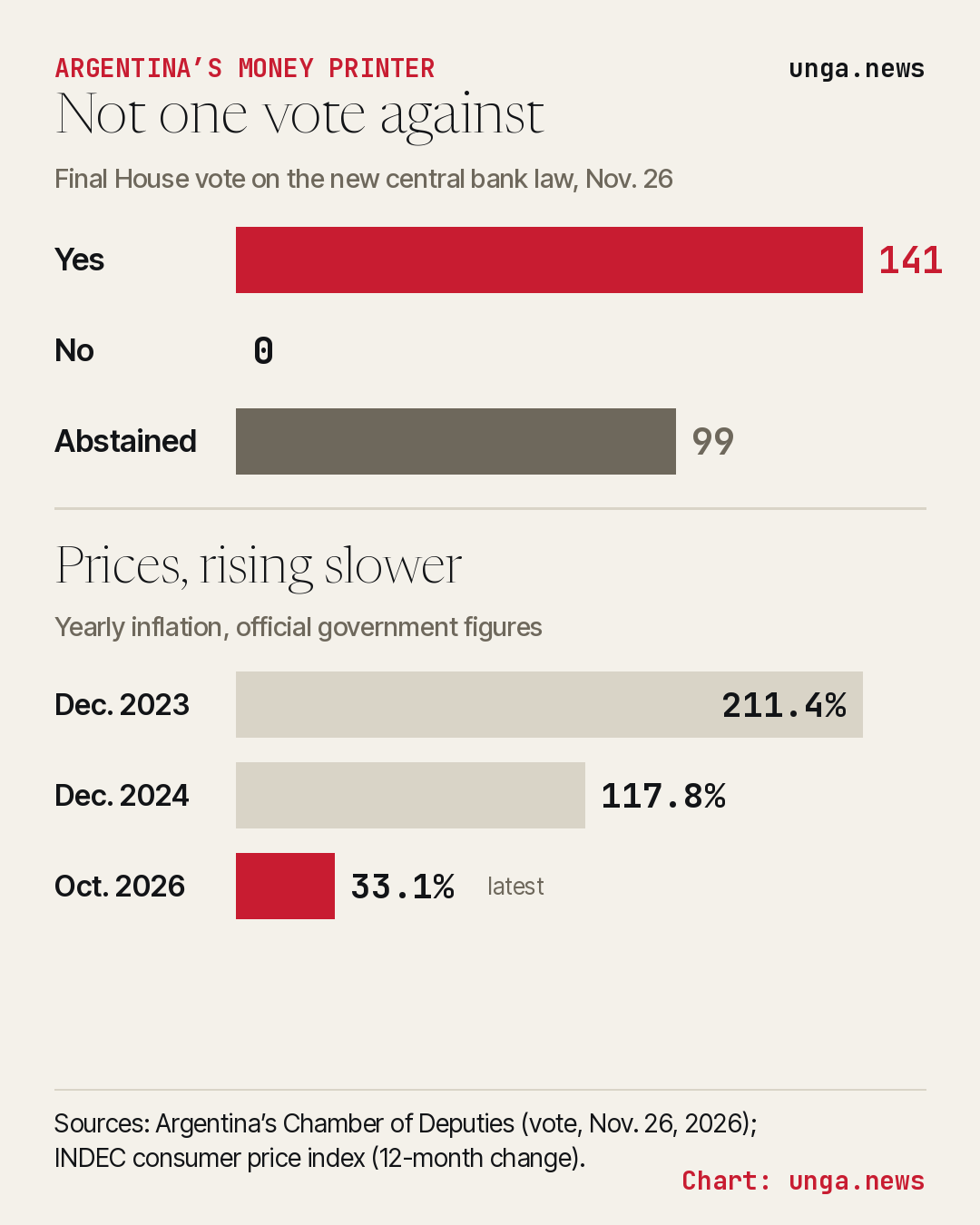
Argentina’s Chamber of Deputies gave final approval to a rewrite of the Banco Central’s founding law, the charter that sets what the bank can and can’t do. The count, posted by the Chamber itself, was 141 in favor, zero against and 99 abstentions. Nobody in the room was willing to stand up and vote to keep the printing press running for the politicians.
President Javier Milei didn’t wait long to say what he thought of it. “We have a new Charter for the Central Bank,” he wrote. “More than 90 years of swindle via printing money to finance the fiscal deficit is over.” He signed off with his trademark “VLLC,” short for “long live freedom, d*mn it.”
Javier Milei on 𝕏 — Nov. 26, 2026
— @JMilei View on 𝕏
The government’s credit card, cut up
The heart of the law is simple. The central bank’s first and main job is now to protect the value of the peso. Everything else comes second.
To make that stick, the law takes away the tools governments used to raid the bank. It repeals the article that allowed “temporary advances” to the national Treasury, short-term loans whose limits were loosened in 2012 and then leaned on again and again. The bank can no longer lend to the national government, to the provinces, to the City of Buenos Aires or to any town hall. It can’t buy new government bonds straight from the Treasury, and it can’t front money to cover debt payments coming due.
Milei’s own office spelled out the scale of what is being shut down. In the official explanation that came with the bill, the government estimated that under the old rules the Treasury could pull up to 36.6 trillion pesos out of the bank through those advances alone, more than 80% of the country’s entire monetary base, according to the breakdown published by Infobae. That is not a rainy-day fund. That is a blank check.
The law also ends a 1991 setup that let the Treasury tap the bank’s foreign reserves, the dollars that back the currency. Over the years, governments swapped those dollars for IOUs the bank can’t sell to anyone. By April 2025, those IOUs added up to $69.4 billion, the government said.
There’s more. The economy minister no longer gets a seat at the bank’s board meetings, a small change that says a lot about who is supposed to be in charge of the money. Profits from a weaker peso or a higher gold price can no longer be counted as “earnings” and shipped to the Treasury. Only real, cash-in-hand profits can move, and only after the bank’s own cushions reach half of its capital. Even then, the money can go only to paying down public debt.
Why the left sat on its hands
The abstentions came from the left. Infobae reported that the Peronist bloc Unión por la Patria, the Left Front and a few smaller provincial groups all held back, while another bloc split. They didn’t vote yes, but they didn’t vote no either.
That tells you how the politics of this have changed. A few years ago, putting your name to a “no” vote on protecting the peso would have been easy for Peronists. Now, with families who lived through triple-digit inflation watching, they couldn’t do it.
This was the second pass. The House first approved the reform on Aug. 27. The Senate sent it back with one main change, tightening how the bank’s leaders are picked and fired. Under the final version, removing a bank director takes 37 Senate votes, an absolute majority, which makes it much harder for a future government to fire a central banker who won’t print on command.
Milei’s office put out a statement the same day that didn’t pull punches. It said the law “ends 91 years of plunder, expropriation, impunity and institutional decay,” and it named names. It pointed back to 2010, when Cristina Kirchner’s government used $10 billion of the bank’s reserves for a so-called Bicentennial Fund that was never repaid, and to the 2012 charter rewrite that widened the bank’s power to fund the Treasury. The statement ended with a line Americans will recognize: the reform lays the groundwork “to make Argentina great again.”
What 33% inflation looks like after 211%
The numbers behind this vote are why it matters to ordinary Argentines. In December 2023, the month Milei took office, prices were up 211.4% from a year before, according to INDEC, the government’s statistics agency. A year later the yearly rate was 117.8%. In October 2026, the latest reading, it was 33.1%, with prices rising 2.2% in the month.
The same session also gave first approval to Milei’s 2027 budget. Gabriel Bornoroni, who leads Milei’s party on the House floor, said it “has fiscal balance, so as not to repeat the mistakes made in Argentina’s history.” The budget still has to clear the Senate.
That’s the point of locking the rule into law. Spending cuts can be undone by the next government. A central bank that is legally barred from funding the deficit is much harder to undo. Any future president who wants to bring back the old ways will have to pass a new law first, out in the open, and explain to voters why they want the printing press back.
The same session also gave first approval to Milei’s 2027 budget, which a government ally on the floor described as one that “has fiscal balance, so as not to repeat the mistakes made in Argentina’s history.” The budget still has to clear the Senate.
American conservatives noticed. Sen. Mike Lee of Utah, who has pushed for years for tighter limits on federal spending, posted a dry one-liner on the news: “Stop printing money to cover government revenue shortfalls? How novel!” A day later he added that “Argentina could become a major economic power if it keeps up this approach under the leadership of @JMilei.”
He has a point worth sitting with. Argentina spent most of a century proving what happens when politicians control the money. Milei asked the country’s Congress to take that power away from politicians, including himself. It said yes, and not one member was willing to say no on the record.
Sources
- Argentina’s Chamber of Deputies — Diputados le dio media sanción al Presupuesto 2027 y convirtió en ley la reforma del Banco Central (Nov. 26, 2026)
- Office of the President of Argentina — Comunicado Oficial N° 173 (Nov. 26, 2026)
- Javier Milei on 𝕏 — Javier Milei on 𝕏 — new central bank charter (Nov. 26, 2026)
- INDEC — Índice de precios al consumidor, octubre de 2026
- Infobae — Diputados convirtió en ley la reforma de la Carta Orgánica del Banco Central (Nov. 26, 2026)
- Infobae — Seis claves para entender la nueva ley que reforma la Carta Orgánica del Banco Central (Nov. 26, 2026)
- Sen. Mike Lee on 𝕏 — Sen. Mike Lee on 𝕏 — “Stop printing money…” (Nov. 27, 2026)
- Sen. Mike Lee on 𝕏 — Sen. Mike Lee on 𝕏 — “Argentina could become a major economic power…” (Nov. 28, 2026)