

Ask a Chatbot Where to Buy Something and It Might Send You to a Fake Store
A test of 6,795 shopping answers from ChatGPT, Gemini and Perplexity found risky, knockoff or dead websites in about 1 in 11, and the bots recommended them far more often than they warned you off.

Plenty of people will do their Christmas shopping this year by typing a question into a chatbot instead of a search box. “Where can I buy Birkenstocks online?” “Does Le Creuset ship to Canada?” It feels safer than wading through ten pages of links. A new test says it isn’t always.
Podqi, a San Francisco company that hunts down counterfeit sellers for brands, asked ChatGPT, Google’s Gemini and Perplexity the same five where-to-buy questions about 151 brands, from household names like Lululemon, Birkenstock and Le Creuset to smaller labels like Stüssy and Madhappy. It ran the test in two rounds in September, using answer-tracking data from a company called Gauge, and then checked every website the chatbots named by hand. That came to 6,795 answers and 4,437 websites.
About 9% of those answers put a risky site in front of the shopper. Podqi counted a site as risky if it appeared to impersonate the brand, looked like it sold knockoffs, or was dead with nothing to buy. The study was shared first with The Verge and posted in full on Podqi’s site.
Three chatbots, three very different scores
The gap between the chatbots was wide. Perplexity named a risky site in 15% of its answers. ChatGPT did it in 8%. Gemini came in lowest at 4%. Each one got the same 2,265 questions on the same days, so the comparison is apples to apples.
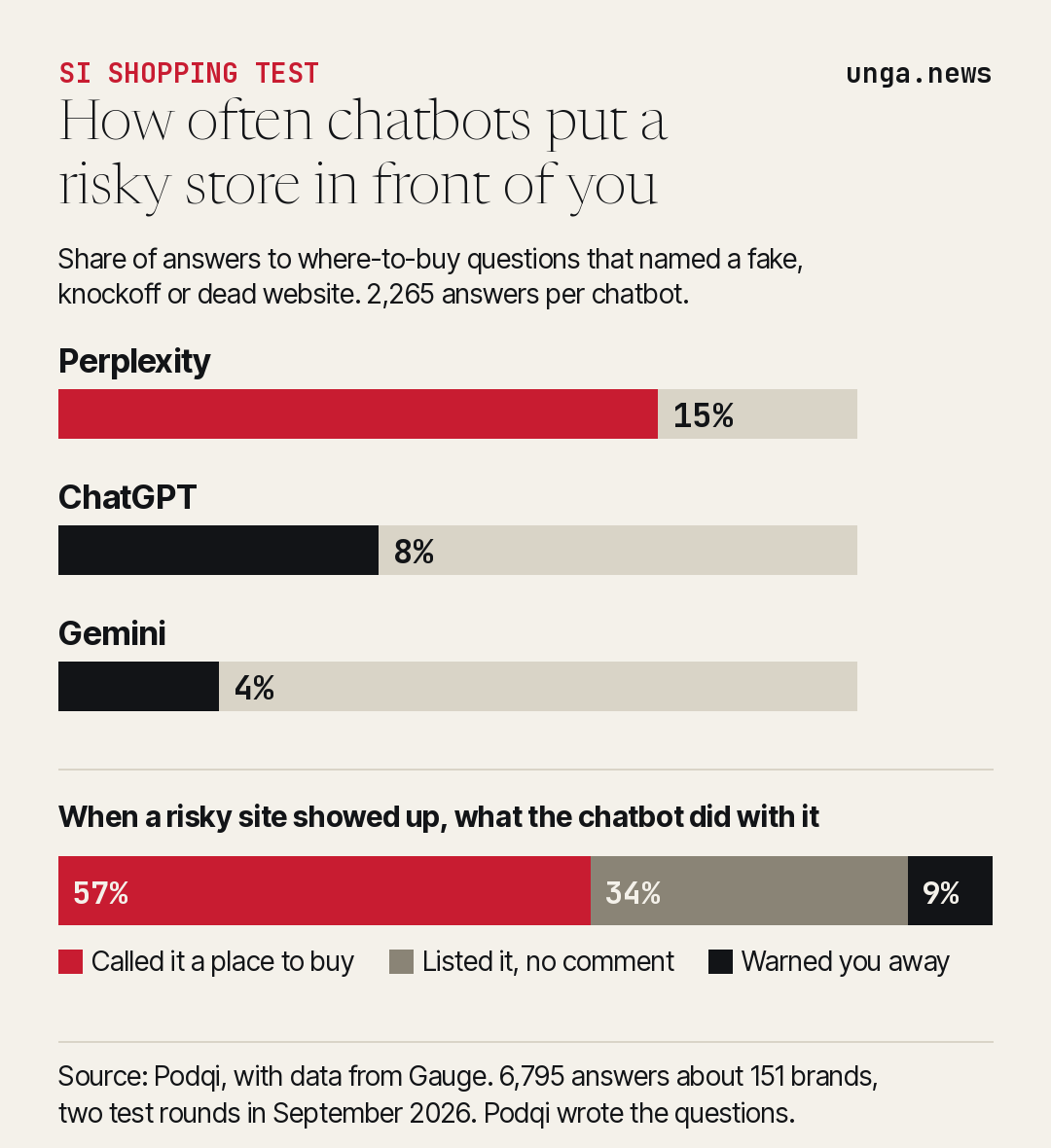
The worse number is what the bots did once a bad site made the list. In 57% of those answers the chatbot presented it as a place to shop. In another 34% it simply listed the site and said nothing. Only 9% of the time did it warn the shopper away. Put another way, the chatbots recommended a risky store 6.3 times as often as they warned against one.
ChatGPT was the best of the three at speaking up, warning about the bad site in 24% of the cases where one appeared. Google’s AI Overviews, the summaries at the top of a Google search, showed a risky site in only seven answers and flagged every one of them.
The bots aren’t clueless about fakes. Podqi found that about one in five of the mishandled answers included a general warning about counterfeits, sometimes right next to a link to a lookalike store. Telling a shopper to watch out for fakes doesn’t do much good if the chatbot hands them one in the same breath.
The innocent question that went wrong most
The riskiest question in the whole test sounded the most harmless: does this brand ship internationally, and what are its regional websites? Sixteen percent of those answers pointed to a risky site, and 36% of the bad sites in those answers used a country ending or a region name, the kind of address that looks official at a glance. In some cases the chatbots made up regional stores for brands that don’t have any.
“Top websites for buying” a brand came next at 11%. The other three questions landed around 6% to 7%. Lists are dangerous by nature, because everything on a “best places to buy” list reads as an endorsement.
In one exchange The Verge described, Perplexity pointed to the wrong page as Stüssy’s official website and called it “the best starting point for guaranteed authentic items.”
Being a big company didn’t help much. Answers about smaller brands showed risky sites about twice as often, but when a risky site did show up for a large brand, the warning almost never came. Of 125 risky answers about the biggest brands, four warned the shopper. The other 121 didn’t.
Dead websites are tomorrow’s fake stores
Of the 718 risky websites Podqi found, 351 were fakes and 367 were dead. A dead site sounds harmless, since there’s nothing to buy. The problem is that anyone can grab an expired web address and put up a storefront, and if a chatbot keeps recommending that address, the new owner inherits a steady stream of shoppers who think they were sent by a trusted helper.
“It is always best to verify the source of that before entering personal information or credit card information,” Podqi chief executive Trevor West told The Verge.
Keep the source in mind here, too. Podqi sells brand protection, and finding fake stores is how it makes money, so it has a reason to show the problem is real. Madhappy, one of the brands in the test, is a Podqi client. The company wrote its own questions rather than using real shopper conversations, and the study didn’t measure how many people clicked, bought something or lost money. That makes it a warning light, not a body count.
There’s good news buried in the data as well. Between the first and second rounds of testing, the share of risky answers fell from 12% to 7%. Podqi itself calls the problem “fixable,” and the drop suggests the chatbot makers can tighten things up quickly when the bad sites get flagged.
A few habits that protect your wallet
None of this means you have to stop asking a chatbot for help. It means treating its answer like a tip from a stranger, not a verified address. If a chatbot hands you a store link, look at the address before you type in a card number. Get to a brand’s country store from the brand’s own main site instead of a link someone, or something, gave you. Be suspicious of any “official” regional site you’ve never heard of, and of prices that look too good for the brand.
Shoppers spent years learning to squint at the top ad in a search result. The same habit works on chatbots. The bots will get better at this. Until they do, the last line of defense is still the person holding the credit card.