

Ask ChatGPT What to Buy, and Now the Store Can Answer Back. Some Will Pay for the Spot.
OpenAI is letting businesses claim their own page inside ChatGPT, add a blue check and put an SI salesperson in front of 1.2 billion weekly users. Paid placements are in a small test.
For years, if you ran a shop, you fought to show up on Google. You claimed your listing, fixed your hours, begged for reviews and paid for ads at the top of the page. On Tuesday, OpenAI opened that same game inside ChatGPT, and it added a twist Google never had: the store gets to talk back.
The company announced Businesses in ChatGPT, a beta program that lets a business claim its profile inside the chatbot, keep its details current and see how often people mention it. OpenAI says ChatGPT now reaches “1.2 billion people” every week. That is the crowd every store in America would love to stand in front of.
The bigger piece is something OpenAI calls a Business Agent. Think of it as a store’s own SI salesperson. When a company shows up in one of ChatGPT’s answers, you can click into its profile. If that company has built an agent, you can start a separate chat with it and ask the stuff you would ask a clerk: what’s the difference between these two models, which one fits what I need, what’s your return policy.
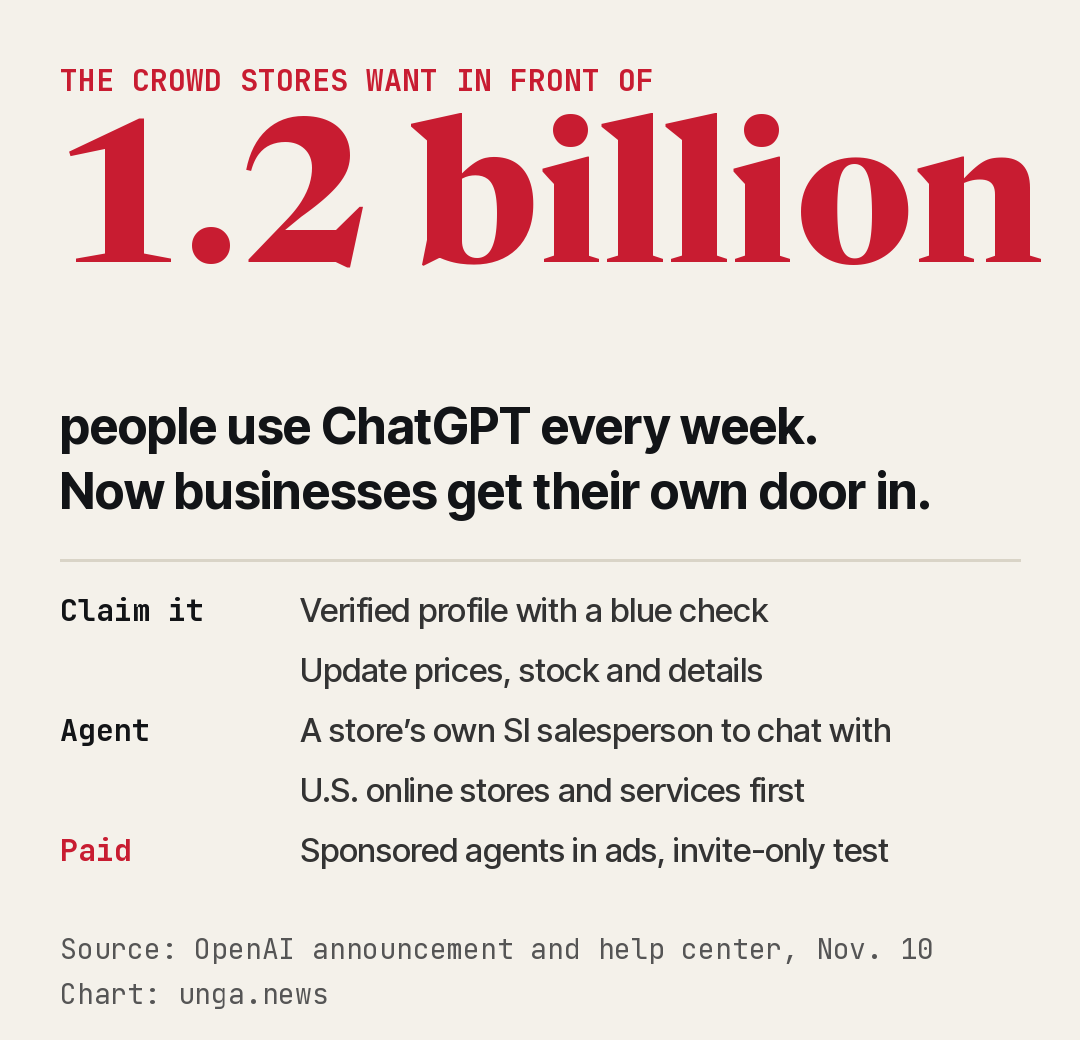
For now, those agents are limited to “eligible ecommerce and online service businesses in the United States,” according to OpenAI. Your local barber or the taco truck down the street will have to wait. Claiming a basic profile is open more widely, to eligible businesses with a website anywhere ChatGPT is offered.
Claiming works a lot like the verified badge on a social media account. A business proves it owns the name, and “a blue check will appear on your business profile in ChatGPT to show it’s been claimed,” OpenAI says on its sign-up page. Retailers can upload product feeds with prices and stock levels, so when you ask about a pair of boots, ChatGPT can pull the price the store actually charges today instead of something it scraped months ago.
Shopify sellers get the easiest path. They can connect their store from Shopify’s own dashboard, and OpenAI says eligible Shopify products are already flowing into ChatGPT through Shopify’s catalog.
Now for the part every shopper should read twice. Businesses can pay to promote their agents. OpenAI says companies can “sponsor their Business Agent and use it as the destination for ChatGPT Ads.” Translation: you see an ad, you tap it, and instead of landing on a web page you land in a conversation with the company’s SI.
OpenAI’s help center says these sponsored agents are “currently available only to selected advertisers in a limited alpha test,” meaning a small invite-only trial, and the company is “not accepting early access requests at this time.” It adds that you “may see Sponsored Agents in ChatGPT” even if a given advertiser can’t buy one yet. So some of you will run into these soon.
OpenAI is clearly aware of how this could look. The announcement says paid placements are “clearly labeled and separate from ChatGPT responses,” and that the agent chat is “distinct from ChatGPT’s independent answers.” The sign-up page goes further: “Claiming does not guarantee higher placement or sales.” In other words, OpenAI is promising you can’t simply buy your way into the answer ChatGPT gives you. That promise is the whole ballgame. The day people suspect the answer is for sale, the product loses the trust that made 1.2 billion people use it.
There are rules on the store’s side too. OpenAI’s Business Agents policy says an agent “must be clear that it is AI representing the business” and must not pretend to be “an independent adviser, a human, or endorsed by OpenAI.” You can only build one for a business you own or are authorized to represent, and OpenAI says it weighs the business category before letting an agent go live.
Read the fine print and you find a detail most owners will miss. OpenAI’s terms say the company “may create and configure a Business Agent for your business before you elect to use it.” It does not go public unless the owner chooses to publish it. But once it’s live, the business is on the hook for what the bot says “whether or not you provided, reviewed, or approved them,” and any deals it makes are the business’s to honor. OpenAI states plainly that it does not become the seller. If a store’s bot promises a discount it shouldn’t, that is the store’s problem.
On privacy, OpenAI says businesses won’t see your chats. “We don’t share users’ conversations or Business Agent chats with businesses,” the announcement says. Owners get rolled-up numbers instead: how many times they were mentioned, how many clicks reached their website, and common topics in conversations where their site was cited. Those insights only appear once enough people have interacted to meet a minimum threshold, so a tiny shop can’t back into who asked about it.
Why should a regular person care? Because the way people shop is moving. More of us now type a question into a chatbot instead of scrolling ten blue links, and whoever controls that answer controls a huge chunk of commerce. Google built a giant business selling the space next to search results. OpenAI is laying the groundwork to do the same next to chatbot answers, with a salesperson attached.
If you own a small business, this one is a little urgent. ChatGPT is already talking about your business whether you like it or not. OpenAI says it “may show information about your business whether or not you have an agent.” Claiming the profile at least lets you fix the hours, the prices and the details it gets wrong.
OpenAI calls this “an early step” and says it plans to expand to more countries and more kinds of businesses over time. The program is still labeled beta, and the paid agent ads are still a tiny test. One thing the announcement never mentions is what those sponsored spots will cost a business.
Sources
- OpenAI — Introducing Businesses in ChatGPT
- OpenAI — Businesses in ChatGPT: Claim Your Business
- OpenAI Help Center — Sponsored Agents in ChatGPT Ads
- OpenAI — Businesses in ChatGPT Terms
- OpenAI — Business Agents Policy