

Australia’s Left Just Cut a Deal to Fine American Tech Giants Billions Over Online ‘Harm’
To pass its online safety law, Australia’s Labor government gave the Greens a right to sue platforms and fines of up to 5% of global revenue. The Trump administration and Australia’s conservatives warn it will push companies to censor lawful speech.
Australia’s Labor government needed votes to push its big online safety law through the Senate this week. It got them by handing the Greens nearly everything on their wish list. The price of that deal will land mostly on American companies, and possibly on what Americans see in their own feeds.
Communications Minister Anika Wells announced the agreement Tuesday in Canberra. Under the deal, Australians get a new right to sue social media platforms for harm, and the top fine for breaking the law jumps from a fixed A$109.2 million to as much as 5% of a company’s global revenue. According to ABC News, the Greens will now supply the votes to pass the bill before the Senate breaks for the year.
The bill is called the Online Safety Amendment (Digital Duty of Care) Bill 2026. It passed the House of Representatives on Oct. 28. It would put a legal “duty of care” on platforms like Facebook, Instagram and TikTok, forcing them to assess the “foreseeable harms” of their own products and design them out. The government enforcer would be the eSafety Commissioner.
Seven changes, one direction
Wells listed the amendments herself, per the ABC’s live coverage. There is a private right of action so individuals can take platforms to court. Fines go up to 5% of global revenue. The eSafety office gets expanded “nudify” removal powers. Platforms must treat “addictive” features like endless scrolling as a specific risk. Privacy protections get stronger. The government gains rule-making power to set up an outside complaints body. And the bill will “clarify the definition of hostile attitudes to women and gender equality,” one of the harms platforms will be expected to police.
Read that last one twice. A government agency will be in the business of deciding what counts as a “hostile attitude” toward “gender equality,” and companies facing billion-dollar fines will be deciding how hard to bury anything that might qualify.
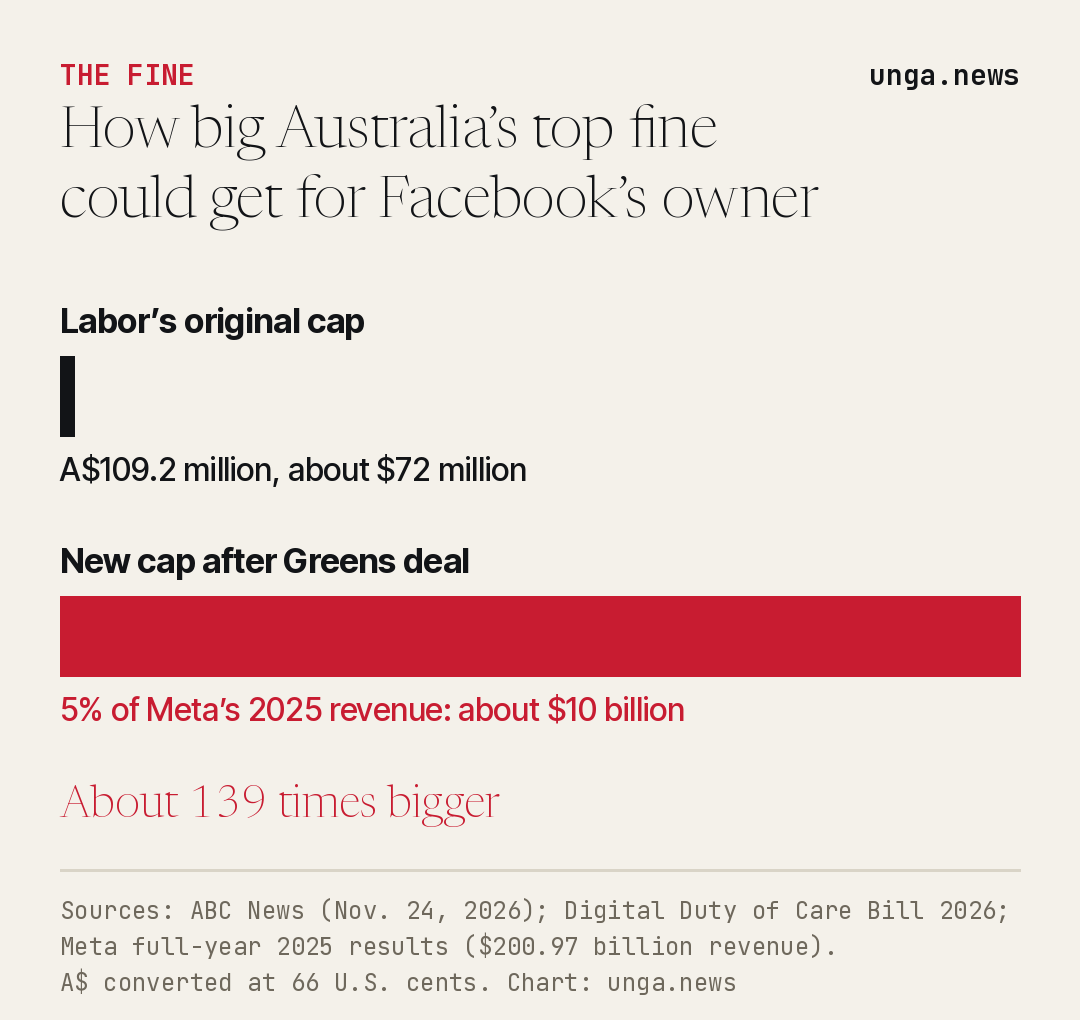
The fine is where the deal gets serious. Take Meta, which owns Facebook and Instagram. It reported $200.97 billion in revenue for 2025. Five percent of that is about $10 billion, roughly 139 times the cap Labor started with.
Wells played down the lawsuit piece. She said she imagined it would be “fairly rare” for Australians to sue big tech. The Greens said the opposite out loud. Greens senator Sarah Hanson-Young said that if the companies didn’t “clean up their act” there “must be class actions,” and told them: “Or we’ll see you in court.” Greens leader David Shoebridge called it “taking power back” from what the ABC described as largely U.S.-based corporations.
Asked whether she expected blowback from Washington, Wells said she had briefed the U.S. ambassador to Australia, David Brat, on the changes. Asked about a legal challenge from the companies, she said, “If people want to have another go, bring it on.”
Washington saw this coming
The Trump administration put its objections on paper two months ago. In a Sept. 22 filing to Australia’s public consultation, the U.S. Embassy in Canberra said “preserving a free, open internet and protecting freedom of expression online are top priorities for the Trump Administration.”
The embassy warned that “a framework that empowers governments to enforce vague definitions of ‘harm’ risks becoming a mechanism for viewpoint-based censorship, as platforms will be incentivized to over-moderate speech that should be protected to avoid regulatory penalties.” It added that if Australia forces platforms to filter feeds and that sweeps in protected speech, “the U.S. government would likely consider such a measure as facilitating censorship.”
The embassy also made a point that matters to every American with a phone. Platforms build features for the whole world, not country by country. Forced design changes aimed at Australia “could result in systemic changes that affect how users everywhere, including Americans, experience these platforms and reach audiences.” It asked Australia to withdraw any plan to make platforms algorithmically suppress content based on “ambiguous government-defined safety criteria.”
That warning was written when the top fine was A$109.2 million. Labor’s answer was to raise it roughly a hundredfold.
The conservatives who said no
Australia’s conservative opposition, the Liberal-National Coalition, has opposed the bill from the start, and it didn’t soften its language. In their dissenting report from the Senate committee, Coalition senators called the bill “so deeply flawed and so ill-conceived that it should never have seen the light of day.”
They accused the Albanese government of using “the cover of child safety to enact what can only be described as a blank cheque for political censorship.” Their core argument is simple economics. Companies face huge penalties for leaving up something the regulator calls harmful, but the bill carries “no corresponding penalty” for wrongly removing lawful speech. So “the safest commercial decision will be to remove or restrict any content which might fall foul of the regulator.”
That logic only gets stronger now. When the possible fine was A$109.2 million, a cautious platform had a reason to over-censor. At $10 billion, it has a reason to censor first and never ask questions.
Nobody serious argues kids should be left alone with predators, stalkers or sites pushing eating disorders, and the Coalition senators said plainly that they back real protections for children. Wells talks about the phone “under the pillow at night” and kids “being radicalised on a school bus.” Those are real worries for parents. The trouble is the tool. The bill hands a minister and an unelected commissioner the power to define harm, then dangles billion-dollar fines over the companies that have to guess where the line is.
Votes locked in before the Senate goes home
The Senate’s last scheduled sitting days of 2026 run through Thursday, and with the Greens on board the government has the votes. Most of the duty would kick in 12 months after the bill becomes law, so late 2027, though some takedown changes would start the day after. Wells said Monday that small businesses with low-risk websites will be exempted by rule.
Australia already passed a 2024 law barring under-16s from social media accounts, and Wells said she was at the High Court a couple of weeks ago defending it. This new law goes further, covering how platforms are built for adults too, including SI chatbots that generate text and images.
Canberra keeps telling Washington this is about safety. The State Department told Canberra it looks a lot like censorship with a safety label. After this week, the companies stuck in the middle will have about $10 billion worth of reasons to pick a side, and it won’t be the side of the users.
Sources
- ABC News (Australia) — Australians to gain right to sue social media giants under Labor-Greens deal (Nov. 24, 2026)
- ABC News (Australia) — Federal politics live: Wells confirms amendments to digital duty of care bill (Nov. 24, 2026)
- U.S. Embassy & Consulates in Australia — U.S. Government Response to the Australian Consultation on the Online Safety Amendment (Digital Duty of Care) Bill 2026 (Sept. 22, 2026)
- Parliament of Australia — Online Safety Amendment (Digital Duty of Care) Bill 2026: Coalition Senators’ Dissenting Report
- Parliament of Australia — Minister for Communications Anika Wells, doorstop transcript, Parliament House (Nov. 23, 2026)
- Parliament of Australia — Online Safety Amendment (Digital Duty of Care) Bill 2026, bills digest
- Meta — Meta Reports Fourth Quarter and Full Year 2025 Results