

Australia’s Online Safety Bill Could Let Its Internet Watchdog Run Fake Accounts. An American Told Its Senate No.
Michael Shellenberger testified that the Digital Duty of Care Bill is “the most extreme online censorship legislation ever.” His team says it would let eSafety profile users’ politics and share files with spy agencies.
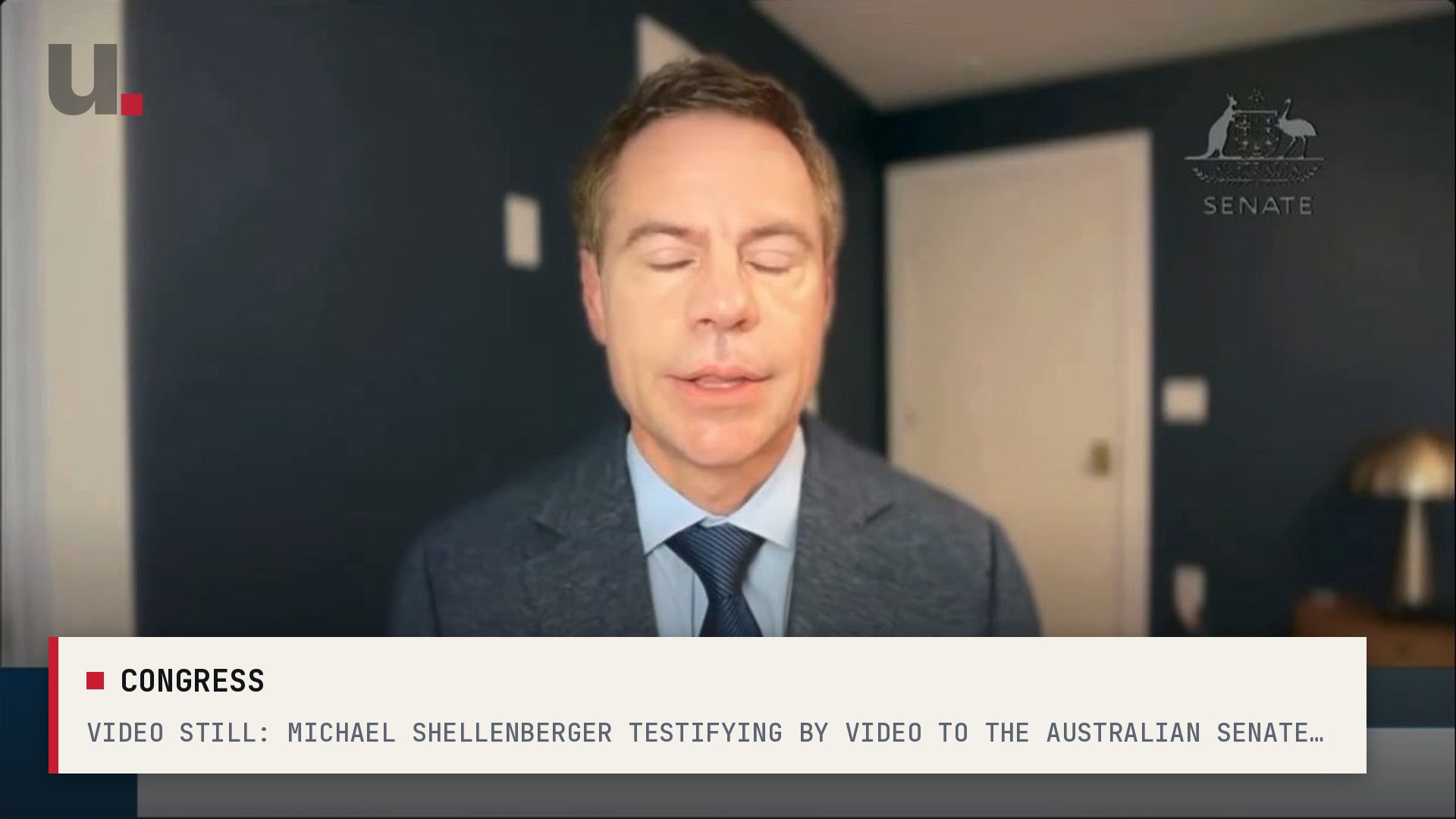
Michael Shellenberger didn’t fly to Canberra for this one. He logged in by video, sat in front of a plain blue wall with a little Senate crest in the corner of the screen, and told Australian senators that the bill in front of them is “the most extreme online censorship legislation ever.”
The bill is the Online Safety Amendment (Digital Duty of Care) Bill 2026. The Albanese government introduced it on Oct. 15 and pitches it as a way to make the internet safer for kids. Shellenberger, the American journalist who runs the outlet Public and helped report the Twitter Files, says it would do something else entirely: hand Australia’s internet watchdog the tools to watch, profile and report on ordinary users, including people who never set foot in Australia.
“The government says it wants to protect kids,” he wrote after his testimony. “Its bill would allow it to wage info war and censor its populist enemies.” His post with the hearing video has been viewed more than 120,000 times.
Michael Shellenberger on 𝕏, Nov. 10, 2026: “I told the Senate that this is the most extreme online censorship legislation ever.”
— @shellenberger View on 𝕏
Sock puppets with a badge
The details Shellenberger brought to the hearing come from an investigation he published the next day with Mike Nayna and the research group Network Affects. Their reading of the bill is blunt, and it’s worth laying out piece by piece, because each part sounds smaller on its own than it does stacked together.
First, Public says the bill would let Australia’s eSafety Commissioner create an unlimited number of SI-generated “sock puppet” identities, fake accounts that look like regular citizens, under policies set “in consultation with the Commissioner of the Australian Federal Police.” Those accounts could watch and record speech that is legal but that the government considers harmful.
Second, the bill would change Australia’s Privacy Act so eSafety counts as an “enforcement body,” in the same legal category as the federal police for “surveillance activities, intelligence gathering activities or monitoring activities.” Public reports that would let the agency collect sensitive personal information without consent, a warrant or a judge, as long as it “reasonably believes” it needs to. Under Australian privacy law, sensitive information includes political opinions, religious beliefs, sexual orientation and health records.
Third, what eSafety gathers could go further than the police. An eSafety official, Heidi Snell, told the inquiry in October that today the agency can share with the Australian Federal Police but not with intelligence agencies. “But the amendments would see us being able to share directly with those other government agencies,” she said, according to Public. That list runs from Australia’s spy services to its signals intelligence agency, the country’s version of the NSA.
And Australia is part of the Five Eyes, the intelligence-sharing club with the United States, Britain, Canada and New Zealand. Public’s warning to Americans is that an anonymous U.S. account complaining about mass migration could be unmasked by an Australian regulator and the details passed along through those channels to the FBI. That’s Public’s reading of how the pieces could fit, not something the government has said it plans to do. But nothing in the bill, as Public describes it, would stop it.
The commissioner who wants to go global
Australia’s eSafety Commissioner is Julie Inman Grant, an American who used to work at Twitter and Microsoft. She already has the power to order a platform to reveal who runs an anonymous account, Public reports, and she has made no secret of wanting regulators around the world to work together.
Public points to a September 2025 meeting at Stanford, titled “Compliance and Enforcement in a Rapidly Evolving Landscape,” where government online-safety officials from Europe, the United Kingdom, Brazil, California and Australia gathered, with Inman Grant giving the keynote. Earlier, she told the World Economic Forum that “we know we’re going to go much further when we work together with other like-minded independent statutory authorities around the globe.”
That’s the part Americans should notice. Free speech in this country is protected by the First Amendment, but the platforms Americans post on answer to regulators everywhere. When one government can fine a company into compliance, the rules it writes for Sydney tend to show up in the settings for Seattle.
A Senate committee has eight days
The bill isn’t law yet. Public reports the lower house has already passed it, and the Senate’s Environment and Communications Legislation Committee is due to report on it by Nov. 20. The committee took 168 written submissions before they closed on Oct. 30, according to the inquiry tracker TrackGov, and held two days of public hearings.
Shellenberger asked the committee to recommend that the Senate throw it out. “I encourage the committee to recommend that the Senate reject it on fundamental moral principles,” he wrote. “Our liberal democratic societies depend on the people having free access to information. Censorship is barbarism.”
He also says he traveled to Australia in October to hear the other side. “I found no good reason for it,” he wrote. “And its supporters didn’t understand the bill and couldn’t defend it.” Free-speech groups and Australia’s right-leaning Institute of Public Affairs have been pressing the same case, and the IPA was first to flag the Privacy Act changes.
Supporters say the bill is about the duty platforms owe their youngest users, and nobody serious argues that predators and scammers should get a free pass online. The question senators have to answer is whether protecting kids requires a government agency that can run fake accounts, keep files on people’s politics and pass them to spy services. Parents can want safer apps for their children and still say no to that.
Australia’s Senate, where the government doesn’t hold a majority on its own, is now the last real checkpoint. If the committee waves it through on Nov. 20, the fight moves to the floor. If it balks, a bill sold as child safety will have been stopped by people asking what else it does.
Sources
- Michael Shellenberger on 𝕏 — I told the Senate that this is the most extreme online censorship legislation ever, Nov. 10, 2026
- Michael Shellenberger on 𝕏 — Public investigation by Mike Nayna, Network Affects and Michael Shellenberger on the DDoC bill, Nov. 11, 2026
- Michael Shellenberger on 𝕏 — I encourage the committee to recommend that the Senate reject it, Nov. 10, 2026
- Michael Shellenberger on 𝕏 — I visited Australia in October to understand why anyone would want to pass this bill, Nov. 10, 2026
- Parliament of Australia — Senate Environment and Communications Committees: current inquiries
- TrackGov — Online Safety Amendment (Digital Duty of Care) Bill 2026 inquiry