

Bait Hidden in 2 Million SI Chats Caught Hackers, Snooping Resellers and a Chinese Lab Reading Along
A security researcher planted fake passwords and secret links in prompts sent to SI services. Now OpenRouter is warning customers that chats with Chinese MiniMax models may have been read by outsiders.

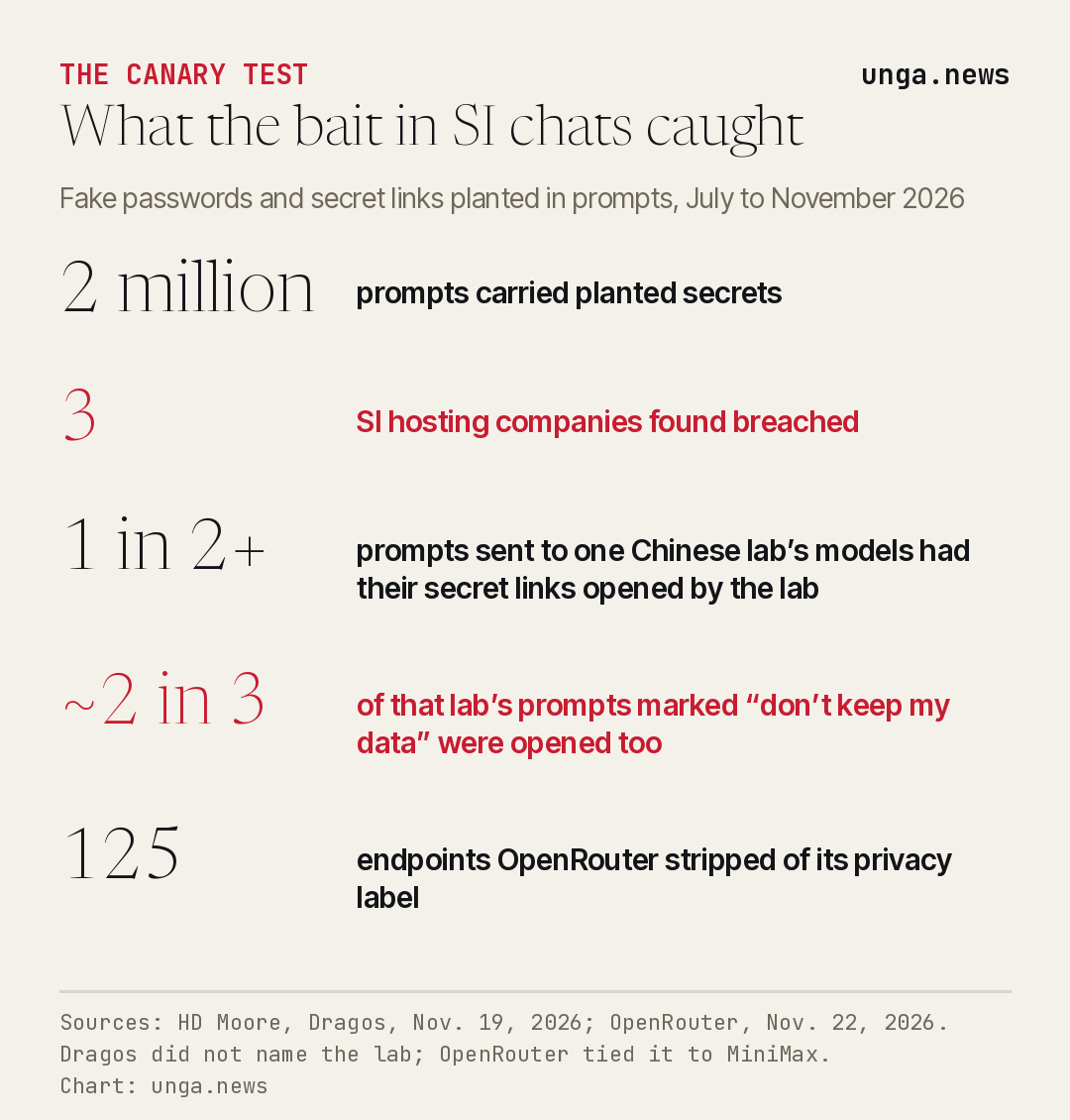
If you have ever pasted something private into a chatbot, this one is for you. HD Moore, the hacker who created the Metasploit security toolkit and now leads research at the security firm Dragos, spent five months planting bait inside SI prompts. Nearly two million of them. Each one carried a secret that existed nowhere else on Earth: a fake password, a working Amazon cloud key tied to an empty account, a one-of-a-kind web link or the address of a private code repository.
Every secret went into exactly one prompt sent to one company. So if anyone, anywhere, ever tried to use one, Moore would know precisely which link in the chain had leaked it.
They got used. A lot. In a report published Nov. 19, Moore laid out three separate problems: hackers inside three SI hosting companies, cut-rate resellers quietly reading customer prompts, and companies ignoring the “don’t keep my data” settings their customers paid for. On Friday and Saturday the fallout reached real customers, as OpenRouter, one of the biggest SI middlemen, started emailing users that their chats may have been read.
The cheap middlemen in the chain
Most people picture a chatbot as a straight line: you type, the company answers. A lot of SI apps don’t work that way. They hand your prompt to a broker like OpenRouter, which shops it to whichever company is serving that model at the best price. Sometimes one broker hands it to another. Moore’s point is blunt: “every hop can see the entire prompt and response.”
That is where the thieves were waiting. The biggest breach Moore found involved a couple hundred of his bait cloud keys, all sent in a few short windows in late October. “Every request we sent during those windows was stolen,” he wrote. Some came from requests the company rejected before the SI even ran, which means the attacker was copying traffic at the front door. Within hours the stolen keys were being tested. Then the attacker went digging for files and passwords, tried to switch on paid SI models and added accounts of their own to keep access. All told, the bait keys were used for tens of thousands of cloud commands. None of the three companies knew it had been breached until Moore told them.
The resellers didn’t even need to hack anything. On open marketplaces, sellers undercut each other on price, and the cheapest offer gets the traffic. Moore found sellers who listed a popular model low, switched on logging and waited. In one case someone on a home internet line in France pulled the passwords out of two of his prompts and tried to log into his servers as the all-powerful root user, typing each attempt by hand.
A Chinese lab kept reading
The finding that should worry Washington the most involves a Chinese SI lab. Its systems opened the secret links in more than half the prompts Moore sent to its models between July and October, including roughly two-thirds of the ones marked “no data collection” or Zero Data Retention, the strictest privacy setting these services sell. The visits usually came two or three days later.
Paying an American company didn’t help. Several U.S. hosts resell that lab’s models, and prompts sent through them set off the very same scraper. “A customer who picked a U.S. provider specifically to keep their data in the U.S. didn’t get what they paid for,” Moore wrote.
In the strangest case, involving a Chinese provider, a secret link showed up in a company chat on Feishu, the Chinese workplace app, 24 days after the prompt went to a U.S.-based host with the privacy flag on. Within two minutes it was opened from three desktops and three phones in Beijing and Shanghai.
Moore didn’t name the lab. OpenRouter’s email did. Customers began posting it Friday. “A security researcher placed unique test URLs in prompts sent to MiniMax models from July to October 2026,” it reads. “A third party accessed those URLs 40 to 130 hours after the requests were sent, whether MiniMax served a request directly or another provider forwarded it to MiniMax.” OpenRouter said three resellers, AtlasCloud, Novita and StreamLake, admitted forwarding its MiniMax traffic straight to MiniMax. “This means a third party may have read the prompts and outputs of these requests,” the email says.
MiniMax, by OpenRouter’s account, told StreamLake that content moderation was switched on for its service before Oct. 22 and that it has since turned on zero retention. OpenRouter said it asked MiniMax for its own explanation and hadn’t gotten one.
Who has owned up so far
Novita posted a privacy notice saying a forwarding path “intended for specific customers” ended up applying “more broadly,” sending MiniMax requests to MiniMax’s own servers instead of Novita’s. Anyone who used MiniMax models through Novita between May 28 and Nov. 11, including through OpenRouter, may have had their requests “accessed or retained by a third party.” Novita said the pattern suggests “automated content review may have been involved,” suspended the affected models and told customers to change any passwords or keys they had pasted in. Together AI posted its own notice about leaked prompts from June and July.
OpenRouter said Saturday that none of this was a breach of its own systems. It still kicked three providers off its platform, pulled the zero-retention label from 125 endpoints, notified every customer who might be affected and promised to run Moore-style bait tests on its own from now on. No endpoint gets the privacy label back without proof.
The giants aren’t spotless either. Moore found one big U.S. provider still crawling a secret link more than two months after a single search request, and another that returns for links days after every request.
Guarding your own secrets
Moore’s advice is simple. The safest move is running the SI on your own machines. If that’s too expensive, buy directly from a top-tier company, so there is “one contract and a privacy policy to read,” and pick the companies yourself instead of accepting a broker’s default pool. Never paste live passwords or keys into a prompt, and if you already have, change them tonight.
The bigger lesson is about trust. A “don’t keep my data” box is a promise, not a lock, and plenty of companies in this chain were ignoring it. Some of those prompts ended up in China. Moore only caught it because he thought to set a trap.
Sources
- Dragos — Three breaches, endless leaks: Your AI supply chain needs canaries (HD Moore, Nov. 19, 2026)
- OpenRouter — Data Processing Incidents on Inference Providers (Nov. 22, 2026)
- Novita AI — Privacy Notice Regarding MiniMax Requests on Novita (Nov. 22, 2026)
- Together AI — Security event: Prompt leakage for requests in June and July of 2026 (Nov. 21, 2026)
- Hacker News — Text of OpenRouter’s customer email: “Requests you sent to MiniMax models may have been read” (Nov. 21, 2026)
- Ars Technica — Researcher plants 2m canaries into the AI supply chain. A privacy disaster surfaced. (Nov. 20, 2026)