

Banks Made Half a Billion on Claude’s IPO. The Catch: Their Bankers Had to Shun ChatGPT’s Maker
Like Elon Musk with SpaceX in June, Anthropic ran its record stock sale on its own terms: four-person teams, name-stamped files and six-month bans on working for its rivals.
Wall Street’s biggest banks just split more than half a billion dollars in fees for selling the largest stock offering in history. According to people who worked on it, they also had to play by rules almost nobody in finance had seen before. Reuters reported Sunday that Anthropic, the company behind the Claude chatbot, ran its record IPO the way Elon Musk ran SpaceX’s in June: on its own terms, with the banks taking orders instead of giving them.
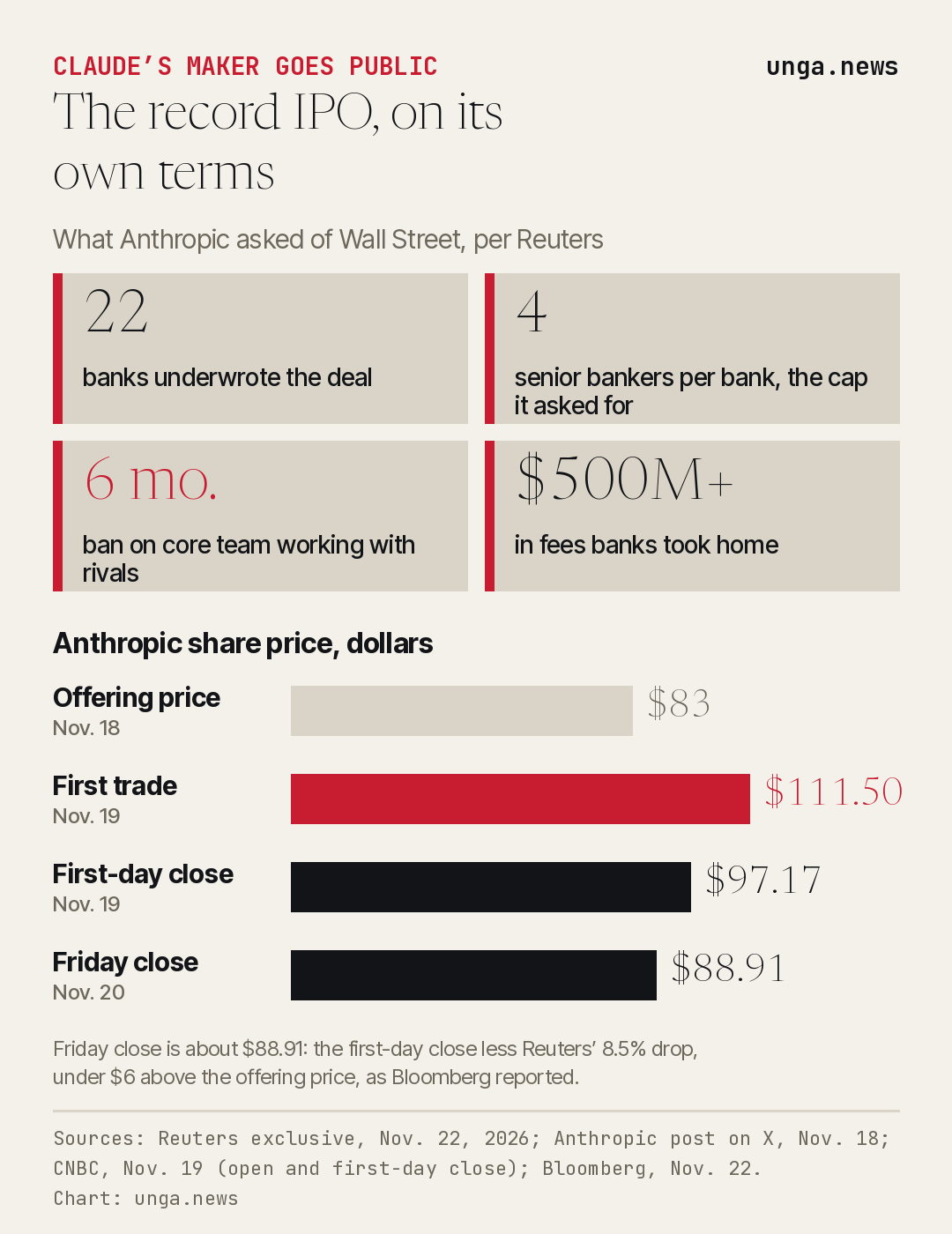
The new details land three days after Claude’s maker jumped 17% on its first day of trading. That pop didn’t last. Reuters says the stock closed down 8.5% on Friday, and Bloomberg reported it finished the week less than $6 above its $83 offering price as tech stocks sold off hard.
Four bankers, no copies, no rivals
Twenty-two banks underwrote the offering, which Anthropic called “Project Lantern” internally. Several people familiar with the deal told Reuters the company asked some of those banks to cap their teams at four bankers and to make sure those four were senior staff. One person said the limit likely came from fear of leaks, and that the banks found ways around it anyway.
The bigger ask went further. Anthropic asked some senior officers at the banks to sign legal papers barring the core members of the deal team from working with rival companies for six months after the listing. Reuters says the named rivals included OpenAI, the maker of ChatGPT, along with the coding company Cursor, the Chinese lab DeepSeek and Hugging Face, the big hub for free SI models.
Banks wall off conflicts all the time. What made this one unusual, bankers and lawyers told Reuters, was how broad it was and that it bound individual bankers by name. In past head-to-head listings like Uber and Lyft, a bank could simply pick a side. Anthropic needed so much money that it had to hire nearly everybody, so it tried to tie down the people instead of the firms. One banker who refused to sign told Reuters it was hard to find anyone who could promise to stay away from Anthropic’s peers, since several of them are lining up their own stock sales.
Then there were the documents. Instead of ordinary PDFs, Anthropic shared its numbers with most of the banks through a service called NetRoadshow. It logs who opened each file and which pages they read, stamps every page with the individual banker’s name and won’t let anyone save a copy. One person told Reuters that slowed the bankers’ work. Leaks kept showing up in the press anyway.
A 2 a.m. sign-off
The timeline was tight and kept moving, according to Reuters. Anthropic planned to file its updated paperwork with the price range and start marketing the shares on Nov. 10. The night before, a law firm on the deal emailed the banks a PDF about selling shares in Canada, then told them to disregard it because it “contains incorrect price range and share information,” according to the email, which Reuters saw.
The corrected filing went out through NetRoadshow around 2 a.m. New York time. The banks got a few hours to sign off before it went to the Securities and Exchange Commission. People close to the deal also complained about late changes, delays in sharing financial projections and rushed approvals.
None of that slowed the buying. The order books were oversubscribed many times over, and Anthropic announced on Nov. 18 that it had priced the shares at $83, above the range it had marketed.
Anthropic on 𝕏 — “We’ve priced our IPO at $83 per share, with trading expected to begin on Nasdaq tomorrow.” (Nov. 18, 2026)
— @AnthropicAI View on 𝕏
Musk wrote the playbook
Reuters frames all of this as a new balance of power, and it started with Musk. On the SpaceX listing in June, people close to the process said Musk’s team dictated terms at every stage. It told the largest banks in America, Goldman Sachs and Morgan Stanley among them, how to market the stock and to whom. It told some banks how big an order they had to fill, in some cases a few billion dollars. Banks signed on to underwrite the deal without being told what they would be paid.
Bankers grumbled in private. They still took the job, because nobody wanted to be left out of the biggest offering of the year. Reuters says the banks earned half a billion dollars in fees on SpaceX. Musk proved that a company with enough demand behind it doesn’t have to accept Wall Street’s standard terms, and Anthropic, which topped SpaceX’s record on Thursday, followed his lead five months later.
Both companies also got the banks to give up a standard payday. University of Florida professor emeritus Jay Ritter, who studies IPOs, told Reuters that SpaceX and Anthropic each negotiated to pay the underwriters nothing on the extra shares sold through what’s called the greenshoe option, the backup allotment banks sell when demand runs hot. “I don’t think most companies are going to be able to demand zero spread on overallotment shares,” Ritter said.
He also said most companies won’t get to rewrite the rules. “These companies certainly did have some market power to tell underwriters that it’s not going to be business as usual,” Ritter told Reuters. “But the big Wall Street firms, I suspect, are still going to be doing things as business as usual for all but maybe OpenAI (after these two deals).”
Anthropic, Goldman Sachs and Morgan Stanley declined to comment to Reuters. SpaceX and OpenAI did not respond.
The leverage cuts both ways
For regular investors, the story behind the deal explains a lot about the stock. The companies building the most powerful SI have so much demand behind them that they can tell the world’s biggest banks how many people to staff, which files they can keep and who they can talk to for half a year. Wall Street went along because the fees were too big to pass up.
That kind of leverage only lasts as long as the demand does. Anthropic opened at $111.50 on Thursday and gave back most of that pop within two trading days, while the Nasdaq 100 fell 10% for the week, its worst since March 2020, according to Bloomberg. The company that set the rules for its own debut now has to answer to the same market every trading day, and its first earnings report as a public company will show whether buyers were paying for real growth or for the hype.
Sources
- Reuters — Exclusive: Like SpaceX, Anthropic ran an unusual IPO process, chafing some bankers (Nov. 22, 2026)
- Anthropic on 𝕏 — Anthropic on 𝕏 — “We’ve priced our IPO at $83 per share…” (Nov. 18, 2026)
- Anthropic — Anthropic prices initial public offering (Nov. 18, 2026)
- CNBC — Anthropic IPO takeaways: ANT debuts with $1.8 trillion market cap (Nov. 19, 2026)
- Bloomberg (via CNBC-TV18) — Wall Street asks what can save AI trade after Anthropic wipeout (Nov. 22, 2026)
- unga.news — Claude’s Maker Jumped 17% on Its First Day of Trading, Now Worth About $1.8 Trillion